Spooner Rachel K, Wilson Tony W
Institute for Human Neuroscience, Boys Town National Research Hospital, Boys Town, NE, USA.
College of Medicine, University of Nebraska Medical Center, Omaha, NE, USA.
Brain Commun. 2022 Oct 6;4(6):fcac249. doi: 10.1093/braincomms/fcac249. eCollection 2022.
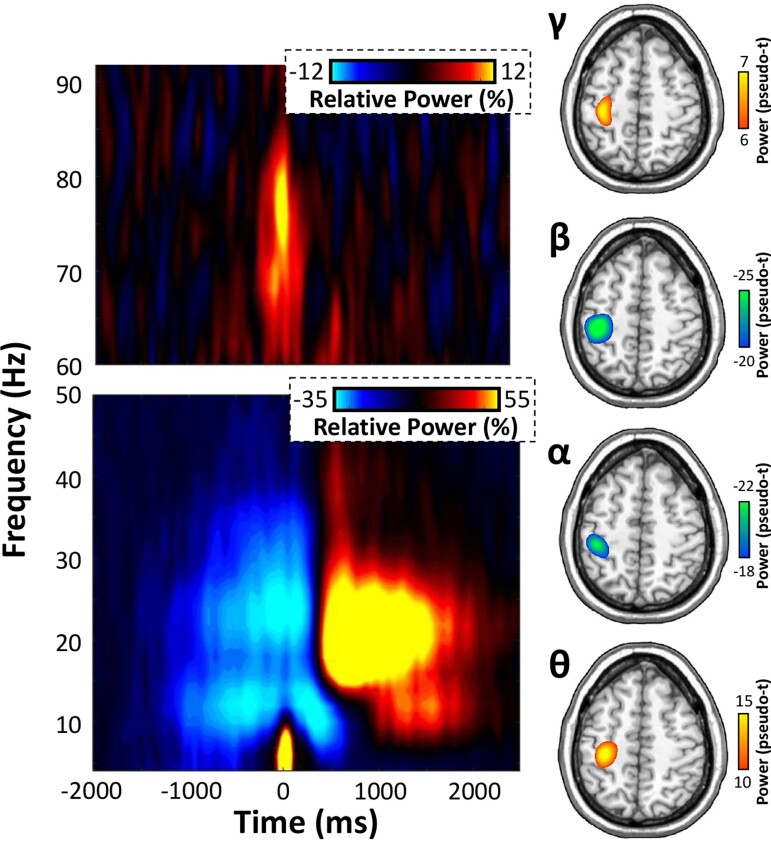
Motor control requires the adaptive updating of internal models to successfully target desired outcomes. This adaptive control can be proactive, such that imminent actions and corresponding sensorimotor programmes are anticipated prior to movement, or reactive, such that online error correction is necessary to adjust to sudden changes. While substantial evidence implicates a distributed cortical network serving adaptive control when behavioural changes are required (e.g. response inhibition), the neural dynamics serving such control when the target motor commands are to remain intact are poorly understood. To address this, we developed a novel proactive-reactive cued finger tapping paradigm that was performed during magnetoencephalography by 25 healthy adults. Importantly, to ensure condition-wise differences in adaptive cueing were not attributable to changes in movement kinematics, motor selection and planning processes were held constant despite changes in task demands. All data were imaged in the time-frequency domain using a beamformer to evaluate the effect of proactive and reactive cues on movement-related oscillations and subsequent performance. Our results indicated spectrally specific increases in low (i.e. theta) and high (i.e. gamma) frequency oscillations during motor execution as a function of adaptive cueing. Additionally, we observed robust cross-frequency coupling of theta and gamma oscillatory power in the contralateral motor cortex and further, the strength of this theta-gamma coupling during motor execution was differentially predictive of behavioural improvements and decrements during reactive and proactive trials, respectively. These data indicate that functional oscillatory coupling may govern the adaptive control of movement in the healthy brain and importantly, may serve as effective proxies for characterizing declines in motor function in clinical populations in the future.
运动控制需要对内部模型进行适应性更新,以成功实现预期目标。这种适应性控制可以是前瞻性的,即在运动之前预测即将发生的动作和相应的感觉运动程序;也可以是反应性的,即需要在线误差校正来适应突然的变化。虽然有大量证据表明,当需要行为改变时(例如反应抑制),一个分布式的皮质网络参与适应性控制,但当目标运动指令保持不变时,参与这种控制的神经动力学却知之甚少。为了解决这个问题,我们开发了一种新颖的前瞻性-反应性线索提示手指敲击范式,由25名健康成年人在脑磁图检查过程中进行。重要的是,为确保适应性提示在不同条件下的差异并非归因于运动运动学、运动选择和计划过程的变化,尽管任务需求发生了变化,但这些过程保持不变。所有数据在时频域中使用波束形成器进行成像,以评估前瞻性和反应性线索对与运动相关的振荡及后续表现的影响。我们的结果表明,在运动执行过程中,低频(即θ波)和高频(即γ波)振荡在频谱上有特定增加,这是适应性提示的函数。此外,我们在对侧运动皮层中观察到θ波和γ波振荡功率的强大跨频耦合,而且,在运动执行过程中,这种θ-γ耦合强度分别对反应性和前瞻性试验中的行为改善和减退具有不同的预测作用。这些数据表明,功能性振荡耦合可能支配健康大脑中运动的适应性控制,重要的是,未来可能作为表征临床人群运动功能下降的有效指标。