Deng Juan, Heydarnejad Tahereh, Farhangi Fariba, Farid Khafaga Ayman
School of Foreign Languages, Huanggang Normal University, Huanggang, China.
Department of English Language, Faculty of Literature and Humanities, University of Gonabad, Gonabad, Iran.
Front Psychol. 2022 Oct 19;13:1019984. doi: 10.3389/fpsyg.2022.1019984. eCollection 2022.
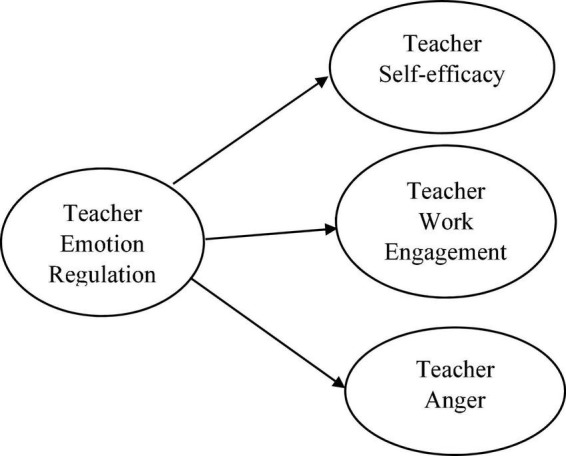
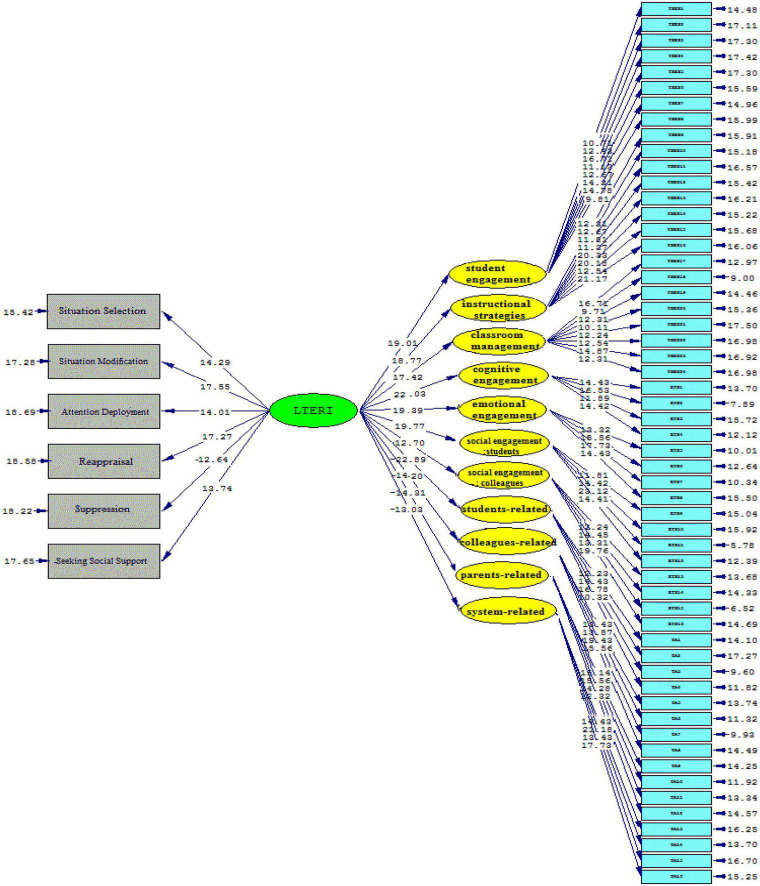
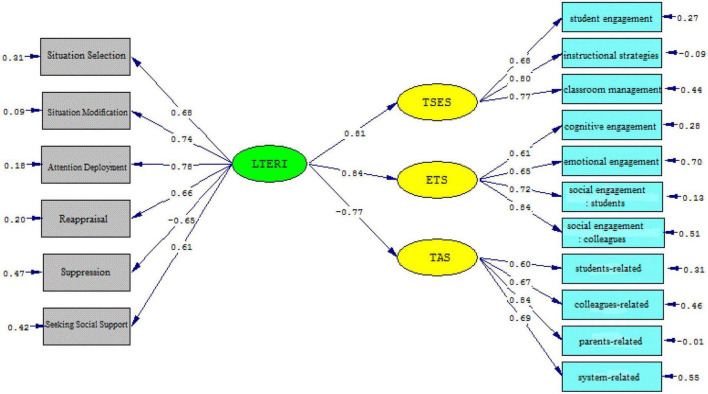
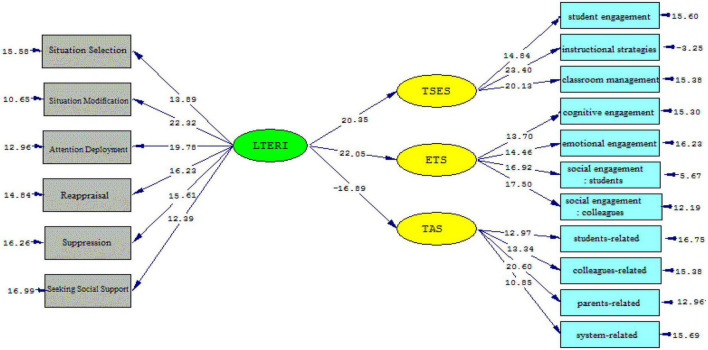
Due to the potent role of teachers' emotion regulation in effective teaching, it seems essential to see how emotion regulation can contribute to other relevant teaching constructs. In this regard, the present study is intended to probe into the causal relationship among teacher emotion regulation, self-efficacy beliefs, engagement, and anger. In so doing, the Language Teacher Emotion Regulation Inventory (LTERI), The Teacher Sense of Efficacy Scale (TSES), The Engaged Teacher Scale (ETS), and The Teacher Anger Scale (TAS) were administered to 581 English as a Foreign Language (EFL) teachers in Iran. To gauge the causal relationships among the variables, confirmatory factor analysis (CFA) and structural equation modeling (SEM) using LISREL 8.80 were conducted. The results indicated that language teacher emotion regulation could positively and significantly predict teachers' self-efficacy beliefs and engagement at work. Moreover, the influence of language teacher emotion regulation on the teacher's anger is significantly negative. That is, the stronger emotion regulation is implemented the better teachers can manage their anger. The implications of this study may uncover new prospects for effective teaching, especially during the COVID-19 pandemic.
由于教师情绪调节在有效教学中发挥着重要作用,了解情绪调节如何对其他相关教学构念产生影响似乎至关重要。在这方面,本研究旨在探究教师情绪调节、自我效能信念、投入度和愤怒之间的因果关系。为此,对伊朗的581名英语外语教师施测了语言教师情绪调节量表(LTERI)、教师效能感量表(TSES)、投入型教师量表(ETS)和教师愤怒量表(TAS)。为了测量变量之间的因果关系,使用LISREL 8.80进行了验证性因素分析(CFA)和结构方程建模(SEM)。结果表明,语言教师情绪调节能够正向且显著地预测教师的自我效能信念和工作投入度。此外,语言教师情绪调节对教师愤怒的影响显著为负。也就是说,实施的情绪调节越强,教师就越能更好地控制自己的愤怒。本研究的意义可能为有效教学揭示新的前景,尤其是在新冠疫情期间。