da Cunha Filho Edson Vieira, Rodrigues Tamara Cristina Gomes Ferraz, Sandrim Valeria Cristina, Veiga Eduardo Carvalho de Arruda, Cavalli Ricardo Carvalho
Hospital Moinhos de Vento, Porto Alegre, RS, Brazil.
Department of Gynecology and Obstetrics, Ribeirão Preto Medical School, University of São Paulo, São Paulo, Brazil.
Front Glob Womens Health. 2022 Oct 19;3:983131. doi: 10.3389/fgwh.2022.983131. eCollection 2022.
Considering the worldwide importance of preeclampsia, especially in Brazil, the screening of pregnant women at greater risk of developing the disease and the application of preventive measures are essential. This study aimed to assess the medical performance in this context in Brazil.
A survey was developed to quantify the number of physicians who prescribe acetylsalicylic acid (ASA) and/or calcium for preeclampsia prevention. The survey was sent to all Brazilian obstetricians affiliated to the Brazilian Federation of OBGYN by email and WhatsApp. The survey remained opened for 6 months and included questions about the use of ASA and calcium, as well as about the use of a complementary test to predict preeclampsia.
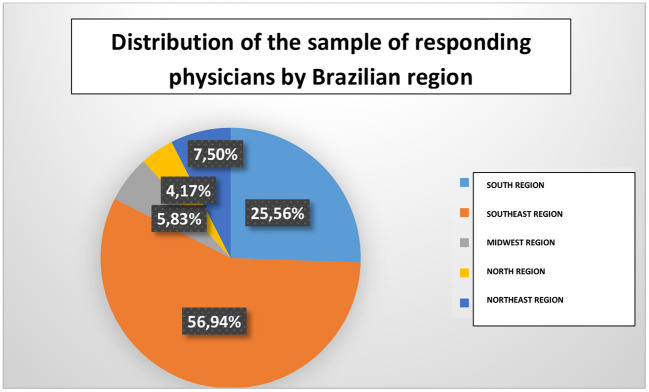
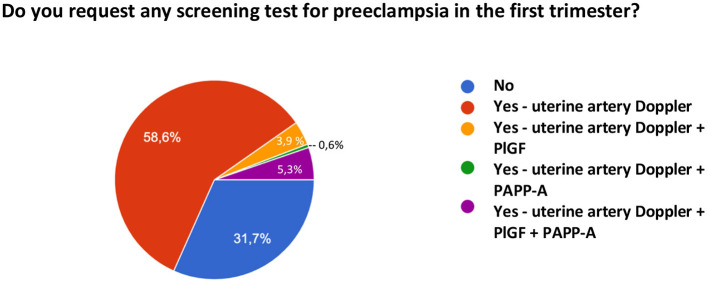
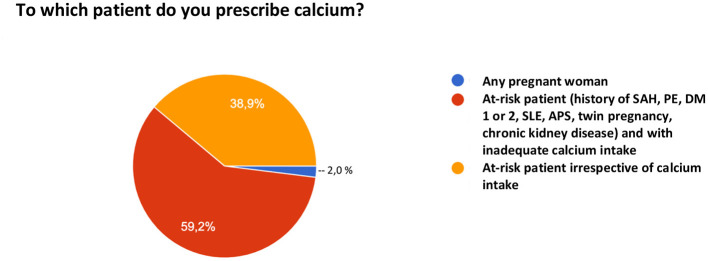
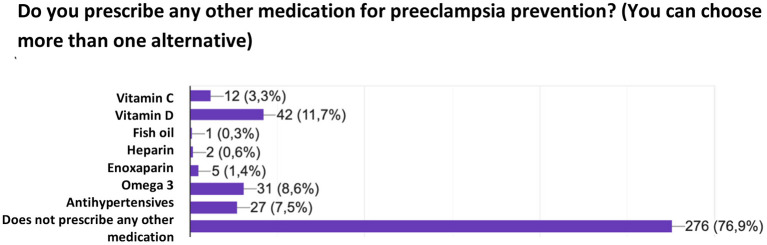
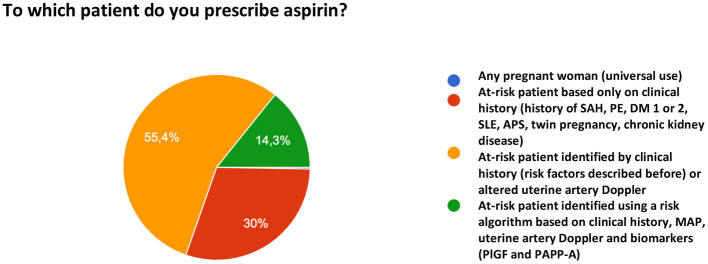
The sample consisted of 360 responding physicians and 100% coverage of responses from physicians from the five different regions of Brazil was obtained. The vast majority of respondents (94.72%) prescribe ASA to prevent preeclampsia, with 80.3% prescribing a dose of 100 mg/day. Calcium is prescribed by 83.9% of the respondents. The majority of the interviewed sample (58.6%) requests uterine artery Doppler imaging to predict preeclampsia and 31.7% do not request any additional test. When the analysis was performed by region, only the northern region differed from the other Brazilian regions regarding the use of ASA and calcium for preeclampsia prevention. While more than 90% of physicians in the other regions prescribe ASA, 40% in the northern region do not use it ( < 0.0001). Regarding calcium, 30% of physicians in northern Brazil do not use the drug for preeclampsia prevention, a percentage that also differs from the other regions where the medication is prescribed by 80 to 90% of physicians ( = 0.021).
The vast majority of Brazilian physicians prescribe low-dose aspirin and calcium carbonate to prevent preeclampsia in high-risk pregnant women. In addition to the identification of clinical risk factors, most doctors use Doppler of the uterine arteries as a predictive method. In the northern region of Brazil, physicians use aspirin and calcium less frequently for preventing preeclampsia compared to the rest of the country.
考虑到子痫前期在全球范围内的重要性,尤其是在巴西,筛查患该病风险较高的孕妇并采取预防措施至关重要。本研究旨在评估巴西在这方面的医疗表现。
开展了一项调查,以量化开具乙酰水杨酸(ASA)和/或钙用于预防子痫前期的医生数量。该调查通过电子邮件和WhatsApp发送给巴西妇产科医师联合会下属的所有巴西产科医生。调查持续开放6个月,包括有关ASA和钙的使用问题,以及关于使用辅助检查来预测子痫前期的问题。
样本包括360名回复的医生,且获得了来自巴西五个不同地区医生的100%回复率。绝大多数受访者(94.72%)开具ASA以预防子痫前期,其中80.3%开具的剂量为每日100毫克。83.9%的受访者开具钙。大多数受访样本(58.6%)要求进行子宫动脉多普勒成像以预测子痫前期,31.7%不要求进行任何额外检查。按地区进行分析时,在预防子痫前期使用ASA和钙方面,只有北部地区与巴西其他地区不同。虽然其他地区超过90%的医生开具ASA,但北部地区40%的医生不使用(<0.0001)。关于钙,巴西北部30%的医生不使用该药物预防子痫前期,这一比例也与其他地区不同,其他地区80%至90%的医生开具该药物(=0.021)。
绝大多数巴西医生开具低剂量阿司匹林和碳酸钙以预防高危孕妇的子痫前期。除了识别临床风险因素外,大多数医生使用子宫动脉多普勒作为预测方法。与巴西其他地区相比,巴西北部地区的医生预防子痫前期时较少使用阿司匹林和钙。