Chen Jing, Liu Shuai, Wu Mingchao, Dai Ling, Wang Jie, Xie Weihua, Peng Yuqi, Mu Jinlin, Yang Shunyu, Ran Jinbo, Zhang Jian, Niu Wenshu, Zheng Jingbang, Wu Junxiong, Yuan Guangxiong
Department of Neurology, Baoji Central Hospital, Baoji, Shanxi, China.
Department of Neurology, Xinqiao Hospital and the Second Affiliated Hospital, Army Medical University (Third Military Medical University), Chongqing, China.
Front Aging Neurosci. 2022 Oct 20;14:941034. doi: 10.3389/fnagi.2022.941034. eCollection 2022.
The present study aimed to evaluate the prognostic value of the 24-h National Institute of Health Stroke Scale (NIHSS) for short- and long-term outcomes of patients with basilar artery occlusion (BAO) after endovascular treatment (EVT) in daily clinical routine.
Patients with EVT for acute basilar artery occlusion study registry with the 24-h NIHSS, and clinical outcomes documented at 90 days and 1 year were included. The NIHSS admission, 24-h NIHSS, NIHSS delta, and NIHSS percentage change, binary definitions of early neurological improvement [ENI; improvement of 4/(common ENI)/8 (major ENI)/10 (dramatic ENI)] NIHSS points were compared to predict the favorable outcomes and mortality at 90 days and 1 year. The primary outcome was defined as favorable if the modified Rankin Scale (mRS) score was 0-3 at 90 days.
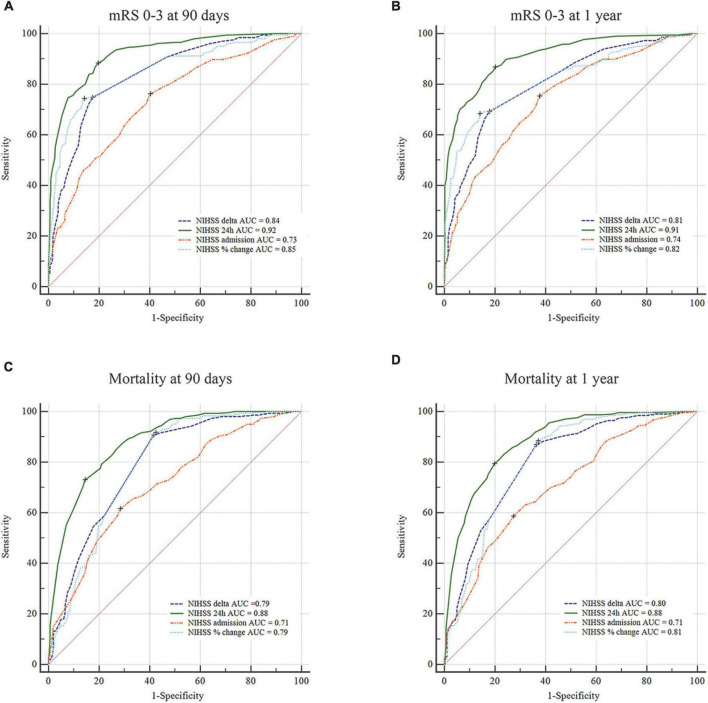
Of the 644 patients treated with EVT, the 24-h NIHSS had the highest discriminative ability for favorable outcome prediction [receiver operator characteristic (ROC) area under the curve (AUC): 0.92 (0.90-0.94)] at 90 days and 1 year [(ROC AUC: 0.91 (0.89-0.94)] in comparison to the NIHSS score at admission [ROC AUC at 90 days: 0.73 (0.69-0.77); 1 year: 0.74 (0.70-0.78)], NIHSS delta [ROC AUC at 90 days: 0.84 (0.81-0.87); 1 year: 0.81 (0.77-0.84)], and NIHSS percentage change [ROC AUC at 90 days: 0.85 (0.82-0.89); 1 year: 0.82 (0.78-0.86)].
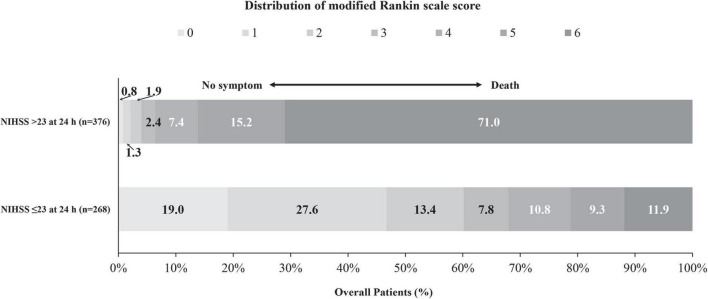
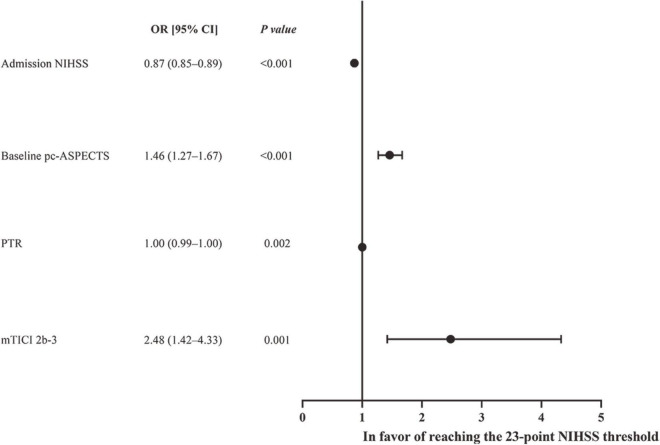
The 24-h NIHSS with a threshold of ≤23 points was the best surrogate for short- and long-term outcomes after EVT for BAO in the clinical routine.
本研究旨在评估在日常临床实践中,24小时美国国立卫生研究院卒中量表(NIHSS)对基底动脉闭塞(BAO)患者血管内治疗(EVT)后短期和长期预后的预测价值。
纳入急性基底动脉闭塞血管内治疗研究登记处中记录了24小时NIHSS以及90天和1年临床结局的患者。比较入院时NIHSS、24小时NIHSS、NIHSS差值和NIHSS百分比变化,以及早期神经功能改善[ENI;改善4/(常见ENI)/8(主要ENI)/10(显著ENI)]NIHSS评分的二元定义,以预测90天和1年时的良好结局和死亡率。主要结局定义为90天时改良Rankin量表(mRS)评分为0 - 3分即为良好。
在644例接受EVT治疗的患者中,与入院时的NIHSS评分[90天时ROC曲线下面积(AUC):0.73(0.69 - 0.77);1年时:0.74(0.70 - 0.78)]、NIHSS差值[90天时ROC AUC:0.84(0.81 - 0.87);1年时:0.81(0.77 - 0.84)]以及NIHSS百分比变化[90天时ROC AUC:0.85(0.82 - 0.89);1年时:0.82(0.78 - 0.86)]相比,24小时NIHSS在预测90天和1年时的良好结局方面具有最高的判别能力[90天时ROC曲线下面积(AUC):0.92(0.90 - 0.94)] [1年时ROC AUC:0.91(0.89 - 0.94)]。
在临床实践中,阈值≤23分的24小时NIHSS是BAO患者EVT后短期和长期结局的最佳替代指标。