Krentz Abigail, García-Cano Israel, Jiménez-Flores Rafael
Department of Food Science and Technology, The Ohio State University, Parker Food Science and Technology Building, 2015 Fyffe Rd., Columbus 43210.
JDS Commun. 2022 Feb 10;3(2):85-90. doi: 10.3168/jdsc.2021-0157. eCollection 2022 Mar.
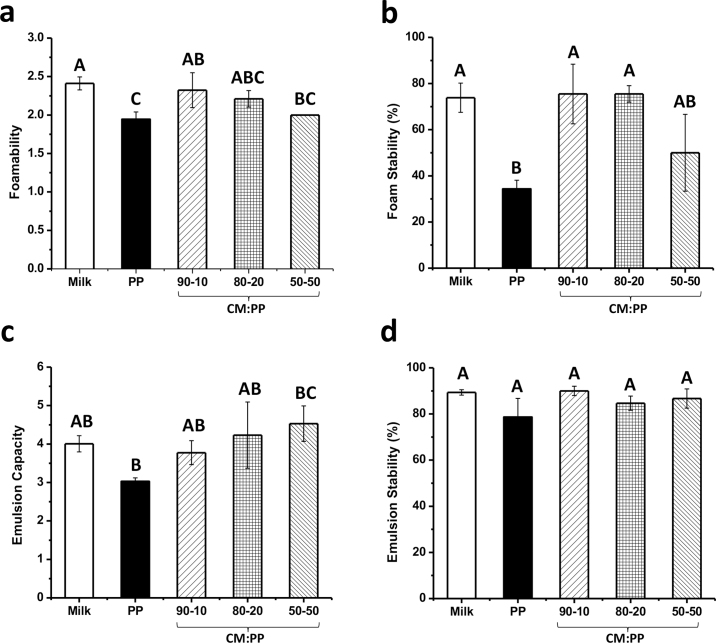
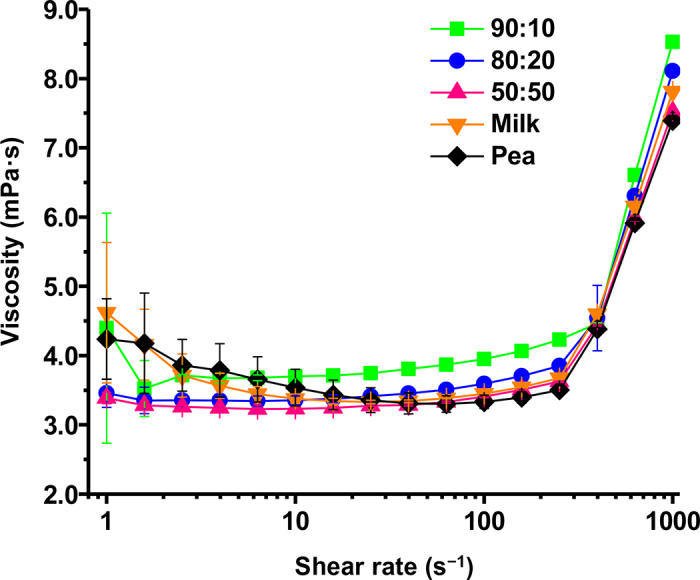
In the midst of rising consumer health and environmental concerns, pea protein has increased in popularity as an alternative to animal-origin proteins. However, the use of pea protein in food systems is largely hindered by its poor functionality, including low solubility. The objective of this study was to measure the textural, functional, and rheological properties of a mixed plant- and animal-based protein system. Caseins, the major protein in bovine milk, are a known animal-based protein with optimal functional properties and high sensory acceptability. Through cold-temperature homogenization, insoluble pea proteins were incorporated with casein micelles in a stable, mixed, colloidal dispersion. Three blends with various casein-to-pea ratios (90:10, 80:20, 50:50) were prepared and analyzed. We hypothesized that incorporation with casein micelles would improve the poor functional properties of pea protein, and thus increase its potential uses in the food industry as a functional ingredient. The protein blend successfully underwent chymosin coagulation, a key ability of caseins, and formed protein gels with textures similar to commercial queso fresco and hard tofu. The 50% casein micelle:50% pea protein blend had better emulsification properties than pea protein alone. In contrast, this blend had the same foaming properties as pea protein alone. The mixed protein blends had similar rheological properties to skim milk, thus increasing their potential applications in the food industry. These results serve as a starting point to begin fully understanding the interactions between pea protein isolate and casein micelles combined via low-temperature homogenization and the effect on their techno-functional properties.
在消费者对健康和环境的关注度不断提高的背景下,豌豆蛋白作为动物源蛋白的替代品,其受欢迎程度日益增加。然而,豌豆蛋白在食品体系中的应用在很大程度上受到其功能不佳的阻碍,包括溶解度低。本研究的目的是测量基于植物和动物的混合蛋白体系的质地、功能和流变学特性。酪蛋白是牛奶中的主要蛋白质,是一种已知的具有最佳功能特性和高感官可接受性的动物源蛋白。通过低温均质化,不溶性豌豆蛋白与酪蛋白胶束形成稳定的混合胶体分散体。制备并分析了三种不同酪蛋白与豌豆比例(90:10、80:20、50:50)的混合物。我们假设与酪蛋白胶束结合会改善豌豆蛋白较差的功能特性,从而增加其在食品工业中作为功能成分的潜在用途。该蛋白混合物成功经历了凝乳酶凝结,这是酪蛋白的一项关键能力,并形成了质地类似于商业新鲜奶酪和硬豆腐的蛋白凝胶。50%酪蛋白胶束:50%豌豆蛋白的混合物比单独的豌豆蛋白具有更好的乳化性能。相比之下,这种混合物与单独的豌豆蛋白具有相同的起泡性能。混合蛋白混合物的流变学特性与脱脂牛奶相似,从而增加了它们在食品工业中的潜在应用。这些结果作为一个起点,有助于全面了解通过低温均质化结合的豌豆分离蛋白和酪蛋白胶束之间的相互作用及其对技术功能特性的影响。