Braun Megan M, Puglielli Luigi
Department of Medicine, University of Wisconsin-Madison, Madison, WI, United States.
Waisman Center, University of Wisconsin-Madison, Madison, WI, United States.
Front Cell Neurosci. 2022 Oct 20;16:1031153. doi: 10.3389/fncel.2022.1031153. eCollection 2022.
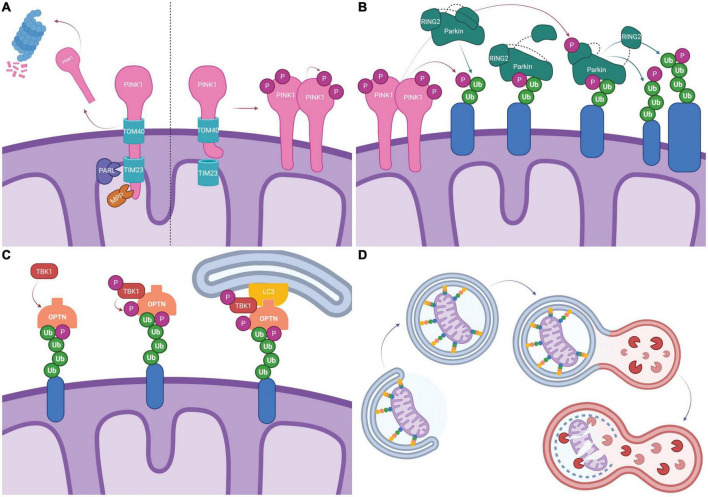
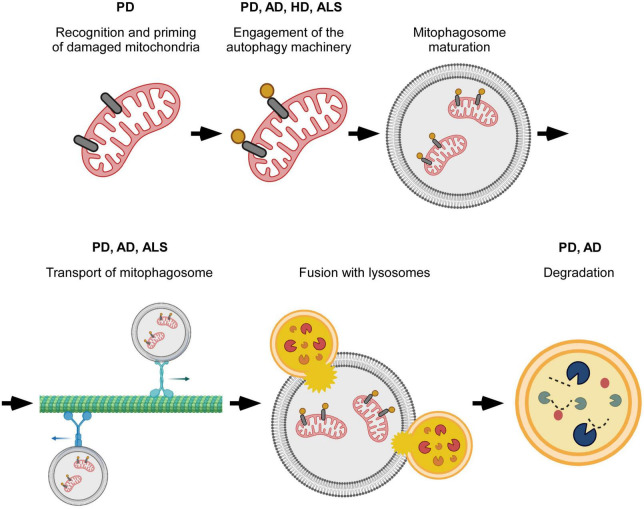
The selective degradation of mitochondria through mitophagy is a crucial process for maintaining mitochondrial function and cellular health. Mitophagy is a specialized form of selective autophagy that uses unique machinery to recognize and target damaged mitochondria for mitophagosome- and lysosome-dependent degradation. This process is particularly important in cells with high metabolic activity like neurons, and the accumulation of defective mitochondria is a common feature among neurodegenerative disorders. Here, we describe essential steps involved in the induction and progression of mitophagy, and then highlight the various mechanisms that specifically contribute to defective mitophagy in highly prevalent neurodegenerative diseases such as Parkinson's disease, Alzheimer's disease, Huntington's disease, and Amyotrophic Lateral Sclerosis.
通过线粒体自噬对线粒体进行选择性降解是维持线粒体功能和细胞健康的关键过程。线粒体自噬是选择性自噬的一种特殊形式,它利用独特的机制识别受损线粒体并将其靶向,以便通过线粒体自噬体和溶酶体依赖性降解。这一过程在神经元等高代谢活性细胞中尤为重要,而有缺陷的线粒体的积累是神经退行性疾病的一个共同特征。在这里,我们描述了线粒体自噬诱导和进展所涉及的基本步骤,然后重点介绍了在帕金森病、阿尔茨海默病、亨廷顿舞蹈病和肌萎缩侧索硬化症等高度常见的神经退行性疾病中,导致有缺陷的线粒体自噬的各种机制。