Claussen Caroline, Matejko Emily, Exner-Cortens Deinera
Department of Psychology, University of Calgary, Calgary, AB, Canada.
Front Psychiatry. 2022 Oct 20;13:933433. doi: 10.3389/fpsyt.2022.933433. eCollection 2022.
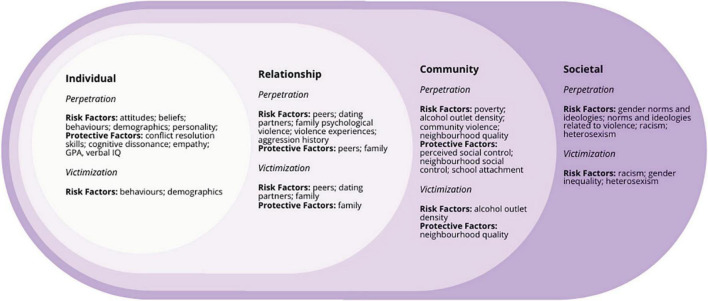
Adolescent dating violence (ADV) is a serious issue that affects millions of youth worldwide. ADV can be any intentional psychological, emotional, physical, or sexual aggression that occurs in adolescent dating and/or sexual relationships, and can occur both in person and electronically. The mental health consequences of ADV can be significant and far reaching, with studies finding long-term effects of dating violence victimization in adolescence. Preventing ADV so that youth do not experience negative mental health consequences is thus necessary. To be effective, however, prevention efforts must be comprehensive and address more than one domain of the social-ecological model, incorporating risk and protective factors across the individual level; relationship level; community level; and societal level. To support researchers and practitioners in designing such prevention programs, an understanding of what risk and protective factors have been identified over the past several decades of ADV research, and how these factors are distributed across levels of the social-ecological model, is needed.
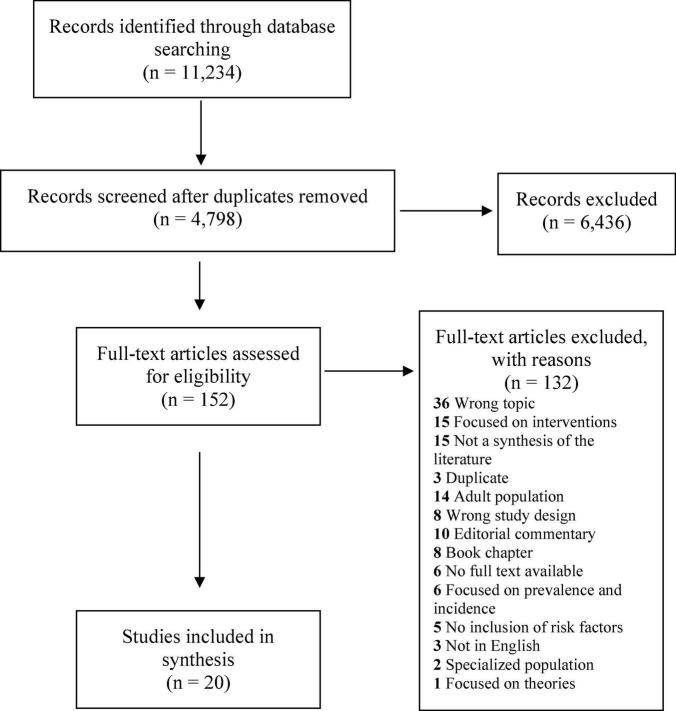
This study was conducted in accordance with PRISMA guidelines. We included peer-reviewed articles published in English between January 2000 and September 2020. The search strategy was developed in collaboration with a research librarian. Covidence was used for title and abstract screening and full text review. Data were extracted from included articles using a standardized charting template, and then synthesized into tables by type of factor (risk or protective), role in ADV (victimization or perpetration), and level(s) of the social-ecological model (individual, relationship, community, societal).
Our initial search across six databases identified 4,798 potentially relevant articles for title and abstract review. Following title and abstract screening and full text review, we found 20 articles that were relevant to our study objective and that met inclusion criteria. Across these 20 articles, there was a disproportionate focus on risk factors at the individual and relationship levels of the social-ecological model, particularly for ADV perpetration. Very little was found about risk factors at the community or societal levels for ADV victimization or perpetration. Furthermore, a very small proportion of articles identified any protective factors, regardless of level of the social-ecological model.
Despite best practice suggesting that ADV prevention strategies should be comprehensive and directed at multiple levels of an individual's social ecology, this systematic scoping review of reviews revealed that very little is known about risk factors beyond the individual and relationship level of the social-ecological model. Further, past research appears steeped in a risk-focused paradigm, given the limited focus on protective factors. Research is needed that identifies risk factors beyond the individual and relationship levels, and a strengths-based focus should be used to identify novel protective factors. In addition, a more critical approach to ADV research - to identify structural and not just individual risk and protective factors - is needed.
青少年恋爱暴力(ADV)是一个严重问题,影响着全球数百万年轻人。ADV可以是青少年恋爱和/或性关系中发生的任何故意的心理、情感、身体或性侵犯行为,并且可以通过面对面和电子方式发生。ADV对心理健康的影响可能很大且影响深远,研究发现青少年恋爱暴力受害会产生长期影响。因此,预防ADV以使年轻人不经历负面心理健康后果是必要的。然而,要想有效,预防工作必须全面,且要涉及社会生态模型的多个领域,纳入个体层面、关系层面、社区层面和社会层面的风险因素和保护因素。为了支持研究人员和从业者设计此类预防项目,需要了解在过去几十年的ADV研究中已确定的风险因素和保护因素,以及这些因素如何分布在社会生态模型的各个层面。
本研究按照PRISMA指南进行。我们纳入了2000年1月至2020年9月期间以英文发表的同行评审文章。搜索策略是与一位研究馆员合作制定的。使用Covidence进行标题和摘要筛选以及全文评审。使用标准化图表模板从纳入的文章中提取数据,然后按因素类型(风险或保护)、在ADV中的作用(受害或施暴)以及社会生态模型的层面(个体、关系、社区、社会)进行综合制表。
我们在六个数据库中的初步搜索确定了4798篇可能与标题和摘要评审相关的文章。经过标题和摘要筛选以及全文评审,我们发现20篇文章与我们的研究目标相关且符合纳入标准。在这20篇文章中,对社会生态模型的个体和关系层面的风险因素关注不成比例,特别是对于ADV施暴。关于ADV受害或施暴在社区或社会层面的风险因素发现得很少。此外,无论社会生态模型的层面如何,只有极小比例的文章确定了任何保护因素。
尽管最佳实践表明ADV预防策略应全面且针对个人社会生态的多个层面,但对综述的这项系统范围综述显示,对于社会生态模型中个体和关系层面之外的风险因素知之甚少。此外,鉴于对保护因素的关注有限,过去的研究似乎深陷以风险为重点的范式。需要开展研究以确定个体和关系层面之外的风险因素,并且应以基于优势的重点来确定新的保护因素。此外,需要对ADV研究采取更批判性的方法——确定结构性而非仅仅是个体的风险和保护因素。