Departamento de Química Instituto de Ciencias Básicas, Universidad Técnica de Manabí, Avenida Urbina, y Che Guevara, Portoviejo, Manabí, 130105, Ecuador.
Universidad Técnica de Manabí, Avenida Urbina, y Che Guevara, Portoviejo, Manabí, 130105, Ecuador.
F1000Res. 2022 Jun 27;11:702. doi: 10.12688/f1000research.112653.2. eCollection 2022.
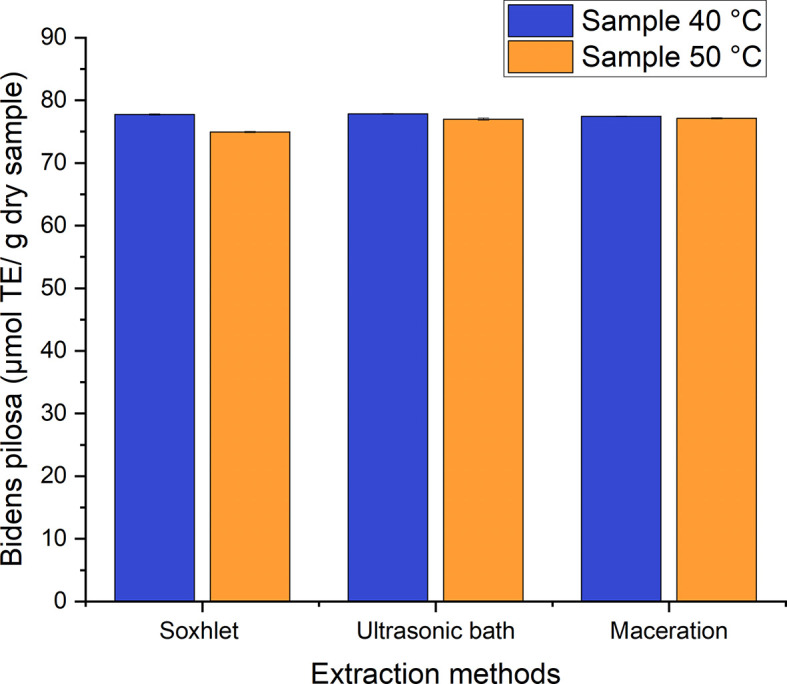
Given the chemical richness of medicinal plants ( L. and ) in Ecuador, they are considered the natural source of numerous medicines. The leaves were dried at 40°C and 50°C and the extracts were characterized by means of phytochemical screening, verifying the presence of secondary metabolites such as alkaloids, reducing sugars, phenols, flavonoids, tannins and saponins. Three extraction processes were carried out, with two solvents of different polarities: hexane and ethanol. The extraction methods that were applied to the leaves of the plants were Soxhlet, ultrasonic bath and maceration, the latter two at room temperature and Soxhlet at the boiling temperature of the solvent. Determination of the total content of phenols and flavonoids is carried out using the Follin-Ciocalteau colorimetric reaction, Quercetin standard, Aluminum Chloride solution measured with a UV-Vis spectrophotometer. The antioxidant activity was performed with the DPPH radical and measured with the same equipment. : The highest content of total phenols obtained by employing the Soxhlet method for extraction when the material was dried at 50°C was 48.609 ± 0.370 mg GAE/g of dry sample for L. while in the case of it was 128.212 ± 0.601 mg GAE/g of dry sample obtained from the extraction by means of maceration. Finally, the antioxidant activity against the 1.1-diphenyl-2-picryl-hydrazyl radical was determined, and it was found that the L. species performed better and responded better to the test, with an IC value of 239.33 µg/mL, than (IC of 644.125 µg/mL). The following preliminary phytochemical study of the L. and plants provided important information on the content of secondary metabolites and response to the DPPH radical reported for the first time in Ecuador, which may be future use for medicinal application.
鉴于药用植物(L.和)的化学丰富性,它们被认为是许多药物的天然来源。叶子在 40°C 和 50°C 下干燥,并用植物化学筛选法对提取物进行了表征,验证了存在生物碱、还原糖、酚类、类黄酮、单宁和皂苷等次生代谢物。进行了三种提取过程,使用两种不同极性的溶剂:己烷和乙醇。应用于植物叶子的提取方法是索氏提取、超声波浴和浸渍提取,后两种在室温下进行,索氏提取在溶剂的沸点下进行。使用 Folin-Ciocalteau 比色法、槲皮素标准品和三氯化铝溶液测定总酚和类黄酮的含量,并用紫外可见分光光度计进行测量。采用 DPPH 自由基测定抗氧化活性,并用相同设备进行测量。结果:采用索氏提取法,在 50°C 下干燥时, L. 的总酚含量最高,为 48.609 ± 0.370 mg GAE/g 干样;而 的总酚含量最高,为 128.212 ± 0.601 mg GAE/g 干样,采用浸渍提取法提取。最后,测定了对 1.1-二苯基-2-苦基肼自由基的抗氧化活性,发现 L. 种的表现更好,对测试的反应更好,IC 值为 239.33 µg/mL,而 (IC 值为 644.125 µg/mL)。对 L. 和 植物的初步植物化学研究提供了关于次生代谢物含量和对 DPPH 自由基反应的重要信息,这在厄瓜多尔可能是未来药用应用的基础。