Suwancharoen Chittakun, Phuangsri Chorpaka, Prakhammin Khanuengnij, Japa Ornampai
Division of Microbiology and Parasitology, School of Medical Sciences, University of Phayao, Phayao, Thailand.
Department of Applied Statistics, Rajamangala University of Technology Isan, Khon Kaen Campus, Khon Kaen, Thailand.
Vet World. 2022 Sep;15(9):2309-2314. doi: 10.14202/vetworld.2022.2309-2314. Epub 2022 Sep 26.
Globally, toxoplasmosis is an important zoonotic parasite infection of many warm-blooded animals (including humans). oocysts are widespread, and their contamination can be primarily attributed to the members of the Felidae family. This study aimed to estimate the prevalence and determine the dense granule antigen 6 (GRA6) genotype of among domestic cats in the Phayao Province, Thailand.
A total of 124 fecal samples were collected from owned cats in the Muang district, Phayao, Thailand, from January to December 2020. Fecal samples were tested for the presence of DNA using targeted B1 gene polymerase chain reaction (PCR) amplification, and positive samples were subsequently analyzed for their genotype through PCR-restriction fragment length polymorphism (RFLP) analysis and sequencing of the GRA6 gene.
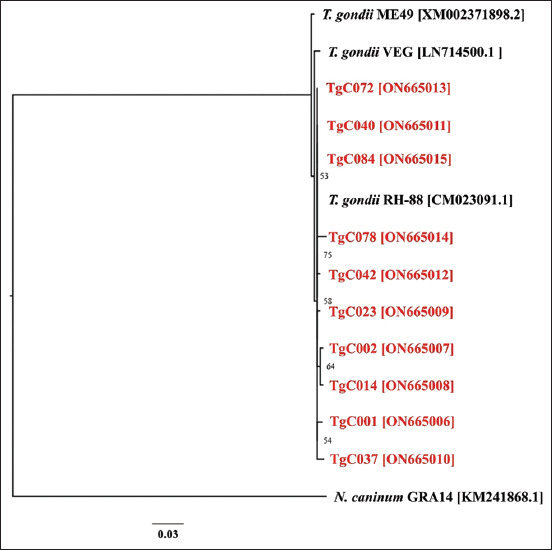
Among the 124 samples, 46 (37.1%) were tested positive for . Only 10 positive DNA samples were successfully amplified for the GRA6 marker. Subsequent PCR-RFLP and sequence analyses indicated that all isolates from cats in Phayao belonged to GRA6 genotype I.
Data revealed that toxoplasmosis is remarkably distributed among (studied) domestic cats in Phayao, Thailand. Moreover, the virulent GRA6 allele was found to be circulated among domestic cats in this area. However, no significant correlation was observed between infection rates and different risk factors, which indicated that pet cats of any age, gender, or breed have similar risks of being infected with . Our results further suggested that infective oocysts of are widely distributed and that environmental contamination with these oocysts will introduce more risks of disease transmission to humans and other animals.
在全球范围内,弓形虫病是许多温血动物(包括人类)重要的人畜共患寄生虫感染病。卵囊广泛存在,其污染主要归因于猫科动物。本研究旨在估计泰国帕尧府家猫中弓形虫的感染率,并确定致密颗粒抗原6(GRA6)基因型。
2020年1月至12月,从泰国帕尧府孟区的家猫中总共采集了124份粪便样本。使用靶向B1基因聚合酶链反应(PCR)扩增检测粪便样本中弓形虫DNA的存在情况,随后对阳性样本通过PCR-限制性片段长度多态性(RFLP)分析和GRA6基因测序来分析其弓形虫基因型。
在124份样本中,46份(37.1%)弓形虫检测呈阳性。仅10份阳性DNA样本成功扩增出GRA6标记。随后的PCR-RFLP和序列分析表明,帕尧府猫的所有弓形虫分离株均属于GRA6基因型I。
数据显示,弓形虫病在泰国帕尧府(所研究的)家猫中分布显著。此外,发现该地区家猫中存在毒性GRA6等位基因传播。然而,未观察到感染率与不同风险因素之间存在显著相关性,这表明任何年龄、性别或品种的宠物猫感染弓形虫的风险相似。我们的结果进一步表明,弓形虫感染性卵囊广泛分布,这些卵囊对环境的污染将给人类和其他动物带来更多疾病传播风险。