Parasit Vectors. 2013 Sep 21;6:273. doi: 10.1186/1756-3305-6-273.
Recent studies of Toxoplasma gondii isolates from animals in different regions of China have shown a limited genetic diversity and type China 1 was the dominant genotype of T. gondii prevalent in Chinese animals. However, little has been known concerning the isolation and genotyping of T. gondii circulating in chickens, pigs and rodents in China. The aim of the study was to characterize samples of T. gondii isolates obtained from naturally infected cats, pigs and free-range chickens slaughtered for human consumption in China.
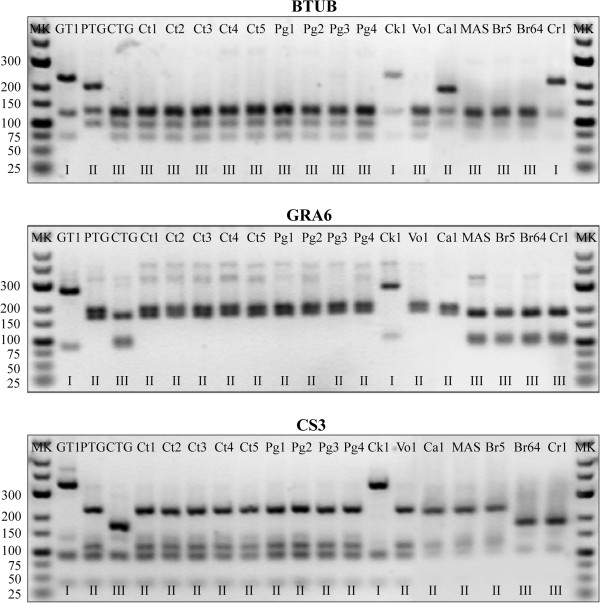
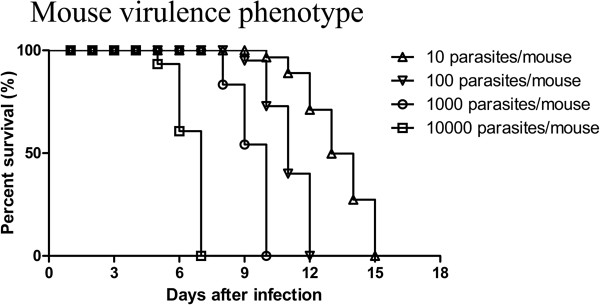
In the present study, brain tissues of 77 animals collected from different areas of China, including 24 free-range chickens (Gallus domesticus) , 13 voles (Rattus flavipectus), 23 pigs and 17 cats, were bioassayed in mice and viable T. gondii were isolated from the brains of eleven. These eleven T. gondii isolates were maintained in Kunming (KM) outbred mice and DNA isolated from tissues of infected mice was characterized using 11 PCR-restriction fragment length polymorphism (PCR-RFLP) markers: SAG1, SAG2, SAG3, BTUB, GRA6, c22-8, c29-2, L358, PK1, Apico, and CS3. Moreover, to determine mouse virulence of China 1 lineage of parasites, a TgCtgy5 genotype isolate was selected randomly and assessed in KM mice with different inoculation doses.
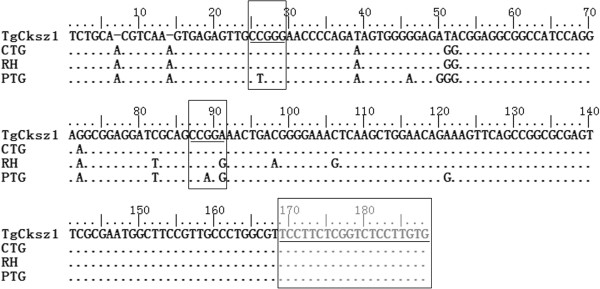
Results of genotyping revealed that ten isolates were type China 1 (ToxoDB PCR-RFLP genotype #9), and TgCksz1 was a new genotype that was reported for the first time designated here as ToxoDB PCR-RFLP #225. No clonal types I, II and III lineages were found. DNA sequencing of four introns (EF1, HP2, UPRT1 and UPRT7) and two genes (GRA6 and GRA7) from representative isolates confirmed the results of PCR-RFLP genotyping. The TgCtgy5 isolate was highly virulent in KM mice; all infected mice died of acute toxoplasmosis, irrespective of the inoculation dose. The results indicate that mouse virulent isolates of T. gondii are predominantly circulating in cats in China.
T. gondii isolated from chickens, pigs, cats and rodents in different locations in China were genotyped and the results reconfirmed the limited diversity of T. gondii in China and showed that type China 1 lineage was dominant in this country.
最近对来自中国不同地区动物的刚地弓形虫分离株的研究表明,其遗传多样性有限,中国 1 型是中国动物中流行的刚地弓形虫的主要基因型。然而,对于在中国鸡、猪和啮齿动物中循环的刚地弓形虫的分离和基因分型知之甚少。本研究的目的是描述从中国不同地区自然感染的猫、猪和散养鸡中获得的刚地弓形虫分离株的样本。
在本研究中,从中国不同地区采集的 77 只动物的脑组织,包括 24 只散养鸡(Gallus domesticus)、13 只田鼠(Rattus flavipectus)、23 只猪和 17 只猫,在小鼠中进行了生物测定,从 11 只动物的脑组织中分离出了活的刚地弓形虫。从这 11 株刚地弓形虫分离株中选取 11 株在昆明(KM)近交系小鼠中进行维持,并使用 11 种 PCR-限制性片段长度多态性(PCR-RFLP)标记:SAG1、SAG2、SAG3、BTUB、GRA6、c22-8、c29-2、L358、PK1、Apico 和 CS3,对感染小鼠的组织进行 DNA 特征分析。此外,为了确定中国 1 谱系寄生虫的小鼠毒力,随机选择一株 TgCtgy5 基因型分离株,并在不同接种剂量的 KM 小鼠中进行评估。
基因分型结果显示,10 株为中国 1 型(ToxoDB PCR-RFLP 基因型#9),TgCksz1 是一种新的基因型,首次被报告为 ToxoDB PCR-RFLP #225。未发现克隆型 I、II 和 III 谱系。来自代表性分离株的四个内含子(EF1、HP2、UPRT1 和 UPRT7)和两个基因(GRA6 和 GRA7)的 DNA 测序证实了 PCR-RFLP 基因分型的结果。TgCtgy5 分离株在 KM 小鼠中具有高度毒力;所有感染小鼠均死于急性弓形虫病,无论接种剂量如何。结果表明,中国猫中主要流行的是具有小鼠毒力的刚地弓形虫分离株。
从中国不同地点的鸡、猪、猫和啮齿动物中分离的刚地弓形虫进行了基因分型,结果再次证实了中国刚地弓形虫的遗传多样性有限,表明中国 1 型谱系在中国占主导地位。