Division of Gastroenterology, Perelman School of Medicine at the University of Pennsylvania, Philadelphia, PA, USA.
Division of Gastroenterology, Department of Medicine, University of British Columbia, Vancouver, BC, Canada.
Inflamm Bowel Dis. 2023 Jan 5;29(1):27-41. doi: 10.1093/ibd/izac084.
In patients with ulcerative colitis (UC), risks of infection and malignancies increase with age. Tofacitinib is an oral, small molecule Janus kinase inhibitor for the treatment of UC. This analysis assessed age as a risk factor for adverse events of special interest (AESI) in the tofacitinib UC clinical program.
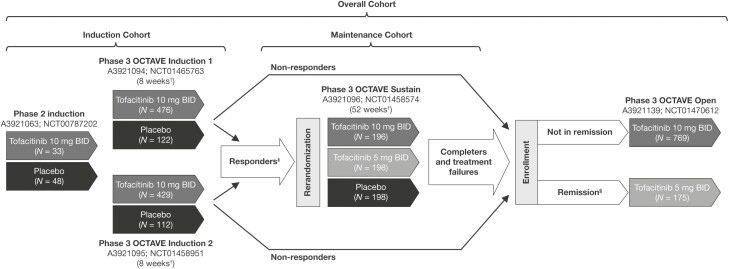
Data were from phase 2 and 3 induction studies, a phase 3 maintenance study, and an open-label, long-term extension study. Efficacy and/or safety outcomes were analyzed in the Induction, Maintenance, and Overall Cohorts (patients who received ≥ 1 dose of tofacitinib), stratified by age. The effects of baseline demographic and disease-related factors on AESI incidence were assessed by Cox proportional-hazards regression analysis.
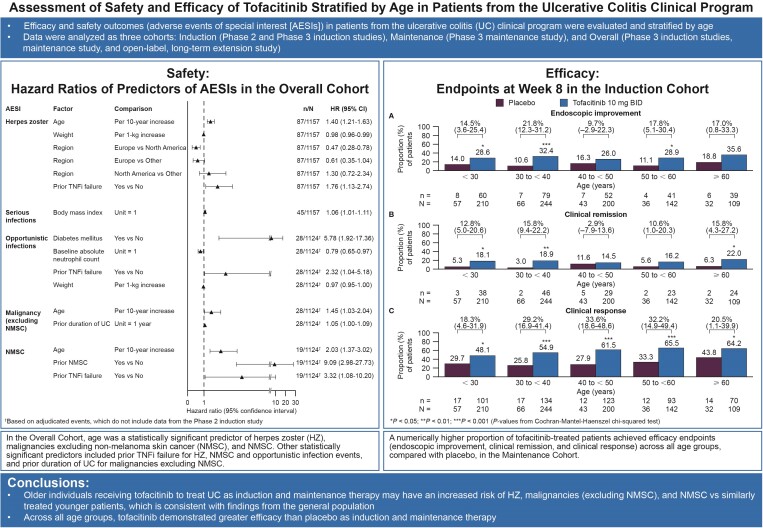
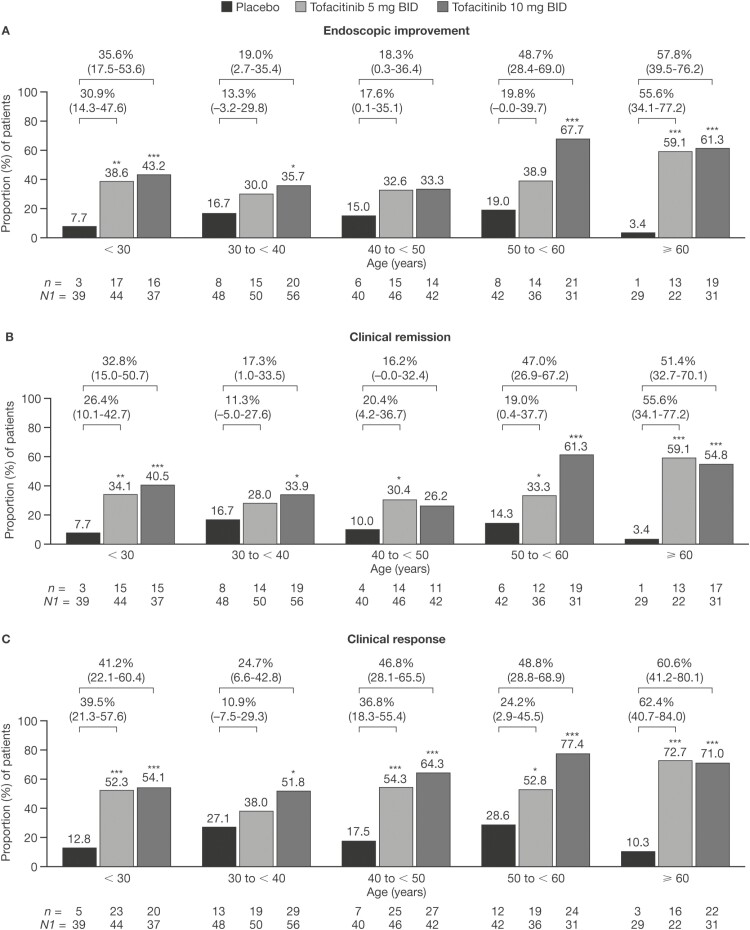
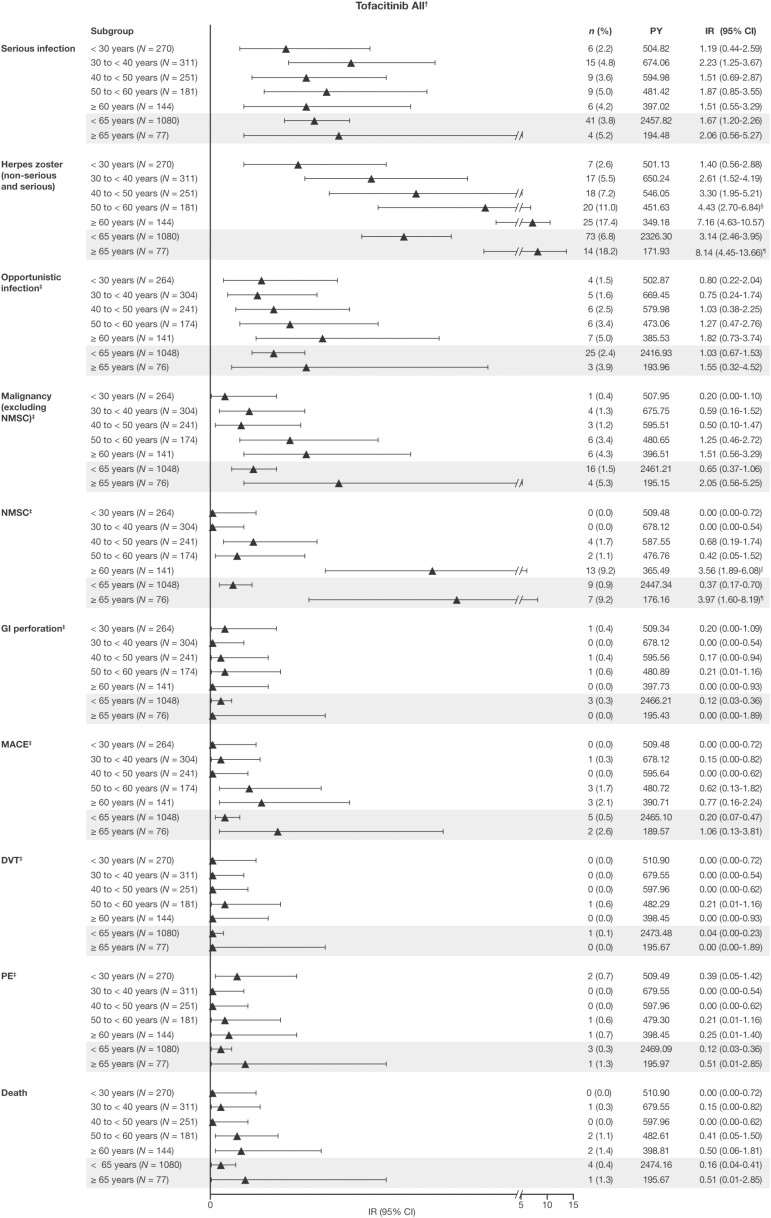
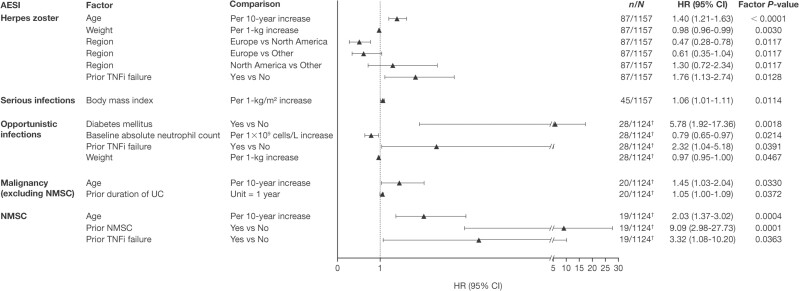
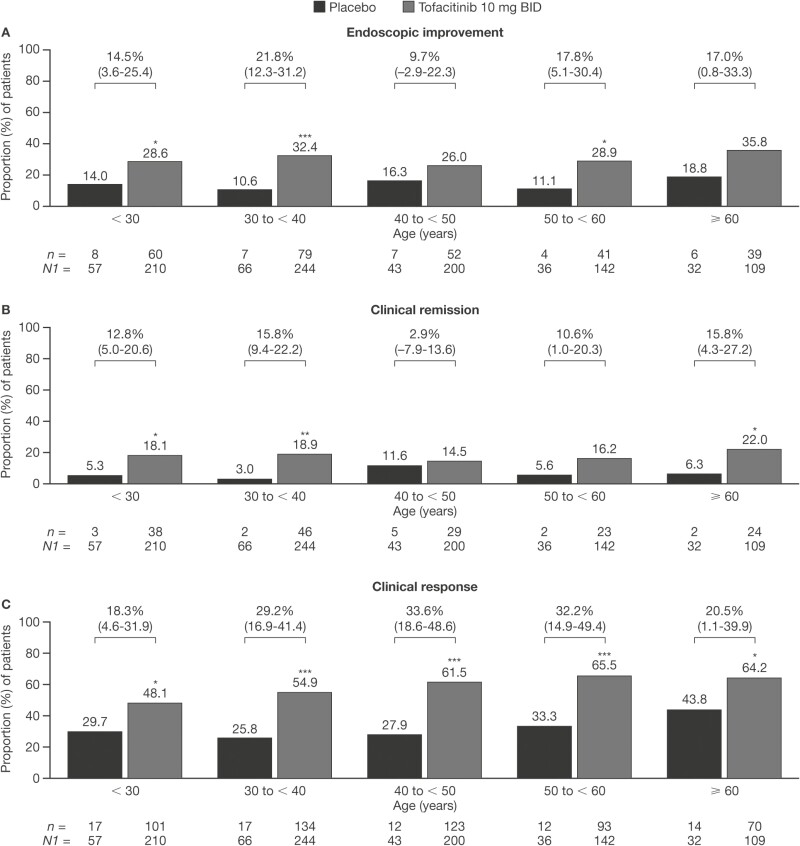
In the Overall Cohort (1157 patients with ≤ 6.8 years' tofacitinib treatment), age was a statistically significant predictor of herpes zoster (HZ), malignancies excluding nonmelanoma skin cancer (NMSC), and NMSC. Other statistically significant predictors included prior tumor necrosis factor inhibitor failure for HZ, NMSC, and opportunistic infection events, and prior duration of UC for malignancies excluding NMSC. In the Induction and Maintenance Cohorts, a higher proportion of tofacitinib-treated than placebo-treated patients (numerical difference) achieved the efficacy endpoints (endoscopic improvement, clinical remission, clinical response) across all age groups.
Older individuals receiving tofacitinib as induction and maintenance therapy to treat UC may have an increased risk of HZ, malignancies (excluding NMSC), and NMSC versus similarly treated younger patients, consistent with findings from the general population. Across all age groups, tofacitinib demonstrated greater efficacy than placebo as an induction and maintenance therapy.
CLINICALTRIALS.GOV REGISTRATION NUMBERS: NCT00787202; NCT01465763; NCT01458951; NCT01458574; NCT01470612.
在溃疡性结肠炎(UC)患者中,感染和恶性肿瘤的风险随着年龄的增长而增加。托法替尼是一种用于治疗 UC 的口服小分子 Janus 激酶抑制剂。这项分析评估了年龄作为托法替尼 UC 临床项目中特殊关注不良事件(AESI)的风险因素。
数据来自 2 期和 3 期诱导研究、3 期维持研究和开放标签、长期扩展研究。在诱导、维持和总体队列(接受≥1 剂托法替尼的患者)中,按年龄分层分析了疗效和/或安全性结局。通过 Cox 比例风险回归分析评估了基线人口统计学和疾病相关因素对 AESI 发生率的影响。
在总体队列(1157 例接受≤6.8 年托法替尼治疗的患者)中,年龄是带状疱疹(HZ)、非黑色素瘤皮肤癌(NMSC)除外恶性肿瘤和 NMSC 的统计学显著预测因素。其他统计学显著预测因素包括 HZ、NMSC 和机会性感染事件的 TNF 抑制剂治疗失败史,以及非 NMSC 恶性肿瘤的 UC 既往持续时间。在诱导和维持队列中,与安慰剂治疗组相比,年龄较大的托法替尼治疗患者(数值差异)在所有年龄组中更有可能达到疗效终点(内镜改善、临床缓解、临床反应)。
与接受类似治疗的年轻患者相比,接受托法替尼诱导和维持治疗的老年 UC 患者发生 HZ、恶性肿瘤(不包括 NMSC)和 NMSC 的风险可能增加,这与一般人群的研究结果一致。在所有年龄组中,托法替尼作为诱导和维持治疗的疗效均优于安慰剂。
NCT00787202;NCT01465763;NCT01458951;NCT01458574;NCT01470612。