Marsico Lung Institute, University of North Carolina at Chapel Hill, Chapel Hill, North Carolina.
Department of Medicine, Johns Hopkins University, Baltimore, Maryland.
Am J Physiol Lung Cell Mol Physiol. 2023 Jan 1;324(1):L32-L37. doi: 10.1152/ajplung.00038.2022. Epub 2022 Nov 7.
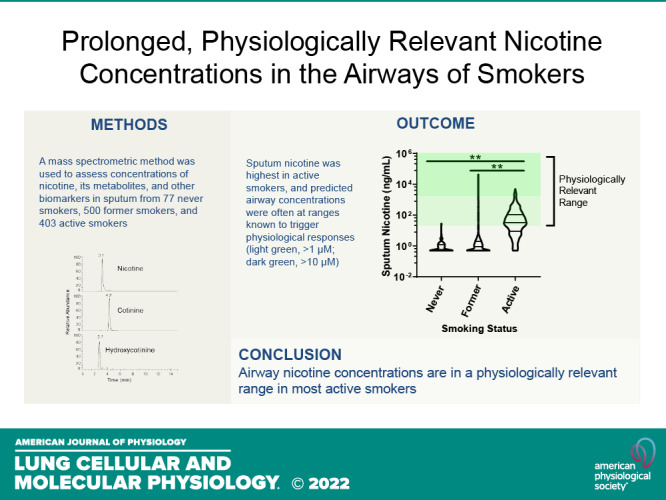
Nicotine from cigarette smoke is a biologically active molecule that has pleiotropic effects in the airway, which could play a role in smoking-induced lung disease. However, whether nicotine and its metabolites reach sustained, physiologically relevant concentrations on airway surfaces of smokers is not well defined. To address these issues, concentrations of nicotine, cotinine, and hydroxycotinine were measured by mass spectrometry (MS) in supernatants of induced sputum obtained from participants in the subpopulations and intermediate outcome measures in COPD study (SPIROMICS), an ongoing observational study that included never smokers, former smokers, and current smokers with and without chronic obstructive pulmonary disease (COPD). A total of 980 sputum supernatants were analyzed from 77 healthy never smokers, 494 former smokers (233 with COPD), and 396 active smokers (151 with COPD). Sputum nicotine, cotinine, and hydroxycotinine concentrations corresponded to self-reported smoking status and were strongly correlated to urine measures. A cutoff of ∼8-10 ng/mL of sputum cotinine distinguished never smokers from active smokers. Accounting for sample dilution during processing, active smokers had airway nicotine concentrations in the 70-850 ng/mL (∼0.5-5 µM) range, and concentrations remained elevated even in current smokers who had not smoked within 24 h. This study demonstrates that airway nicotine and its metabolites are readily measured in sputum supernatants and can serve as biological markers of smoke exposure. In current smokers, nicotine is present at physiologically relevant concentrations for prolonged periods, supporting a contribution to cigarette-induced airway disease.
香烟烟雾中的尼古丁是一种具有多种生物学效应的活性分子,可能在吸烟引起的肺部疾病中发挥作用。然而,香烟烟雾中的尼古丁及其代谢物是否能在吸烟者的气道表面达到持续的、具有生理相关性的浓度尚不清楚。为了解决这些问题,我们采用质谱(MS)法测量了 COPD 研究(SPIROMICS)亚人群和中间结果测量中的参与者诱导痰上清液中的尼古丁、可替宁和羟基可替宁的浓度,这是一项正在进行的观察性研究,包括从不吸烟者、前吸烟者和有或没有慢性阻塞性肺疾病(COPD)的现吸烟者。对来自 77 名健康从不吸烟者、494 名前吸烟者(233 名患有 COPD)和 396 名现吸烟者(151 名患有 COPD)的 980 份痰上清液进行了分析。痰中尼古丁、可替宁和羟基可替宁的浓度与自我报告的吸烟状况相对应,与尿液测量结果密切相关。痰中可替宁浓度约为 8-10ng/ml 可将从不吸烟者与现吸烟者区分开来。考虑到处理过程中的样本稀释,现吸烟者的气道尼古丁浓度在 70-850ng/ml(约 0.5-5µM)范围内,即使是在 24 小时内未吸烟的当前吸烟者中,浓度仍保持升高。这项研究表明,气道中的尼古丁及其代谢物可在痰上清液中轻易测量,并且可以作为暴露于烟雾的生物标志物。在现吸烟者中,尼古丁在生理相关浓度下持续存在很长时间,这支持了其在香烟引起的气道疾病中的作用。