Yang Min, Xu Gufeng, Ruan Zhi, Wang Yue
Department of Ambulatory Surgery, Women's Hospital, Zhejiang University School of Medicine, Hangzhou, People's Republic of China.
Department of Clinical Laboratory, Sir Run Run Shaw Hospital, Zhejiang University School of Medicine, Hangzhou, People's Republic of China.
Infect Drug Resist. 2022 Nov 1;15:6405-6412. doi: 10.2147/IDR.S388797. eCollection 2022.
Public health is seriously threatened by the rise of carbapenem-resistant Enterobacterales (CRE). However, the genomic characteristics of CRE detected in pediatric patients are largely unknown. Here, we reported the genomic characteristics of a multidrug-resistant strain containing the plasmid-borne and genes recovered from a Chinese pediatric patient.
The genome sequence of strain B379 was determined using Illumina NovaSeq 6000 and Oxford Nanopore MinION. Multiple bioinformatics tools were used to annotate the genome sequence, identify antimicrobial resistance genes and plasmid replicons and perform the in silico multilocus sequence typing (MLST) analysis. Using BacWGSTdb 2.0 server, a core genome MLST (cgMLST) comparison was made between B379 and all ST746 strains downloaded from the public database.
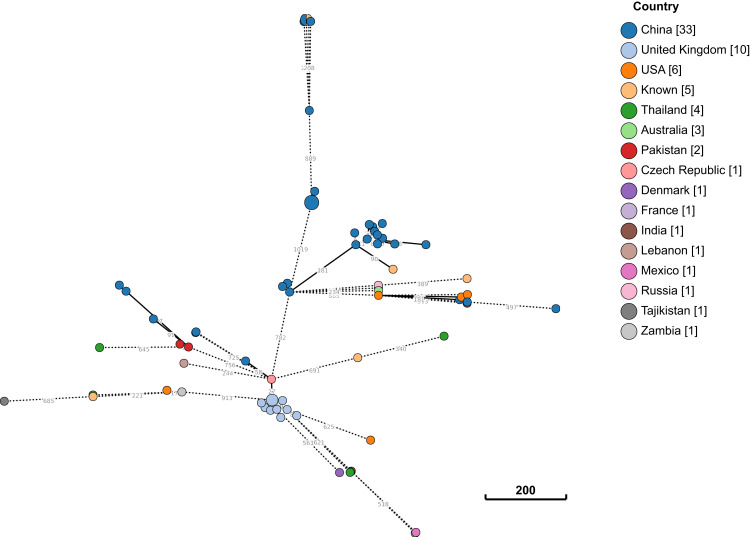
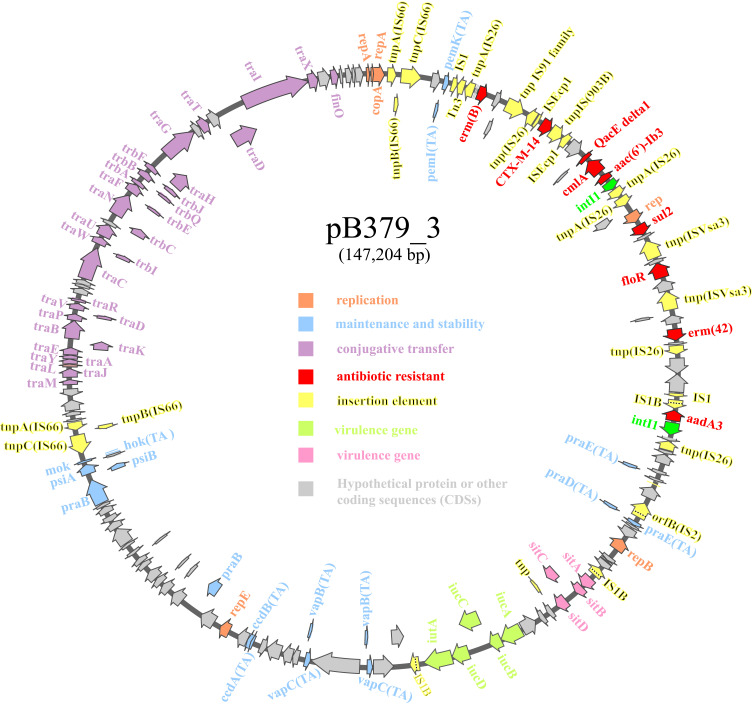
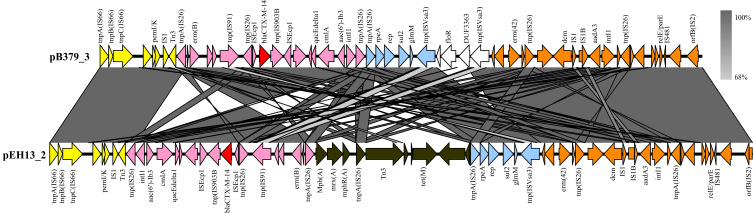
The B379 genome sequence is comprised of six contigs totaling 5,152,502 bp, including one chromosome and five plasmids. Nineteen antimicrobial resistance genes were predicted. The which is located on a 46,161 bp IncX3 plasmid and the gene which is located on a 147,204 bp IncFII/IncFIA/IncFIB plasmid are two examples of these 19 genes. B379 was resistant to ampicillin, ampicillin/sulbactam, ceftriaxone, ceftazidime, imipenem, cefepime, ciprofloxacin, ertapenem, trimethoprim-sulfamethoxazole. This isolate belonged to ST746 and the closest relative was another one originating from a human material specimen in Denmark, which differed by 273 cgMLST alleles.
Our study reports the emergence of a multidrug-resistant strain co-carrying and recovered from a pediatric patient in China. These data would help us better understand the prevalence, genetic characteristics, and mechanisms of antimicrobial resistance of this recently identified multidrug-resistant bacteria in children.
耐碳青霉烯类肠杆菌科细菌(CRE)的出现对公共卫生构成了严重威胁。然而,儿科患者中检测到的CRE的基因组特征在很大程度上尚不清楚。在此,我们报告了从一名中国儿科患者中分离出的携带质粒介导的blaNDM-5和blaOXA-48基因的多重耐药菌株的基因组特征。
使用Illumina NovaSeq 6000和Oxford Nanopore MinION对菌株B379进行基因组测序。使用多种生物信息学工具对基因组序列进行注释,鉴定抗菌药物耐药基因和质粒复制子,并进行计算机多位点序列分型(MLST)分析。使用BacWGSTdb 2.0服务器,对B379与从公共数据库下载的所有ST746菌株进行核心基因组MLST(cgMLST)比较。
B379基因组序列由6个重叠群组成,总计5,152,502 bp,包括1条染色体和5个质粒。预测有19个抗菌药物耐药基因。位于46,161 bp的IncX3质粒上的blaNDM-5和位于147,204 bp的IncFII/IncFIA/IncFIB质粒上的blaOXA-48基因是这19个基因中的两个例子。B379对氨苄西林、氨苄西林/舒巴坦、头孢曲松、头孢他啶、亚胺培南(伊米配能)、头孢吡肟、环丙沙星、厄他培南、甲氧苄啶-磺胺甲恶唑耐药。该分离株属于ST746,与其亲缘关系最近(最相似)的是另一个来自丹麦人类样本的菌株,两者在cgMLST等位基因上相差273个。
我们的研究报告了在中国一名儿科患者中分离出的同时携带blaNDM-5和blaOXA-48的多重耐药菌株的出现。这些数据将有助于我们更好地了解这种最近在儿童中发现的多重耐药细菌的流行情况、遗传特征和抗菌药物耐药机制。