Sir Run Run Shaw Hospital, Zhejiang University School of Medicine, Hangzhou 310016, China.
Institute of Translational Medicine, Zhejiang University School of Medicine, Hangzhou 310029, China.
Nucleic Acids Res. 2021 Jan 8;49(D1):D644-D650. doi: 10.1093/nar/gkaa821.
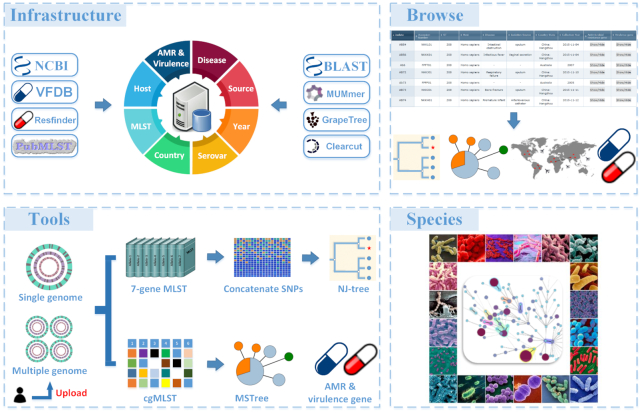
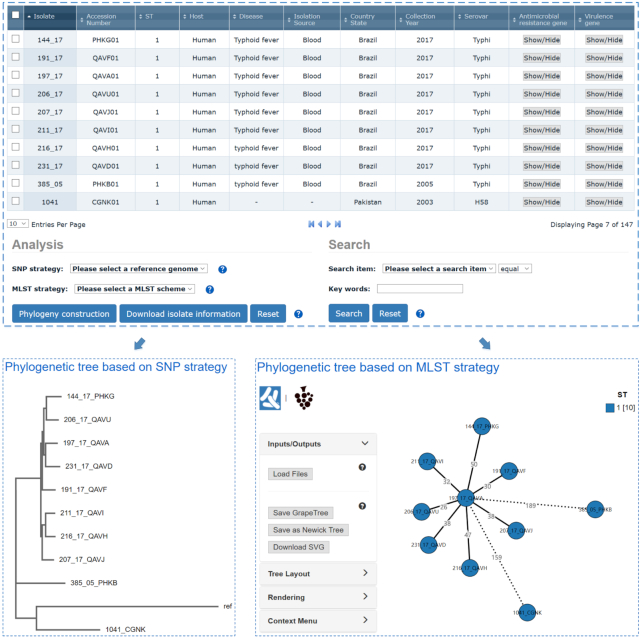
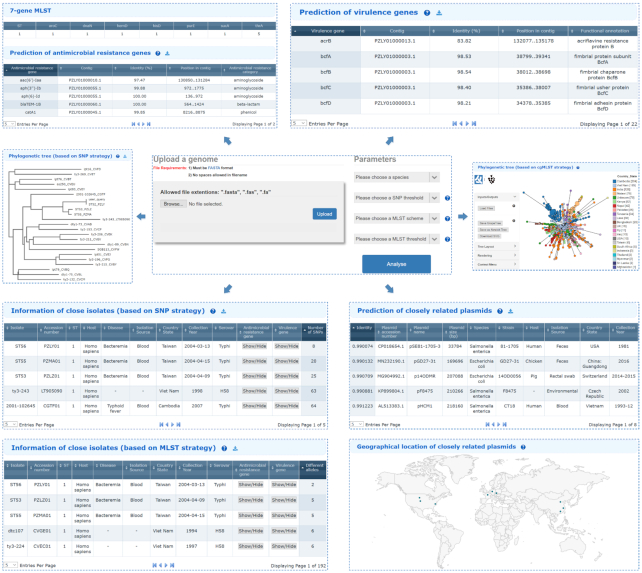
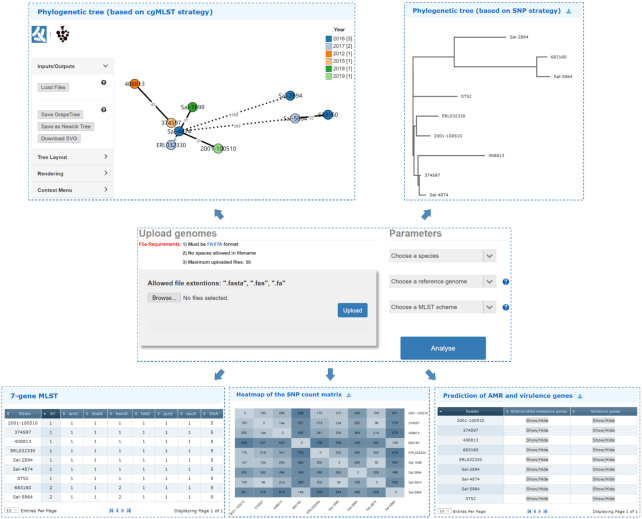
An increasing prevalence of hospital acquired infections and foodborne illnesses caused by pathogenic and multidrug-resistant bacteria has stimulated a pressing need for benchtop computational techniques to rapidly and accurately classify bacteria from genomic sequence data, and based on that, to trace the source of infection. BacWGSTdb (http://bacdb.org/BacWGSTdb) is a free publicly accessible database we have developed for bacterial whole-genome sequence typing and source tracking. This database incorporates extensive resources for bacterial genome sequencing data and the corresponding metadata, combined with specialized bioinformatics tools that enable the systematic characterization of the bacterial isolates recovered from infections. Here, we present BacWGSTdb 2.0, which encompasses several major updates, including (i) the integration of the core genome multi-locus sequence typing (cgMLST) approach, which is highly scalable and appropriate for typing isolates belonging to different lineages; (ii) the addition of a multiple genome analysis module that can process dozens of user uploaded sequences in a batch mode; (iii) a new source tracking module for comparing user uploaded plasmid sequences to those deposited in the public databases; (iv) the number of species encompassed in BacWGSTdb 2.0 has increased from 9 to 20, which represents bacterial pathogens of medical importance; (v) a newly designed, user-friendly interface and a set of visualization tools for providing a convenient platform for users are also included. Overall, the updated BacWGSTdb 2.0 bears great utility in continuing to provide users, including epidemiologists, clinicians and bench scientists, with a one-stop solution to bacterial genome sequence analysis.
越来越多的医院获得性感染和食源性疾病是由病原性和多药耐药细菌引起的,这迫切需要台式计算技术来快速准确地从基因组序列数据中对细菌进行分类,并在此基础上追踪感染源。BacWGSTdb(http://bacdb.org/BacWGSTdb)是我们为细菌全基因组序列分型和溯源开发的免费公共数据库。该数据库整合了大量细菌基因组测序数据和相应元数据资源,结合专门的生物信息学工具,能够对从感染中分离出的细菌进行系统表征。在这里,我们介绍了 BacWGSTdb 2.0,它包含了几个主要的更新,包括(i)整合了核心基因组多位点序列分型(cgMLST)方法,该方法具有高度可扩展性,适用于对不同谱系的分离株进行分型;(ii)增加了一个多基因组分析模块,可以批量处理数十个用户上传的序列;(iii)一个新的溯源模块,用于将用户上传的质粒序列与公共数据库中存储的序列进行比较;(iv)BacWGSTdb 2.0 中包含的物种数量从 9 个增加到 20 个,涵盖了具有医学重要性的细菌病原体;(v)还包括一个新设计的、用户友好的界面和一组可视化工具,为用户提供了一个方便的平台。总的来说,更新后的 BacWGSTdb 2.0 在继续为用户(包括流行病学家、临床医生和基础科学家)提供细菌基因组序列分析的一站式解决方案方面具有很大的实用性。