Organisch-Chemisches Institut, Westfälische Wilhelms-Universität Münster, Corrensstraße 36, 48149, Münster, Germany.
Angew Chem Int Ed Engl. 2023 Jan 2;62(1):e202214906. doi: 10.1002/anie.202214906. Epub 2022 Dec 1.
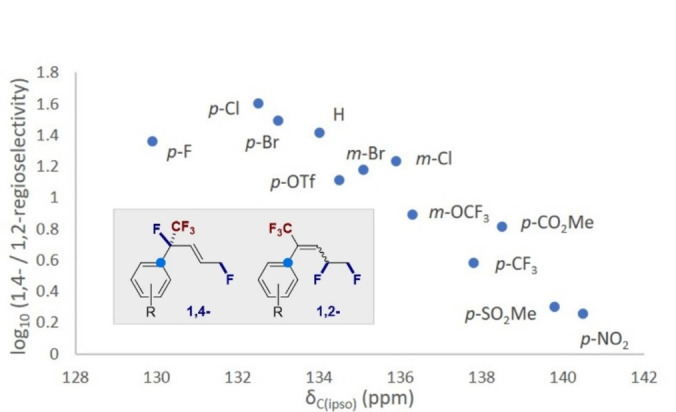
A catalysis-based regioselective 1,4-fluorofunctionalization of trifluoromethyl substituted 1,3-dienes has been developed to access compact, highly functionalized products. The process allows E,Z-mixed dienes to be processed to a single E-alkene isomer, and leverages an inexpensive and operationally convenient I(I)/I(III) catalysis platform. The first example of catalytic 1,4-difluorination is disclosed and subsequently evolved to enable 1,4-hetero-difunctionalization, which allows δ-fluoro-alcohol and amine derivatives to be forged in a single operation. The protocol is compatible with a variety of nucleophiles including fluoride, nitriles, carboxylic acids, alcohols and even water thereby allowing highly functionalized products, with a stereocenter bearing both C(sp )-F and C(sp )-CF groups, to be generated rapidly. Scalability (up to 3 mmol), and facile post-reaction modifications are demonstrated to underscore the utility of the method in expanding organofluorine chemical space.
一种基于催化的区域选择性 1,4-氟官能化三氟甲基取代的 1,3-二烯已被开发出来,以获得紧凑的、高度官能化的产物。该过程允许 E,Z-混合二烯转化为单一的 E-烯烃异构体,并利用廉价且操作方便的 I(I)/I(III)催化平台。首次披露了催化 1,4-二氟化的实例,随后进一步发展为 1,4-杂二氟官能化,从而可以在单个操作中合成 δ-氟醇和胺衍生物。该方案与多种亲核试剂兼容,包括氟化物、腈、羧酸、醇,甚至水,从而可以快速生成具有立体中心的同时含有 C(sp )-F 和 C(sp )-CF 基团的高度官能化产物。可扩展性(高达 3 mmol)和反应后简便的修饰证明了该方法在扩展有机氟化学空间方面的实用性。