Department of Cardiac Surgery, Montreal Heart Institute, Montreal, Canada.
Department of Cardiology, Montreal Heart Institute, Montreal, Canada.
Braz J Cardiovasc Surg. 2022 Oct 8;37(5):628-638. doi: 10.21470/1678-9741-2021-0498.
Most implantations of left ventricular assist devices (LVAD) are performed in low-volume centers. This study aimed to evaluate the procedural learning curve of HeartMate II (HM2) implantations by comparing outcomes between two time periods in a low-volume center.
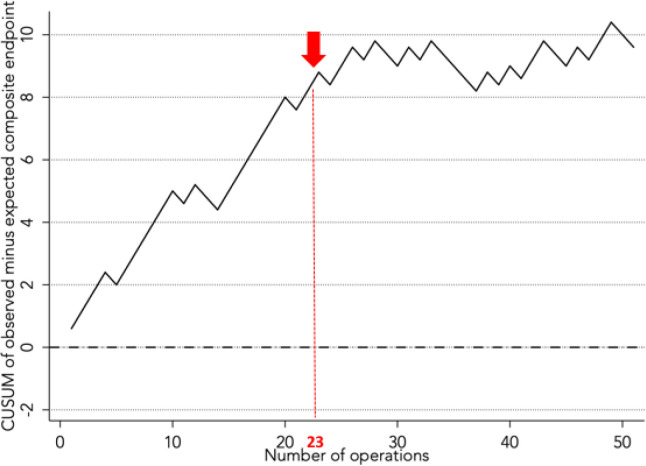
All 51 consecutive patients undergoing HM2 implantation between January 2009 and December 2017 were reviewed and allocated into 2 groups: early-era group (from 2009 to 2014; n=25) and late-era group (from 2015 to 2017; n=26). The primary outcome was the 90-day mortality rate, and the secondary outcome was a composite of mortality, neurological event, reoperation for bleeding, need for temporary right ventricular assist device, and pump thrombosis at 90 days. Median follow-up time was 51 months (0-136). A cumulative sum (CUSUM) control analysis was used to establish a threshold of implantations that optimizes outcomes.
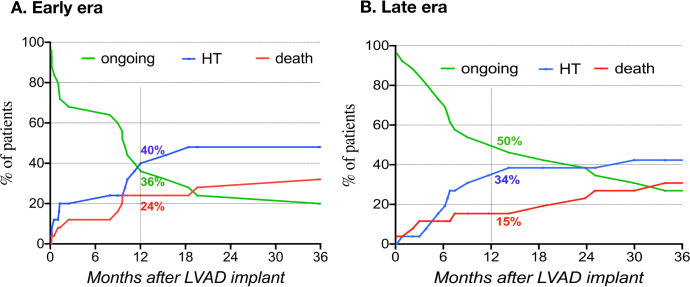
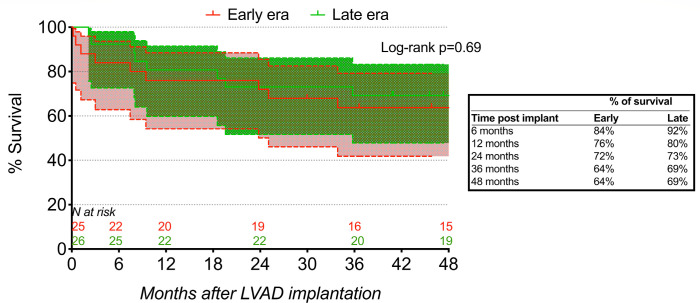
Patients in the early era had a higher rate of diabetes, previous stroke, and inotrope support before HM2 implantation. The 90-day mortality rate was not significantly higher in the early era (24% vs. 15%, P=0.43), but the composite endpoint was significantly higher (76% vs. 42%, P=0.01). The CUSUM analysis found a threshold of 23 operations after which the composite endpoint was optimized.
Patients undergoing HM2 implantation in a low-volume center have improving outcomes with number of cases and optimized results after a threshold of 23 cases. Significant changes in patient selection, surgical techniques, and patient management might lead to improved outcomes after LVAD implantation.
大多数左心室辅助装置(LVAD)的植入都是在低容量中心进行的。本研究旨在通过比较低容量中心两个时间段的结果,评估 HeartMate II(HM2)植入的程序学习曲线。
回顾了 2009 年 1 月至 2017 年 12 月期间连续 51 例接受 HM2 植入的患者,并将其分为 2 组:早期组(2009 年至 2014 年;n=25)和晚期组(2015 年至 2017 年;n=26)。主要结局是 90 天死亡率,次要结局是 90 天死亡率、神经事件、出血再手术、需要临时右心室辅助装置和泵血栓的复合终点。中位随访时间为 51 个月(0-136)。采用累积和(CUSUM)控制分析确定优化结果的植入阈值。
早期组患者的糖尿病、既往卒中、HM2 植入前使用正性肌力药的比例较高。早期组的 90 天死亡率无显著升高(24%比 15%,P=0.43),但复合终点显著升高(76%比 42%,P=0.01)。CUSUM 分析发现,术后 23 例是复合终点优化的阈值。
在低容量中心接受 HM2 植入的患者,随着病例数量的增加和 23 例病例的阈值优化,其结果得到改善。患者选择、手术技术和患者管理方面的显著变化可能导致 LVAD 植入后结局的改善。