Lee Yoon-Jin, Seo Chul Won, Lee Donghyeong, Choi Dongsic
Department of Biochemistry, Soonchunhyang University College of Medicine, Cheonan, Korea.
Department of Medicine, Soonchunhyang University College of Medicine, Cheonan, Korea.
Brain Tumor Res Treat. 2022 Oct;10(4):207-214. doi: 10.14791/btrt.2022.0031.
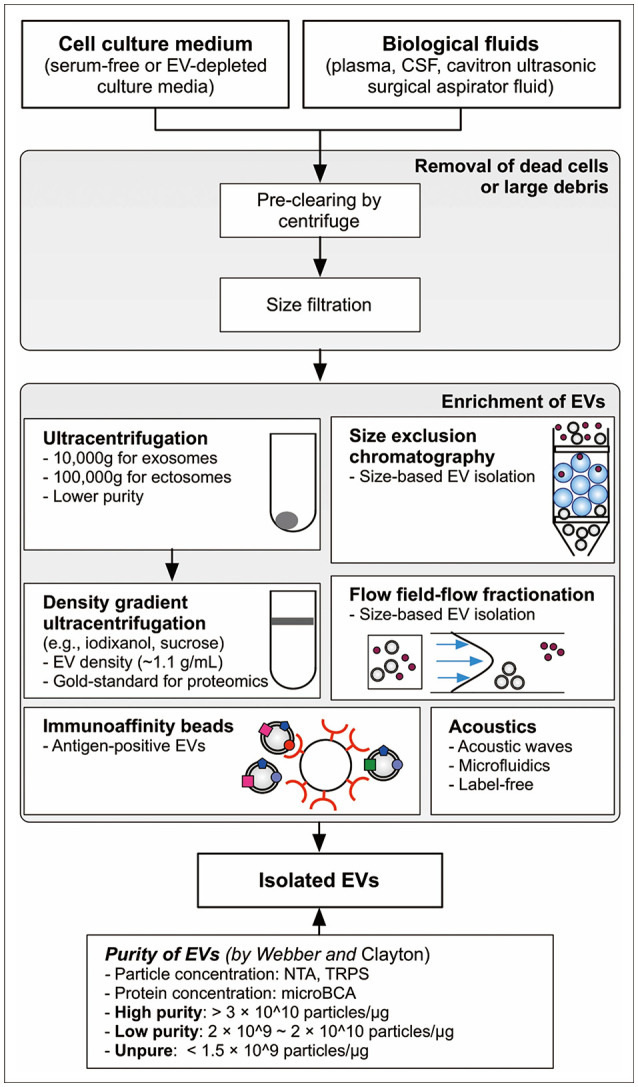
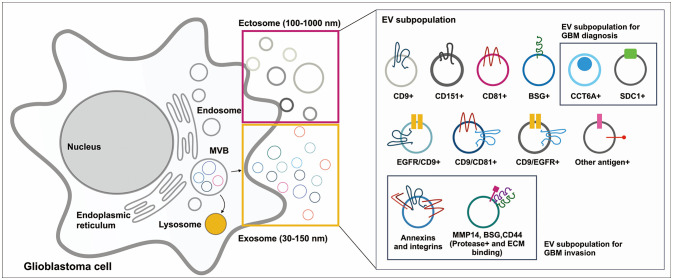
Glioblastoma multiforme (GBM), a high-grade astrocytic brain tumor, has highly aggressive and heterogeneous phenotypes with active cellular invasion, angiogenesis, and immune system modulation in the tumor microenvironment driven by complex oncogenic mutations. This abnormal disease progression could be attributed to extracellular vesicles (EVs) containing diverse bioactive molecules, including proteins, genetic materials, lipids, and metabolites. Importantly, GBM-related EVs have emerged as key mediators in cancer progression, acting as carriers for the transfer of oncogenic proteins such as epidermal growth factor receptor variant III (EGFRvIII) and genetic materials (DNA and RNA). Remarkably, recent progress in EV analysis has enabled its purification with high confidence by estimating the purity level of isolated EVs. Thus, mass spectrometry-based proteomic analysis could generate highly reliable vesicular proteomes. Glioblastoma EV proteome studies have revealed the specific increase in vesicular protein cargo due to their oncogenic transformation, and these EV proteins are closely associated with cancer invasion. Moreover, their proteomic data reflects the molecular alterations that occur in parental GBM and provides potent diagnostic information in a minimally invasive manner in liquid biopsy. Thus, proteomic analysis of GBM EVs could provide an increased understanding of their biological properties and activity in the GBM microenvironment, and provide significant implications for advanced approaches in the diagnosis of these intractable tumors.
多形性胶质母细胞瘤(GBM)是一种高级别星形细胞瘤脑肿瘤,具有高度侵袭性和异质性表型,在由复杂致癌突变驱动的肿瘤微环境中存在活跃的细胞侵袭、血管生成和免疫系统调节。这种异常的疾病进展可能归因于含有多种生物活性分子的细胞外囊泡(EV),这些分子包括蛋白质、遗传物质、脂质和代谢物。重要的是,与GBM相关的EV已成为癌症进展的关键介质,充当致癌蛋白(如表皮生长因子受体变体III,EGFRvIII)和遗传物质(DNA和RNA)转移的载体。值得注意的是,EV分析的最新进展使得通过估计分离的EV的纯度水平能够高可信度地对其进行纯化。因此,基于质谱的蛋白质组学分析可以生成高度可靠的囊泡蛋白质组。胶质母细胞瘤EV蛋白质组研究揭示了由于其致癌转化导致的囊泡蛋白含量的特异性增加,并且这些EV蛋白与癌症侵袭密切相关。此外,它们的蛋白质组数据反映了亲代GBM中发生的分子改变,并以微创方式在液体活检中提供有力的诊断信息。因此,对GBM EV进行蛋白质组学分析可以增进对其在GBM微环境中的生物学特性和活性的理解,并为这些难治性肿瘤的诊断的先进方法提供重要启示。