Centre for Virus Research, Kenya Medical Research Institute (KEMRI), P.O. Box 54628-00200, Nairobi, Kenya.
Centre for Biotechnology Research and Development, Kenya Medical Research Institute (KEMRI), Nairobi, Kenya.
Virol J. 2022 Nov 8;19(1):178. doi: 10.1186/s12985-022-01895-y.
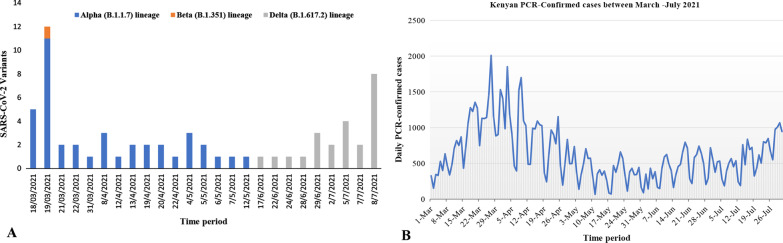
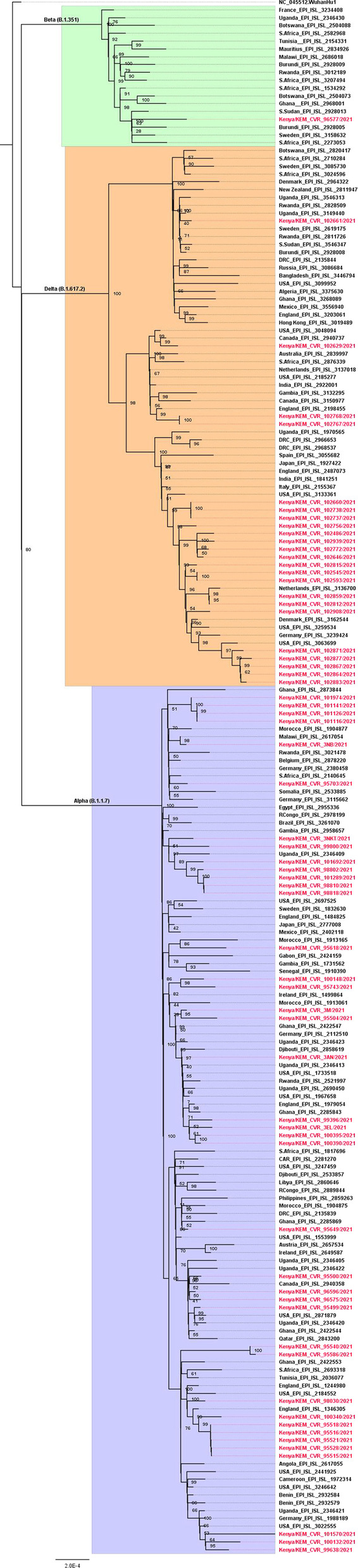
The emergence and rapid spread of SARS-CoV-2 variants of concern (VOC) have been linked to new waves of COVID-19 epidemics occurring in different regions of the world. The VOC have acquired adaptive mutations that have enhanced virus transmissibility, increased virulence, and reduced response to neutralizing antibodies. Kenya has experienced six waves of COVID-19 epidemics. In this study, we analyzed 64 genome sequences of SARS-CoV-2 strains that circulated in Nairobi and neighboring counties, Kenya between March 2021 and July 2021. Viral RNA was extracted from RT-PCR confirmed COVID-19 cases, followed by sequencing using the ARTIC network protocol and Oxford Nanopore Technologies. Analysis of the sequence data was performed using different bioinformatics methods. Our analyses revealed that during the study period, three SARS-CoV-2 variants of concern (VOC) circulated in Nairobi and nearby counties in Kenya. The Alpha (B.1.1.7) lineage predominated (62.7%), followed by Delta (B.1.617.2, 35.8%) and Beta (B.1.351, 1.5%). Notably, the Alpha (B.1.1.7) VOC were most frequent from March 2021 to May 2021, while the Delta (B.1.617.2) dominated beginning June 2021 through July 2021. Sequence comparisons revealed that all the Kenyan viruses were genetically similar to those that circulated in other regions. Although the majority of Kenyan viruses clustered together in their respective phylogenetic lineages/clades, a significant number were interspersed among foreign strains. Between March and July 2021, our study's findings indicate the prevalence of multiple lineages of SAR-CoV-2 VOC in Nairobi and nearby counties in Kenya. The data suggest that the recent increase in SARS-CoV-2 infection, particularly in Nairobi and Kenya as a whole, is attributable to the introduction and community transmission of SARS-CoV-2 VOC among the populace. In conclusion, the findings provide a snapshot of the SARS-CoV-2 variants that circulated in Kenya during the study period.
新冠病毒变异株的出现和迅速传播与世界不同地区发生的新一波 COVID-19 疫情有关。这些变异株获得了适应性突变,提高了病毒的传染性、增加了病毒的毒力,并降低了对中和抗体的反应。肯尼亚经历了六波 COVID-19 疫情。在这项研究中,我们分析了 2021 年 3 月至 2021 年 7 月期间在肯尼亚内罗毕和邻近县循环的 64 个 SARS-CoV-2 株的基因组序列。从 RT-PCR 确诊的 COVID-19 病例中提取病毒 RNA,然后使用 ARTIC 网络协议和牛津纳米孔技术进行测序。使用不同的生物信息学方法对序列数据进行分析。我们的分析结果显示,在研究期间,三种 SARS-CoV-2 变异株(VOC)在肯尼亚内罗毕和附近县循环。Alpha(B.1.1.7)谱系占主导地位(62.7%),其次是 Delta(B.1.617.2,35.8%)和 Beta(B.1.351,1.5%)。值得注意的是,Alpha(B.1.1.7)VOC 从 2021 年 3 月到 2021 年 5 月最为常见,而 Delta(B.1.617.2)则从 2021 年 6 月开始主导到 7 月。序列比较显示,所有肯尼亚病毒在遗传上与其他地区流行的病毒相似。尽管大多数肯尼亚病毒聚集在各自的进化谱系/分支中,但相当数量的病毒散落在外国株之间。在 2021 年 3 月至 7 月期间,我们的研究结果表明,在肯尼亚内罗毕和附近县存在多种 SARS-CoV-2 VOC。数据表明,最近 SARS-CoV-2 感染的增加,特别是在内罗毕和整个肯尼亚,是由于 SARS-CoV-2 VOC 在人群中的引入和社区传播。总之,这些发现提供了在研究期间肯尼亚流行的 SARS-CoV-2 变异株的快照。