
大鼠阿霉素诱导心脏损伤生物标志物的评估
Evaluation of biomarkers for doxorubicin‑induced cardiac injury in rats.
作者信息
Pan Dong-Sheng, Li Bo, Wang San-Long
机构信息
Graduate School of Peking Union Medical College, Chinese Academy of Medical Sciences and Peking Union Medical College, Beijing 100730, P.R. China.
National Center for Safety Evaluation of Drugs, National Institutes for Food and Drug Control, Beijing Economic-Technological Development Area, Beijing 100176, P.R. China.
出版信息
Exp Ther Med. 2022 Oct 5;24(6):712. doi: 10.3892/etm.2022.11648. eCollection 2022 Dec.
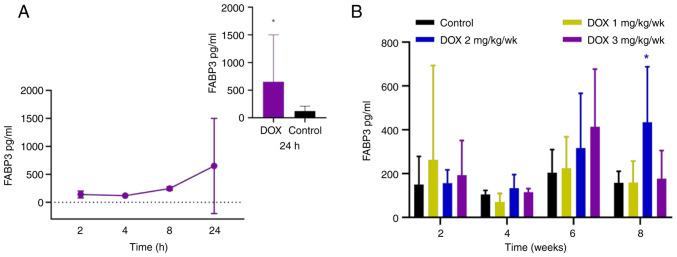
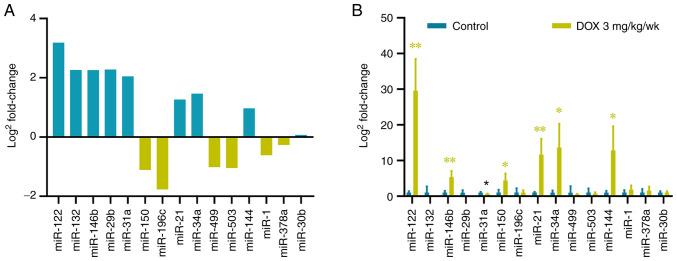
Drug-induced cardiotoxicity is a leading cause of failure in drug development and predicting its occurrence in non-clinical studies is the primary preventive measure. The present study aimed to evaluate the changes in biomarkers during acute and chronic myocardial injury induced by doxorubicin (DOX) in rats. A rat model of acute myocardial injury was established through a single-dose, intraperitoneal injection of DOX (40 mg/kg), the changes in biomarkers were measured at 2, 4, 8 and 24 h after administration, following DOX administration, creatine kinase (CK) and fatty acid-binding protein 3 (FABP3) levels increased between 8 and 24 h, whereas cardiac troponin I (cTnI) peaked at 8 h. To establish a chronic myocardial injury model, rats received 1, 2 or 3 mg/kg DOX weekly by caudal vein injection for 2, 4, 6 or 7 weeks, the changes in biomarkers were detected at 2, 4, 6 and 8 weeks, the results showed that cTnI increased significantly after 2 and 8 weeks of administration. A significant increase in FABP3 and microRNA (miR)-146b levels was observed after 8 weeks of administration. Receiver operating characteristic curve and correlation analysis showed that cTnI and miR-146b had relatively high predictive values for chronic myocardial injury (area under the curve, 0.83 and 0.71, respectively) and were closely correlated with myocardial damage. These data suggested that CK, cTnI and FABP3 were relatively sensitive to DOX-induced acute myocardial injury, whereas cTnI and miR-146b were relatively sensitive to DOX-induced chronic myocardial injury.
药物性心脏毒性是药物研发失败的主要原因之一,在非临床研究中预测其发生是主要的预防措施。本研究旨在评估阿霉素(DOX)诱导大鼠急性和慢性心肌损伤过程中生物标志物的变化。通过单次腹腔注射DOX(40mg/kg)建立大鼠急性心肌损伤模型,给药后2、4、8和24小时测量生物标志物的变化,给药后,肌酸激酶(CK)和脂肪酸结合蛋白3(FABP3)水平在8至24小时之间升高,而心肌肌钙蛋白I(cTnI)在8小时达到峰值。为建立慢性心肌损伤模型,大鼠每周通过尾静脉注射1、2或3mg/kg DOX,持续2、4、6或7周,在2、4、6和8周检测生物标志物的变化,结果显示给药2周和8周后cTnI显著升高。给药8周后观察到FABP3和微小RNA(miR)-146b水平显著升高。受试者工作特征曲线和相关性分析表明,cTnI和miR-146b对慢性心肌损伤具有相对较高的预测价值(曲线下面积分别为0.83和0.71),并且与心肌损伤密切相关。这些数据表明,CK、cTnI和FABP3对DOX诱导的急性心肌损伤相对敏感,而cTnI和miR-146b对DOX诱导的慢性心肌损伤相对敏感。



 Zotero 插件