Department of Pathology, Pellegrin Hospital, Bordeaux University Hospital, Place Amélie Raba Léon, 33000, Bordeaux, France.
University of Bordeaux, CNRS, ImmunoConcEpT, UMR 5164, 146 Rue Léo Saignat, 33000, Bordeaux, France.
Sci Rep. 2022 Nov 9;12(1):19094. doi: 10.1038/s41598-022-23078-z.
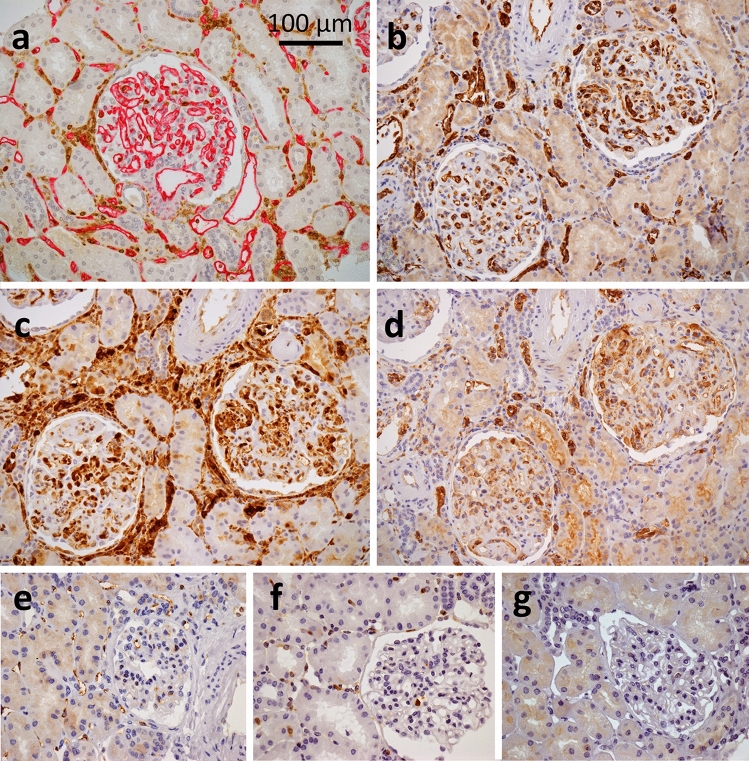
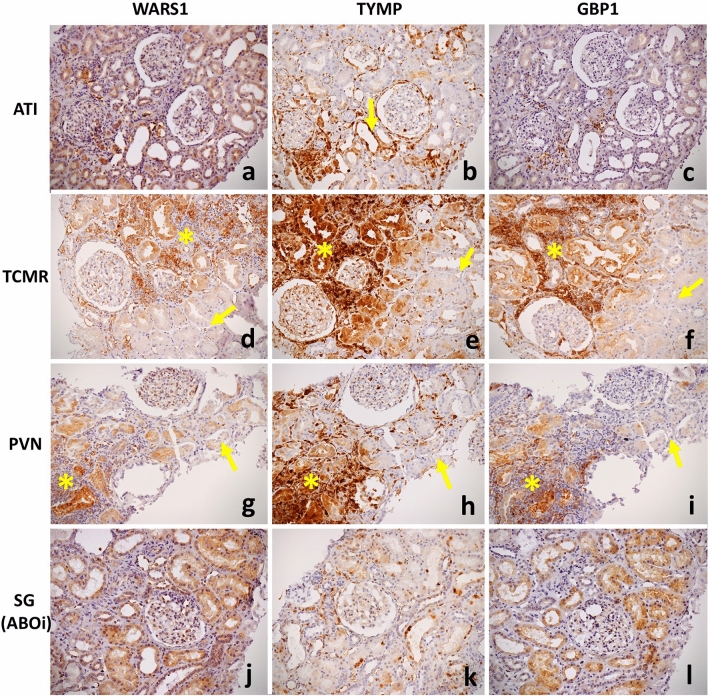
Antibody-mediated rejection (ABMR) is the leading cause of allograft failure in kidney transplantation. Defined by the Banff classification, its gold standard diagnosis remains a challenge, with limited inter-observer reproducibility of the histological scores and efficient immunomarker availability. We performed an immunohistochemical analysis of 3 interferon-related proteins, WARS1, TYMP and GBP1 in a cohort of kidney allograft biopsies including 17 ABMR cases and 37 other common graft injuries. Slides were interpreted, for an ABMR diagnosis, by four blinded nephropathologists and by a deep learning framework using convolutional neural networks. Pathologists identified a distinctive microcirculation staining pattern in ABMR with all three antibodies, displaying promising diagnostic performances and a substantial reproducibility. The deep learning analysis supported the microcirculation staining pattern and achieved similar diagnostic performance from internal validation, with a mean area under the receiver operating characteristic curve of 0.89 (± 0.02) for WARS1, 0.80 (± 0.04) for TYMP and 0.89 (± 0.04) for GBP1. The glomerulitis and peritubular capillaritis scores, the hallmarks of histological ABMR, were the most highly correlated Banff scores with the deep learning output, whatever the C4d status. These novel immunomarkers combined with a CNN framework could help mitigate current challenges in ABMR diagnosis and should be assessed in larger cohorts.
抗体介导的排斥反应 (ABMR) 是肾移植中同种异体移植物失功的主要原因。根据 Banff 分类定义,其金标准诊断仍然具有挑战性,组织学评分的观察者间重复性有限,有效的免疫标志物可用性有限。我们对包括 17 例 ABMR 病例和 37 例其他常见移植物损伤在内的一组肾移植活检进行了 3 种干扰素相关蛋白(WARS1、TYMP 和 GBP1)的免疫组织化学分析。四位盲法肾病理学家和使用卷积神经网络的深度学习框架对切片进行了 ABMR 诊断解读。病理学家在所有三种抗体中都发现了 ABMR 的独特微循环染色模式,显示出有前景的诊断性能和相当高的重复性。深度学习分析支持微循环染色模式,并通过内部验证实现了类似的诊断性能,WARS1 的平均接收者操作特征曲线下面积为 0.89(±0.02),TYMP 为 0.80(±0.04),GBP1 为 0.89(±0.04)。肾小球肾炎和肾小管毛细血管炎评分是 ABMR 组织学的标志,与深度学习输出的相关性最高,无论 C4d 状态如何。这些新的免疫标志物与 CNN 框架相结合,可以帮助缓解当前 ABMR 诊断中的挑战,应在更大的队列中进行评估。