Department of Neurology, Meizhou People's Hospital, 63, Huangtang Road, Meijiang District, Meizhou City, 514031, Guangdong Province, China.
Department of Radiology, Meizhou People's Hospital, Meizhou, China.
BMC Infect Dis. 2022 Nov 9;22(1):825. doi: 10.1186/s12879-022-07827-z.
Descriptions of the patterns of acute/subacute cerebral infarction (ASCI) in HIV-negative patients with cryptococcal meningitis (CM) are scarce, and the predictors of ischemic stroke and outcomes following ASCI remain unclear.
To study the clinical characteristics and evaluate the predictors of ASCI in HIV-negative patients with CM and assess the impact of ischemic stroke on the outcomes of the patients.
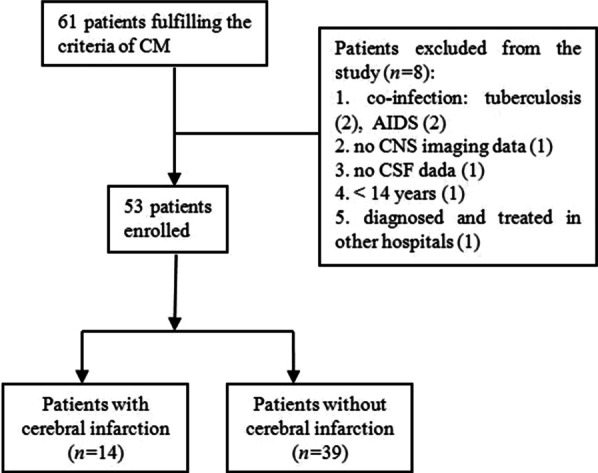
We retrospectively analyzed the data of 61 HIV-negative patients with CM treated between January, 2016 and February, 2022, and among them, 53 patients with complete neuroimaging and cerebrospinal fluid (CSF) data were enrolled in this study. The cohort was stratified by the occurrence of ASCI diagnosed based on MRI evidences for comparison of the clinical characteristics (consciousness disturbance, GCS score, duration of symptoms, and treatment), CSF parameters, imaging findings (meningeal inflammation, hydrocephalus, posterior fossa exudates) and outcomes of the patients. A favorable outcome was defined as a modified Rankin scale (mRS) score ≤ 2 and a poor outcome as a mRS score > 2. Logistic regression analysis was used to identify the risk factors of ASCI in the HIV-negative patients with CM.
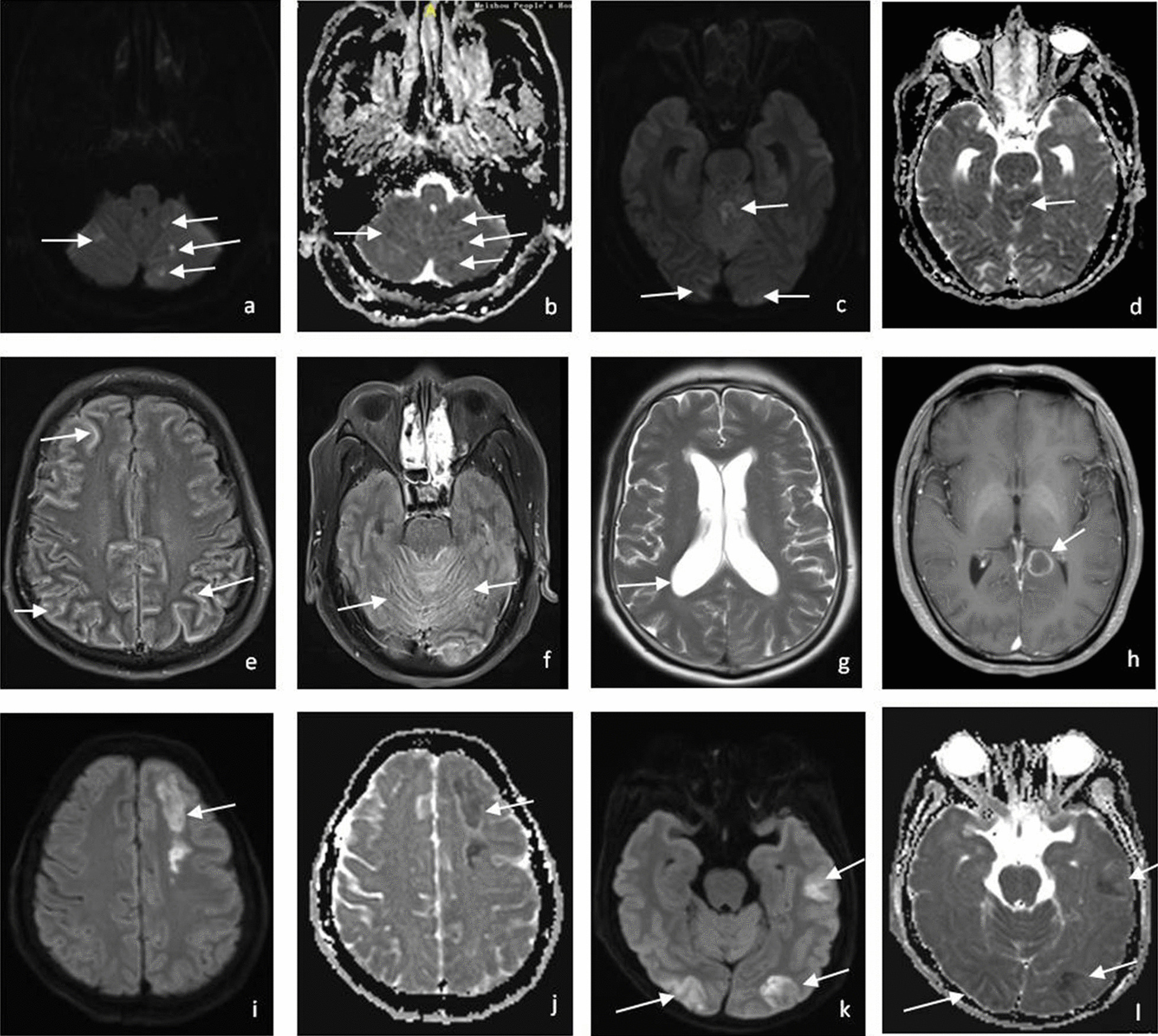
Of the 53 HIV-negative patients with CM, 14 (26.4%) had ASCI. The incidences of fever, headache, neck stiffness, duration of symptoms, CSF parameters, meningeal enhancement in brain MRI and the treatment regimens were similar between the patients with and those without ASCI. Most of the infarcts (92.9%) were of the lacunar type, involving both the anterior and posterior territories. Basal ganglia-corona radiata and the brainstem-cerebellum were the most frequently involved sites. Univariate logistic regression analysis suggested that consciousness disturbance (P = 0.002), MRI evidence of hydrocephalus (P = 0.042) and posterior fossa exudates (P = 0.028) were predictors of ASCI in these HIV-negative patients with CM. Multivariate analysis identified consciousness disturbance as a significant predictor of ASCI (P = 0.020). Compared with the patients without ASCI, the HIV-negative patients with CM and ASCI had poorer outcomes (P = 0.001).
ASCI can occur in HIV-negative patients with CM, presented commonly as multiple lacunar infarctions involving all the cerebrovascular territories. The presence of consciousness disturbance, hydrocephalus and posterior fossa exudates may increase the risk of ASCI in patients with CM. ASCI is associated with a poor outcome of the HIV-negative patients with CM.
关于 HIV 阴性的隐球菌性脑膜炎(CM)患者中急性/亚急性脑梗死(ASCI)的模式描述较少,并且缺血性卒中的预测因子和 ASCI 后的结果仍不清楚。
研究 HIV 阴性 CM 患者中 ASCI 的临床特征,并评估其预测因子,评估缺血性卒中对患者结局的影响。
我们回顾性分析了 2016 年 1 月至 2022 年 2 月期间收治的 61 例 HIV 阴性 CM 患者的数据,其中有完整的神经影像学和脑脊液(CSF)数据的 53 例患者被纳入本研究。根据 MRI 证据将队列分为发生和未发生 ASCI 的两组,比较两组患者的临床特征(意识障碍、GCS 评分、症状持续时间和治疗)、CSF 参数、影像学表现(脑膜炎症、脑积水、后颅窝渗出物)和结局。采用改良 Rankin 量表(mRS)评分≤2 定义为良好结局,mRS 评分>2 定义为不良结局。采用 logistic 回归分析识别 HIV 阴性 CM 患者发生 ASCI 的风险因素。
53 例 HIV 阴性 CM 患者中,有 14 例(26.4%)发生 ASCI。两组患者发热、头痛、颈强直、症状持续时间、CSF 参数、脑 MRI 脑膜增强以及治疗方案相似。大多数梗死(92.9%)为腔隙性梗死,涉及前循环和后循环。基底节-放射冠和脑桥-小脑是最常受累的部位。单因素 logistic 回归分析提示意识障碍(P=0.002)、MRI 证据显示脑积水(P=0.042)和后颅窝渗出物(P=0.028)是这些 HIV 阴性 CM 患者发生 ASCI 的预测因素。多因素分析确定意识障碍是 ASCI 的显著预测因素(P=0.020)。与无 ASCI 的患者相比,发生 ASCI 的 HIV 阴性 CM 患者的结局更差(P=0.001)。
ASCI 可发生于 HIV 阴性的 CM 患者,表现为常见的多腔隙性梗死,涉及所有脑血管分布区。意识障碍、脑积水和后颅窝渗出物的存在可能会增加 CM 患者发生 ASCI 的风险。ASCI 与 HIV 阴性 CM 患者的不良结局相关。