Yimam Mohammed, Yimer Siraj Mammo, Beressa Tamirat Bekele
Department of Biology, College of Natural and Computational Science, Ambo University, P.O.Box 19, Ambo, Ethiopia.
Department of Pharmacy, College of Medicine and Health Sciences, Ambo University, P.O. Box 19, Ambo, Ethiopia.
Trop Med Health. 2022 Nov 9;50(1):85. doi: 10.1186/s41182-022-00438-z.
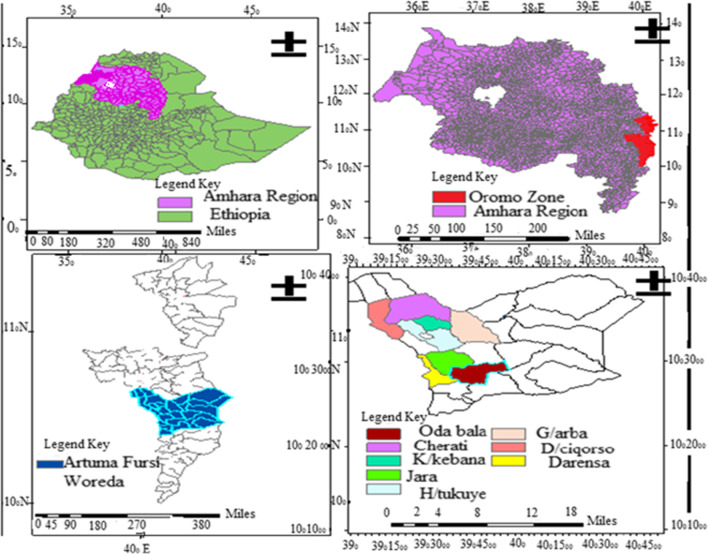
Indigenous people of different ethnic groups in Ethiopia are noticeably reliant on traditional medicinal plants for their healthcare due to their effective medicinal values. The study was aimed to document different herbal medicinal plants used and the associated knowledge of herbal medicine in the communities of the Artuma Fursi district.
Ethnobotanical data were collected through semi-structured interviews, field observations, focused group discussions with the informants selected from the study area. Key informants were selected by purposive sampling technique, while the rest, were selected by random sampling techniques. The collected data were analyzed using descriptive statistics; paired comparison, preference ranking, and informant consensus factor.
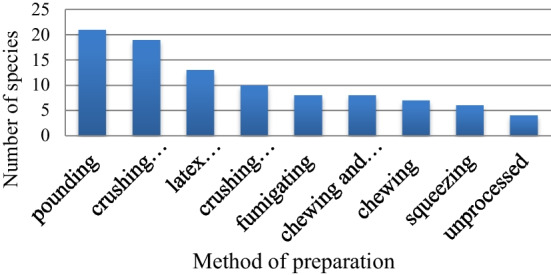
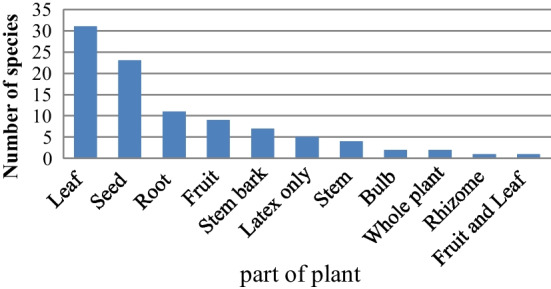
A total of 86 informants participated in the collection of the ethnobotanical data. A total of 92 medicinal plants were collected and identified. Fabaceae was the highest family cited (11.9%). The study revealed that leaves (31.1%), seeds (19.8%), and roots (12.26%) were the most cited plant parts used for the preparation of herbal medicine by the respondents. The most common method of preparation of herbal medicines was pounding (21.6%) and the most common route of administration was oral route (53.7%). The majority of the medications (60.3%) were prepared without the additive. Charcoal production was the major threat to medicinal plants in the study area.
Artuma Fursi district is rich in medicinal plant and the associated indigenous knowledge. The documented knowledge will be helpful for further research in the drug development process.
埃塞俄比亚不同族群的原住民因其有效的药用价值,明显依赖传统药用植物进行医疗保健。本研究旨在记录阿尔图马·富尔西地区社区使用的不同草药以及相关的草药知识。
通过半结构化访谈、实地观察以及与从研究区域选取的 informant 进行焦点小组讨论来收集民族植物学数据。关键 informant 通过目的抽样技术选取,其余则通过随机抽样技术选取。使用描述性统计、配对比较、偏好排序和 informant 共识因子对收集到的数据进行分析。
共有86名 informant 参与了民族植物学数据的收集。共收集并鉴定出92种药用植物。豆科是被提及最多的科(11.9%)。研究表明,叶子(31.1%)、种子(19.8%)和根(12.26%)是受访者制备草药时提及最多的植物部位。制备草药最常见的方法是捣碎(21.6%),最常见的给药途径是口服(53.7%)。大多数药物(60.3%)制备时未添加添加剂。木炭生产是研究区域内药用植物面临的主要威胁。
阿尔图马·富尔西地区富含药用植物及相关的本土知识。记录的这些知识将有助于药物研发过程中的进一步研究。