Teklehaymanot Tilahun, Giday Mirutse
Endod and Other Medicinal Plants Unit, Aklilu Lemma Institute of Pathobiology, Addis Ababa University, PO Box 1176, Addis Ababa, Ethiopia.
J Ethnobiol Ethnomed. 2007 Mar 14;3:12. doi: 10.1186/1746-4269-3-12.
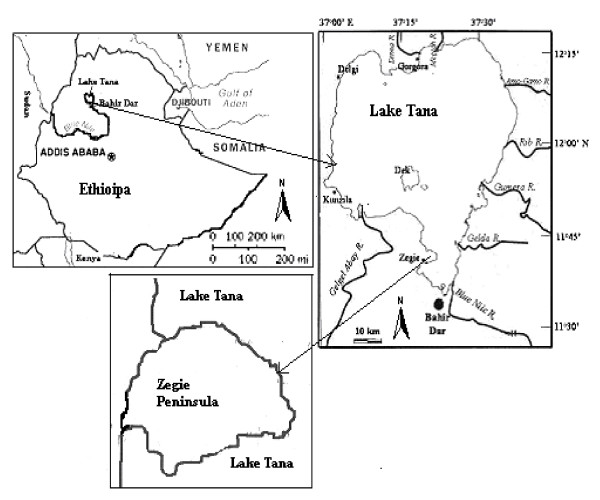
An ethnobotanical study was conducted from October 2005 to June 2006 to investigate the uses of medicinal plants by people in Zegie Peninsula, northwestern Ethiopia. Information was gathered from 200 people: 70 female and 130 males, using semistructured questionnaire. Of which, six were male local healers. The informants, except the healers, were selected randomly and no appointment was made prior to the visits. Informant consensus factor (ICF) for category of ailments and the fidelity level (FL) of the medicinal plants were determined. Sixty-seven medicinal plants used as a cure for 52 ailments were documented. They are distributed across 42 families and 64 genera. The most frequently utilized plant part was the underground part (root/rhizome/bulb) (42%). The largest number of remedies was used to treat gastrointestinal disorder and parasites infections (22.8%) followed by external injuries and parasites infections (22.1%). The administration routes are oral (51.4%), external (38.6%), nasal (7.9%), and ear (2.1%). The medicinal plants that were presumed to be effective in treating a certain category of disease, such as 'mich' and febrile diseases (0.80) had higher ICF values. This probably indicates a high incidence of these types of diseases in the region, possibly due to the poor socio-economic and sanitary conditions of this people. The medicinal plants that are widely used by the local people or used as a remedy for a specific ailment have higher FL values (Carissa spinarum, Clausena anisata, Acokanthera schimperi, Calpurnia aurea, Ficus thonningii, and Cyphostemma junceum) than those that are less popular or used to treat more than one type of ailments (Plumbago zeylanicum, Dorstenia barnimiana).
2005年10月至2006年6月开展了一项民族植物学研究,以调查埃塞俄比亚西北部泽吉半岛居民对药用植物的使用情况。通过半结构化问卷从200人(70名女性和130名男性)那里收集信息。其中有6名男性当地治疗师。除治疗师外,其他被调查者是随机选取的,且在访问前未进行预约。确定了疾病类别的 informant共识因子(ICF)和药用植物的保真度水平(FL)。记录了67种用于治疗52种疾病的药用植物。它们分布在42个科和64个属中。最常使用的植物部位是地下部分(根/根茎/鳞茎)(42%)。用于治疗胃肠道疾病和寄生虫感染的药物数量最多(22.8%),其次是外伤和寄生虫感染(22.1%)。给药途径为口服(51.4%)、外用(38.6%)、鼻腔给药(7.9%)和耳部给药(2.1%)。被认为对某类疾病有效的药用植物,如“mich”和发热性疾病(0.80),其ICF值较高。这可能表明该地区这类疾病的发病率较高,可能是由于该人群社会经济和卫生条件较差所致。当地居民广泛使用或用于治疗特定疾病的药用植物(刺黄果、茴香吴茱萸、箭毒木、金黄羽扇豆、托氏榕、灯台叶)的FL值高于那些不太受欢迎或用于治疗多种疾病的植物(白花丹、巴尼氏肉托果)。