Robinson George A, Peng Junjie, Peckham Hannah, Butler Gary, Pineda-Torra Ines, Ciurtin Coziana, Jury Elizabeth C
Centre for Rheumatology Research, Division of Medicine, University College London, London, UK.
Centre for Adolescent Rheumatology Versus Arthritis, Division of Medicine, University College London, London, UK.
Lancet Rheumatol. 2022 Aug 31;4(10):e710-e724. doi: 10.1016/S2665-9913(22)00198-9. eCollection 2022 Oct.
Sexual dimorphisms, which vary depending on age group and pubertal status, have been described across both the innate and adaptive immune system. We explored the influence of sex hormones on immune phenotype in the context of adolescent health and autoimmunity.
In this cross-sectional study, healthy, post-pubertal cisgender individuals (aged 16-25 years); healthy, pre-pubertal cisgender individuals (aged 6-11 years); transgender individuals (aged 18-19 years) undergoing gender-affirming treatment (testosterone in individuals assigned female sex at birth and oestradiol in individuals assigned male sex at birth); and post-pubertal cisgender individuals (aged 14-25 years) with juvenile-onset systemic lupus erythematosus (SLE) age-matched to cisgender individuals without juvenile-onset SLE were eligible for inclusion. Frequencies of 28 immune-cell subsets (including different T cell, B cell, and monocyte subsets) from each participant were measured in peripheral blood mononuclear cells by flow cytometry and analysed by balanced random forest machine learning. RNA-sequencing was used to compare sex and gender differences in regulatory T (Treg) cell phenotype between participants with juvenile-onset SLE, age-matched cis-gender participants without the disease, and age matched transgender individuals on gender-affirming sex hormone treatment. Differentially expressed genes were analysed by cluster and pathway analysis. Suppression assays assessed the anti-inflammatory function of Treg cells in vitro.
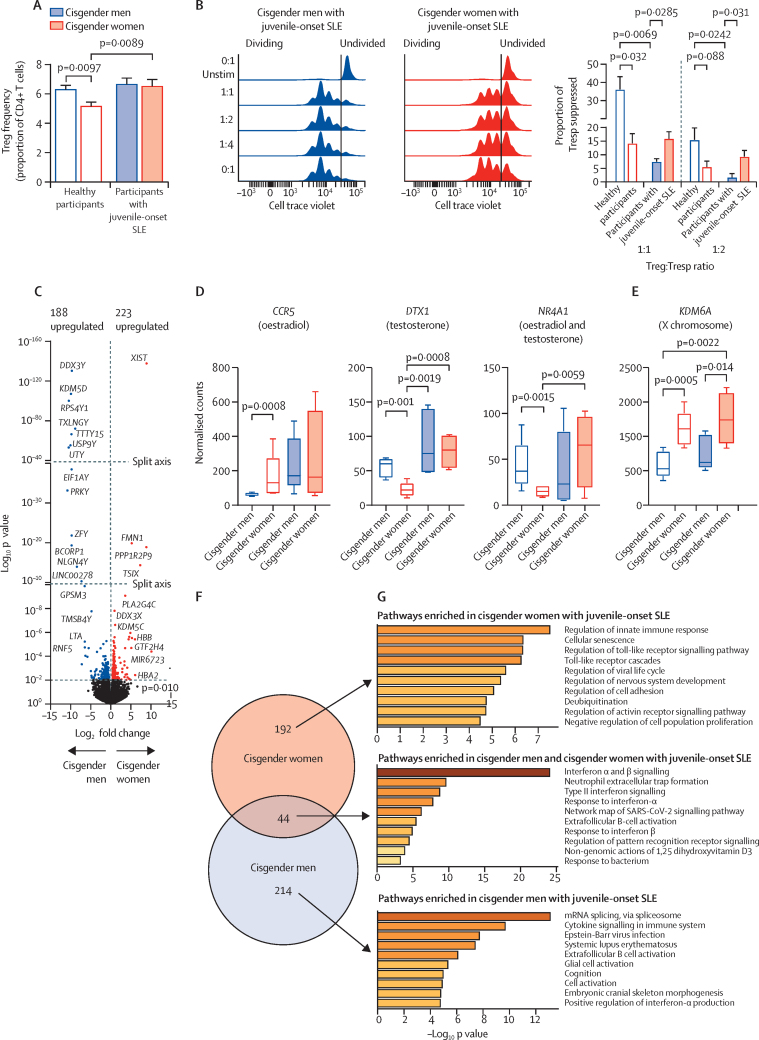
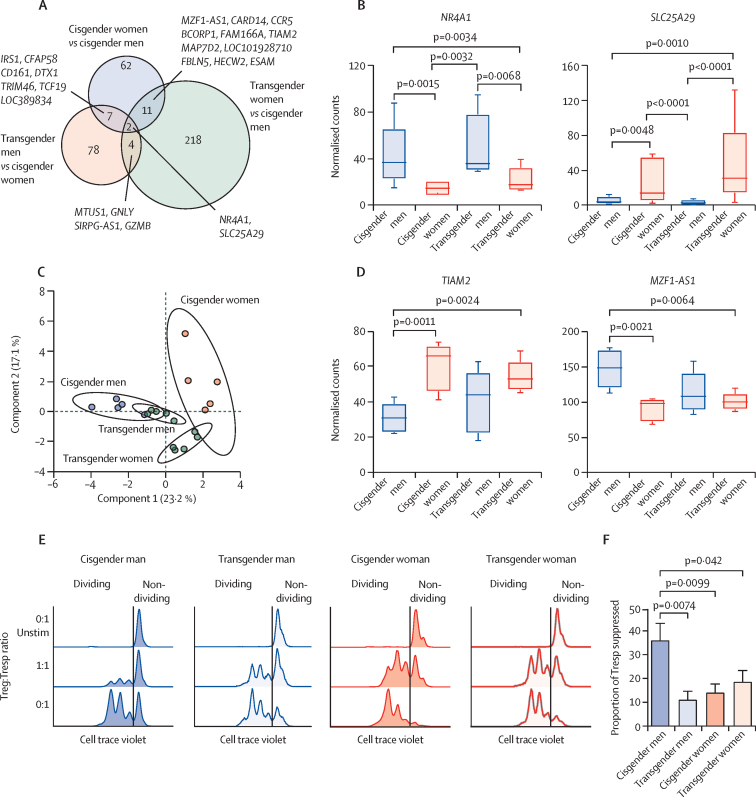
Between Sept 5, 2012, and Nov 6, 2019, peripheral blood was collected from 39 individuals in the post-pubertal group (17 [44%] cisgender men, mean age 18·76 years [SD 2·66]; 22 [56%] cisgender women, mean age 18·59 years [2·81]), 14 children in the cisgender pre-pubertal group (seven [50%] cisgender boys, mean age 8·90 [1·66]; seven [50%] cisgender girls, mean age 8·40 [1·58]), ten people in the transgender group (five [50%] transgender men, mean age 18·20 years [0·47]; five [50%] transgender women, mean age 18·70 years [0·55]), and 35 people in the juvenile-onset SLE group (12 [34%] cisgender men, mean age 18·58 years [2·35]; 23 [66%] cisgender women, mean age 19·48 [3·08]). Statistically significantly elevated frequencies of Treg cells were one of the top immune-cell features differentiating young post-pubertal cisgender men from similarly aged cisgender women (p=0·0097). Treg cells from young cisgender men had a statistically significantly increased suppressive capacity in vitro compared with those from cisgender women and a distinct transcriptomic signature significantly enriched for genes in the PI3K-AKT signalling pathway. Gender-affirming sex hormones in transgender men and transgender women induced multiple statistically significant changes in the Treg-cell transcriptome, many of which enriched functional pathways that overlapped with those altered between cisgender men and cisgender women, highlighting a hormonal influence on Treg-cell function by gender. Finally, sex differences in Treg-cell frequency were absent and suppressive capacity was reversed in patients with juvenile-onset SLE, but sex differences in Treg-cell transcriptional signatures were significantly more pronounced in patients with juvenile-onset SLE compared with individuals without juvenile-onset SLE, suggesting that sex hormone signalling could be dysregulated in autoimmunity.
Sex-chromosomes and hormones might drive changes in Treg-cell frequency and function. Young post-pubertal men have a more anti-inflammatory Treg-cell profile, which could explain inflammatory disease susceptibilities, and inform sex-tailored therapeutic strategies.
Versus Arthritis, UK National Institute for Health Research University College London Hospital Biomedical Research Centre, Lupus UK, and The Rosetrees Trust.
性二态性在先天性和适应性免疫系统中均有体现,且因年龄组和青春期状态而异。我们在青少年健康和自身免疫的背景下,探讨了性激素对免疫表型的影响。
在这项横断面研究中,纳入了健康的青春期后顺性别个体(16 - 25岁);健康的青春期前顺性别个体(6 - 11岁);接受性别确认治疗的跨性别个体(18 - 19岁,出生时被指定为女性的个体接受睾酮治疗,出生时被指定为男性的个体接受雌二醇治疗);以及患有青少年起病的系统性红斑狼疮(SLE)且年龄与无青少年起病SLE的顺性别个体相匹配的青春期后顺性别个体(14 - 25岁)。通过流式细胞术检测每个参与者外周血单核细胞中28种免疫细胞亚群(包括不同的T细胞、B细胞和单核细胞亚群)的频率,并采用平衡随机森林机器学习进行分析。使用RNA测序比较青少年起病SLE患者、年龄匹配的无该疾病的顺性别参与者以及接受性别确认性激素治疗的年龄匹配跨性别个体之间调节性T(Treg)细胞表型的性别差异。通过聚类和通路分析对差异表达基因进行分析。抑制试验在体外评估Treg细胞的抗炎功能。
在2012年9月5日至2019年11月6日期间,从青春期后组的39名个体(17名[44%]顺性别男性,平均年龄18.76岁[标准差2.66];22名[56%]顺性别女性,平均年龄18.59岁[2.81])、青春期前顺性别组的14名儿童(7名[50%]顺性别男孩,平均年龄8.90[1.66];7名[50%]顺性别女孩,平均年龄8.40[1.58])、跨性别组的10名个体(5名[50%]跨性别男性,平均年龄18.20岁[0.47];5名[50%]跨性别女性,平均年龄18.70岁[0.55])和青少年起病SLE组的35名个体(12名[34%]顺性别男性,平均年龄18.58岁[2.35];23名[66%]顺性别女性,平均年龄19.48[3.08])采集了外周血。Treg细胞频率在统计学上显著升高是区分青春期后年轻顺性别男性与同龄顺性别女性的首要免疫细胞特征之一(p = 0.0097)。与顺性别女性相比,年轻顺性别男性的Treg细胞在体外具有统计学上显著增强的抑制能力,并且具有明显的转录组特征,PI3K - AKT信号通路中的基因显著富集。跨性别男性和跨性别女性的性别确认性激素在Treg细胞转录组中诱导了多个统计学上显著的变化,其中许多富集的功能通路与顺性别男性和顺性别女性之间改变的通路重叠,突出了激素对Treg细胞功能的性别影响。最后,青少年起病SLE患者中Treg细胞频率不存在性别差异且抑制能力相反,但与无青少年起病SLE的个体相比,青少年起病SLE患者中Treg细胞转录特征的性别差异明显更显著,这表明自身免疫中性激素信号可能失调。
性染色体和激素可能驱动Treg细胞频率和功能的变化。青春期后年轻男性具有更具抗炎性的Treg细胞特征,这可以解释炎症性疾病的易感性,并为针对性别的治疗策略提供依据。
英国关节炎研究协会、英国国家卫生研究院大学学院伦敦医院生物医学研究中心、英国狼疮协会和罗斯特里斯特信托基金。