Lu Jiachen, Wang Jing, Li Weidong, Li Jingjing
School of Psychology, South China Normal University, Guangzhou 510631, China.
School of Physical Education, Guangzhou University, Guangzhou 510006, China.
Behav Sci (Basel). 2022 Nov 8;12(11):436. doi: 10.3390/bs12110436.
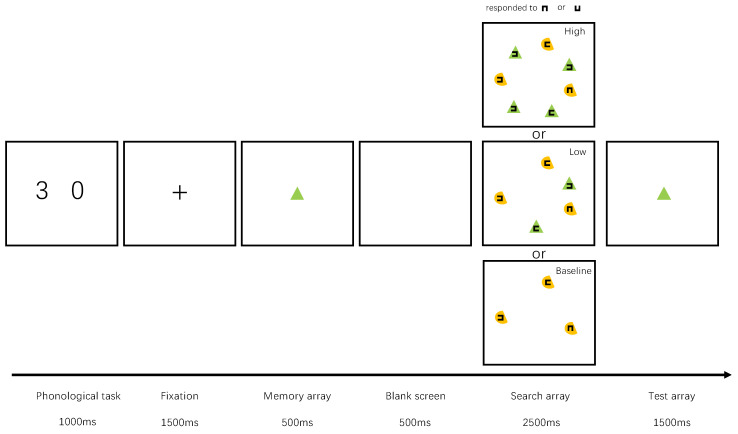
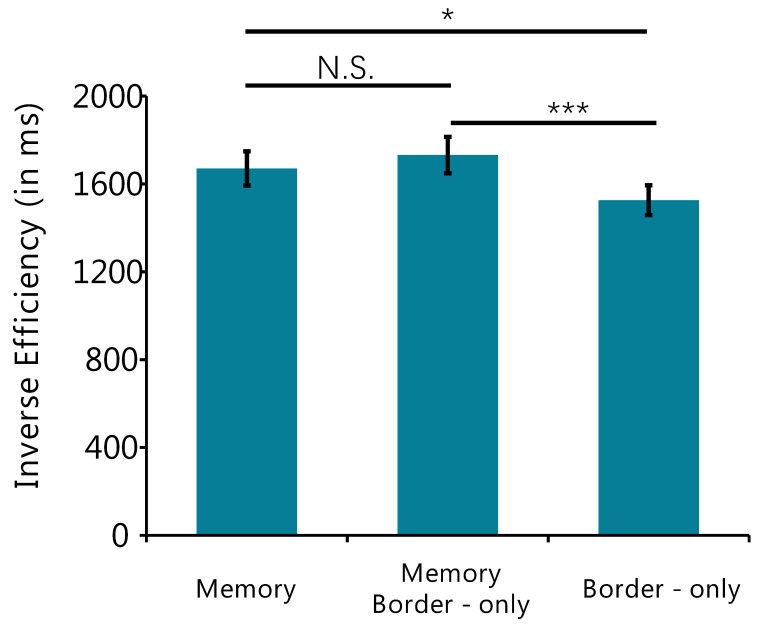
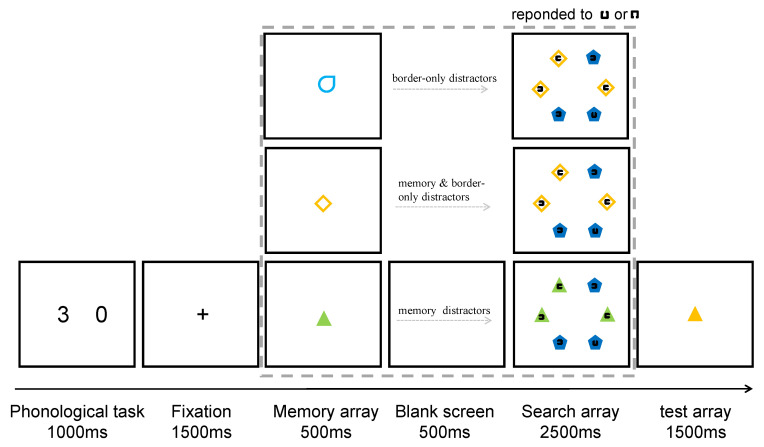
Although scientists know that information stored in working memory guides visual attention, how this is accomplished is still under debate. Specifically, there is a dispute between the Biased Competition Model and Visual Attention Theory. The current study used two experiments to resolve this controversy based on previous research. Experiment 1 found that although inverse efficiency scores for High and Low numbers of memory distractors were both longer than the Baseline (no memory distractors), they did not significantly differ from each other. This indicated that memory might guide attention via a capture-then-global-inhibition process. Experiment 2 addressed the possibility that the findings resulted from the time needed to reject the interfering objects by requiring both memory-matching and memory-mismatching conditions to be rejected under a highlighted target. This result showed that the memory-matching condition resulted in longer search times than the memory-mismatching condition, indicating an attention-capture effect based on working memory. Together, the two experiments support the idea that when multiple memory-matching distractors in a search array first capture an individual's attention, it then acts as a template that allows the individual to suppress all interfering items that containing memory information holds. This study supports the Biased Competition Model early on in visual search. However, the late stage of visual search supports the Visual Attention Theory. These advance our knowledge regarding the relationship between working memory content and attention.
尽管科学家们知道工作记忆中存储的信息会引导视觉注意力,但具体的实现方式仍存在争议。具体而言,偏向竞争模型和视觉注意理论之间存在分歧。当前的研究基于之前的研究,通过两个实验来解决这一争议。实验1发现,尽管记忆干扰物数量多和少的逆效率得分均长于基线水平(无记忆干扰物),但二者之间并无显著差异。这表明记忆可能通过先捕获再全局抑制的过程来引导注意力。实验2探讨了一种可能性,即这些发现是由于在突出显示的目标下,需要同时排除记忆匹配和记忆不匹配条件下的干扰物而导致的。结果表明,记忆匹配条件下的搜索时间比记忆不匹配条件下更长,这表明基于工作记忆存在一种注意力捕获效应。综合来看,这两个实验支持了这样一种观点:当搜索阵列中的多个记忆匹配干扰物首先捕获个体的注意力时,它随后会作为一个模板,使个体能够抑制所有包含记忆信息的干扰项。这项研究在视觉搜索的早期阶段支持偏向竞争模型。然而,视觉搜索的后期阶段支持视觉注意理论。这些研究成果推进了我们对工作记忆内容与注意力之间关系的认识。