Zou Juan, Li Cheng, Jia Sen, Wu Ruoyou, Pei Tingrui, Zheng Hairong, Wang Shanshan
School of Physics and Optoelectronics, Xiangtan University, Xiangtan 411105, China.
Paul C. Lauterbur Research Center for Biomedical Imaging, Shenzhen Institutes of Advanced Technology, Chinese Academy of Sciences, Shenzhen 518055, China.
Bioengineering (Basel). 2022 Nov 4;9(11):650. doi: 10.3390/bioengineering9110650.
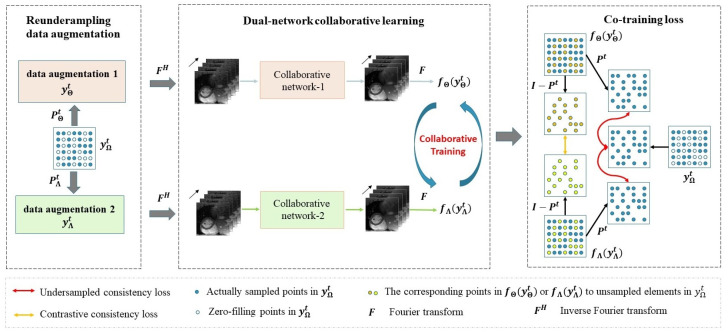
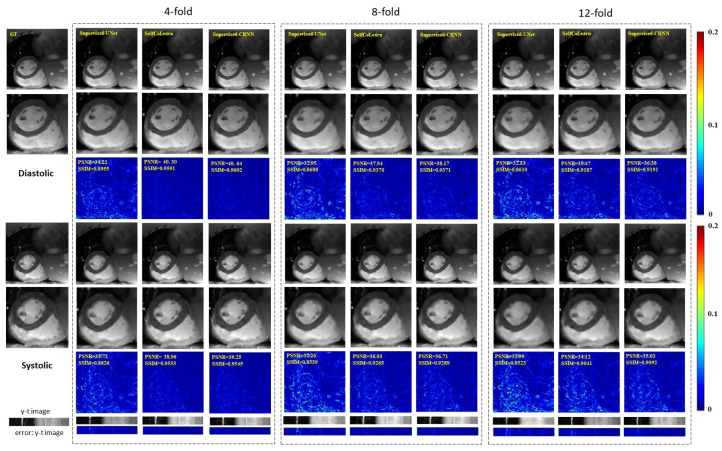
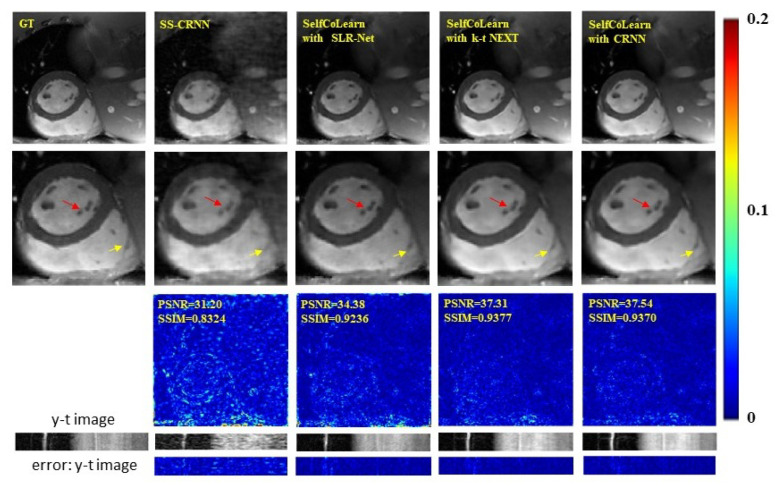
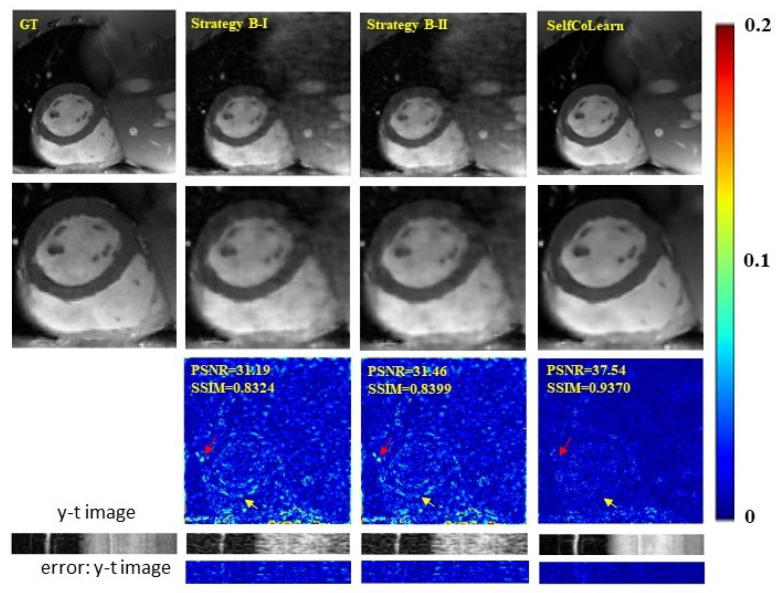
Lately, deep learning technology has been extensively investigated for accelerating dynamic magnetic resonance (MR) imaging, with encouraging progresses achieved. However, without fully sampled reference data for training, the current approaches may have limited abilities in recovering fine details or structures. To address this challenge, this paper proposes a self-supervised collaborative learning framework (SelfCoLearn) for accurate dynamic MR image reconstruction from undersampled k-space data directly. The proposed SelfCoLearn is equipped with three important components, namely, dual-network collaborative learning, reunderampling data augmentation and a special-designed co-training loss. The framework is flexible and can be integrated into various model-based iterative un-rolled networks. The proposed method has been evaluated on an in vivo dataset and was compared to four state-of-the-art methods. The results show that the proposed method possesses strong capabilities in capturing essential and inherent representations for direct reconstructions from the undersampled k-space data and thus enables high-quality and fast dynamic MR imaging.
最近,深度学习技术已被广泛研究用于加速动态磁共振(MR)成像,并取得了令人鼓舞的进展。然而,由于缺乏用于训练的全采样参考数据,当前方法在恢复精细细节或结构方面的能力可能有限。为应对这一挑战,本文提出了一种自监督协作学习框架(SelfCoLearn),用于直接从欠采样的k空间数据中准确重建动态MR图像。所提出的SelfCoLearn配备了三个重要组件,即双网络协作学习、重新采样数据增强和特殊设计的协同训练损失。该框架具有灵活性,可以集成到各种基于模型的迭代展开网络中。所提出的方法已在体内数据集上进行了评估,并与四种最新方法进行了比较。结果表明,所提出的方法在从欠采样的k空间数据中捕获用于直接重建的基本和固有特征方面具有强大能力,从而能够实现高质量和快速的动态MR成像。