Chaniad Prapaporn, Techarang Tachpon, Phuwajaroanpong Arisara, Horata Natharinee, Septama Abdi Wira, Punsawad Chuchard
Department of Medical Sciences, School of Medicine, Walailak University, Nakhon Si Thammarat 80160, Thailand.
Research Center in Tropical Pathobiology, Walailak University, Nakhon Si Thammarat 80160, Thailand.
Trop Med Infect Dis. 2022 Nov 10;7(11):368. doi: 10.3390/tropicalmed7110368.
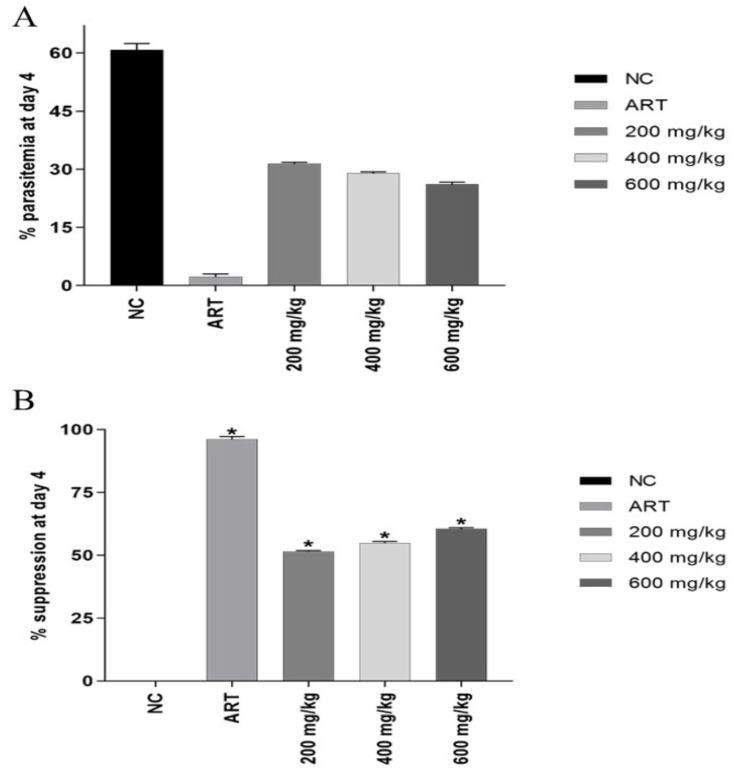
The Kheaw Hom remedy is a traditional Thai medicine widely used to treat fevers. Some plant ingredients in this remedy have been investigated for their antimicrobial, antiviral, anti-inflammatory, and antioxidant activities. However, there have been no reports on the antimalarial activities of the medicinal plants in this remedy. Therefore, this study focuses on identifying potential antimalarial drug candidates from the medicinal plant ingredients of the Kheaw Hom remedy. Eighteen plants from the Kheaw Hom remedy were extracted using distilled water and ethanol. All extracts were investigated for their in vitro antimalarial activity and cytotoxicity. An extract that exhibited good in vitro antimalarial activity and low toxicity was selected for further investigation by using Peter’s 4-day suppressive test and an acute oral toxicity evaluation in mice. Based on the in vitro antimalarial activity and cytotoxicity studies, the ethanolic extract of Globba malaccensis rhizomes showed promising antimalarial activity against the Plasmodium falciparum K1 strain (IC50 = 1.50 µg/mL) with less toxicity to Vero cells (CC50 of >80 µg/mL). This extract exhibited a significant dose-dependent reduction in parasitemia in P. berghei-infected mice. The maximum suppressive effect of this extract (60.53%) was observed at the highest dose administered (600 mg/kg). In a single-dose acute toxicity test, the animals treated at 2000 mg/kg died within 48 h after extract administration. In conclusion, our study indicates that the ethanolic extract of G. malaccensis rhizomes exhibited in vitro and in vivo antimalarial activities, which could serve as a promising starting point for antimalarial drug.
Kheaw Hom疗法是一种广泛用于治疗发热的传统泰国医学。该疗法中的一些植物成分已针对其抗菌、抗病毒、抗炎和抗氧化活性进行了研究。然而,关于该疗法中药用植物的抗疟活性尚无报道。因此,本研究重点从Kheaw Hom疗法的药用植物成分中鉴定潜在的抗疟药物候选物。使用蒸馏水和乙醇对Kheaw Hom疗法中的18种植物进行提取。对所有提取物进行体外抗疟活性和细胞毒性研究。选择一种表现出良好体外抗疟活性和低毒性的提取物,通过彼得4天抑制试验和小鼠急性口服毒性评估进行进一步研究。基于体外抗疟活性和细胞毒性研究,马来西亚舞花姜根茎的乙醇提取物对恶性疟原虫K1株显示出有前景的抗疟活性(IC50 = 1.50 µg/mL),对Vero细胞的毒性较小(CC50 > 80 µg/mL)。该提取物在感染伯氏疟原虫的小鼠中显示出寄生虫血症的显著剂量依赖性降低。在给予的最高剂量(600 mg/kg)下观察到该提取物的最大抑制作用(60.53%)。在单剂量急性毒性试验中,以2000 mg/kg处理的动物在提取物给药后48小时内死亡。总之,我们的研究表明,马来西亚舞花姜根茎的乙醇提取物表现出体外和体内抗疟活性,这可能是抗疟药物的一个有前景的起点。