Department of Surgery, Aga Khan University, Nairobi, Kenya
King's College London, Institute of Cancer Policy, London, UK.
BMJ Glob Health. 2022 Nov;7(11). doi: 10.1136/bmjgh-2022-009849.
Research is a critical pillar in national cancer control planning. However, there is a dearth of evidence for countries to implement affordable strategies. The WHO and various Commissions have recommended developing stakeholder-based needs assessments based on objective data to generate evidence to inform national and regional prioritisation of cancer research needs and goals.
Bibliometric algorithms (macros) were developed and validated to assess cancer research outputs of all 54 African countries over a 12-year period (2009-2020). Subanalysis included collaboration patterns, site and domain-specific focus of research and understanding authorship dynamics by both position and sex. Detailed subanalysis was performed to understand multiple impact metrics and context relative outputs in comparison with the disease burden as well as the application of a funding thesaurus to determine funding resources.
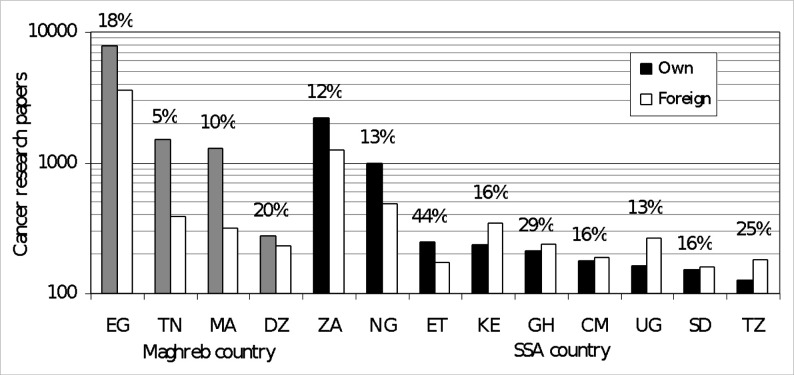
African countries in total published 23 679 cancer research papers over the 12-year period (2009-2020) with the fractional African contribution totalling 16 201 papers and the remaining 7478 from authors from out with the continent. The total number of papers increased rapidly with time, with an annual growth rate of 15%. The 49 sub-Saharan African (SSA) countries together published just 5281 papers, of which South Africa's contribution was 2206 (42% of the SSA total, 14% of all Africa) and Nigeria's contribution was 997 (19% of the SSA total, 4% of all Africa). Cancer research accounted for 7.9% of all African biomedical research outputs (African research in infectious diseases was 5.1 times than that of cancer research). Research outputs that are proportionally low relative to their burden across Africa are paediatric, cervical, oesophageal and prostate cancer. African research mirrored that of Western countries in terms of its focus on discovery science and pharmaceutical research. The percentages of female researchers in Africa were comparable with those elsewhere, but only in North African and some Anglophone countries.
There is an imbalance in relevant local research generation on the continent and cancer control efforts. The recommendations articulated in our five-point plan arising from these data are broadly focused on structural changes, for example, overt inclusion of research into national cancer control planning and financial, for example, for countries to spend 10% of a notional 1% gross domestic expenditure on research and development on cancer.
研究是国家癌症控制规划的重要支柱。然而,各国缺乏实施负担得起的战略的证据。世界卫生组织和各委员会建议根据客观数据制定基于利益相关者的需求评估,以生成证据,为国家和区域优先考虑癌症研究需求和目标提供信息。
开发了文献计量算法(宏)来评估 54 个非洲国家在 12 年期间(2009-2020 年)的癌症研究产出。子分析包括合作模式、研究的地点和特定领域重点以及通过职位和性别了解作者动态。进行了详细的子分析,以了解与疾病负担相比,多个影响指标和背景相关产出以及应用资金词库来确定资金资源。
非洲国家在 12 年期间(2009-2020 年)共发表了 23679 篇癌症研究论文,其中非洲的份额为 16201 篇,其余 7478 篇来自非洲以外的作者。论文总数随时间快速增加,年增长率为 15%。49 个撒哈拉以南非洲(SSA)国家共发表了 5281 篇论文,其中南非的贡献为 2206 篇(占 SSA 总数的 42%,占全非洲的 14%),尼日利亚的贡献为 997 篇(占 SSA 总数的 19%,占全非洲的 4%)。癌症研究占非洲所有生物医学研究产出的 7.9%(非洲传染病研究是癌症研究的 5.1 倍)。与非洲各地的负担相比,相对产出较低的是儿科、宫颈癌、食道癌和前列腺癌。非洲的研究在关注发现科学和药物研究方面与西方国家类似。非洲女性研究人员的比例与其他地方相当,但仅限于北非和一些英语国家。
非洲大陆在相关本地研究方面存在不平衡,癌症控制工作也存在不足。我们从这些数据中提出的五点计划中的建议主要集中在结构变化上,例如,将研究明确纳入国家癌症控制规划,以及资金方面,例如,各国将名义上的国内生产总值的 1%用于癌症研究和开发的 10%。