Department of Emergency Medicine and Critical Care, Shanghai East Hospital, Nanjing Medical University, Nanjing, 211166, Jiangsu Province, China.
Department of Emergency Medicine and Critical Care, Shanghai East Hospital, Tongji University School of Medicine, 150 Jimo Road, Shanghai, 200120, China.
BMC Immunol. 2022 Nov 10;23(1):54. doi: 10.1186/s12865-022-00528-x.
Sepsis still remains a major challenge in intensive care medicine with unacceptably high mortality among patients with septic shock. Due to current limitations of human CD19CD24CD38 Breg cells (Bregs) studies among sepsis, here, we tried to evaluate Bregs in severity and prognostic value in patients with sepsis.
Peripheral blood from 58 patients with sepsis and 22 healthy controls was analyzed using flow cytometry to evaluate the frequency and number of Bregs. All cases were divided into non-survived or survived group after 28 days followed up. Spearman's correlation analysis was performed on Bregs frequency and clinical indices. The area under the curve was acquired using the receiver operating characteristic analysis to assess the sensitivity and specificity of Bregs for outcome of sepsis. Survival curve analysis and binary logistic regression were applied to estimate the value of Bregs in prognosis among cases with sepsis.
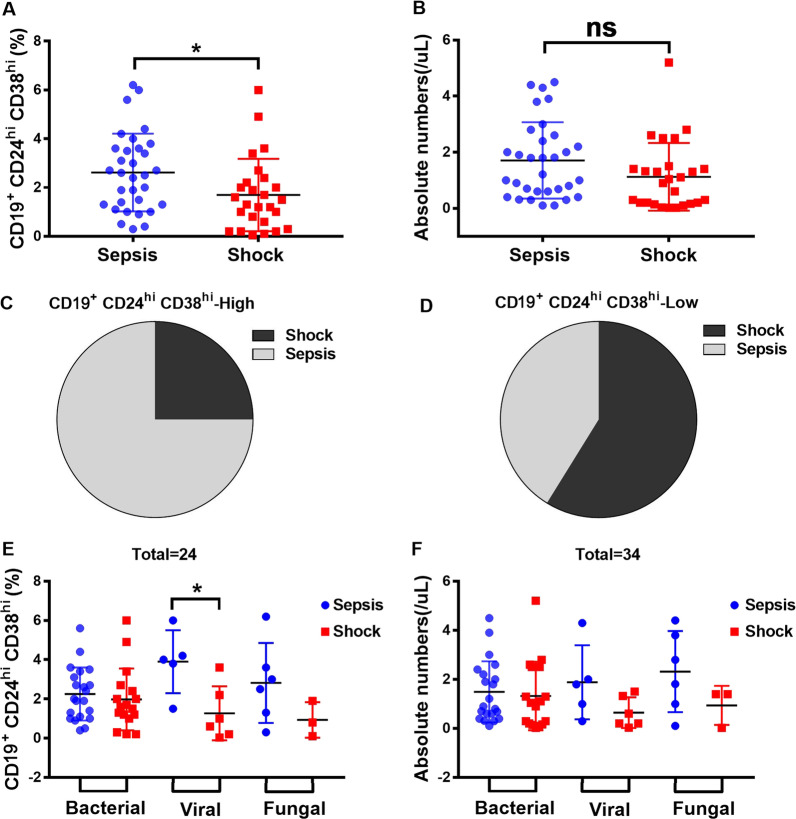
Sepsis patients had decreased proportions and number of Bregs. Sepsis patients with low frequency of Bregs were associated with an increased risk of septic shock. Bregs frequency is inversely associated with lactate, SOFA, and APACHE II and positively correlated with Tregs frequency. Low levels of Bregs closely correlated with septic outcomes. Numbers of Bregs were prediction factors for poor prognosis.
Frequency and number of Bregs decreased, and Bregs deficiency revealed poor prognosis in patients with sepsis.
脓毒症仍然是重症监护医学中的一个主要挑战,脓毒性休克患者的死亡率仍然居高不下。由于目前对脓毒症患者的人 CD19CD24CD38 Breg 细胞(Bregs)研究存在局限性,因此,我们试图评估 Bregs 在脓毒症患者严重程度和预后价值中的作用。
使用流式细胞术分析 58 例脓毒症患者和 22 例健康对照者的外周血,以评估 Bregs 的频率和数量。所有病例在 28 天后分为非存活组或存活组。采用 Spearman 相关分析评估 Bregs 频率与临床指标之间的相关性。采用受试者工作特征曲线分析评估 Bregs 对脓毒症结局的敏感性和特异性。生存曲线分析和二元逻辑回归用于评估 Bregs 在脓毒症患者预后中的价值。
脓毒症患者 Bregs 的比例和数量减少。Bregs 频率低的脓毒症患者发生脓毒性休克的风险增加。Bregs 频率与乳酸、SOFA 和 APACHE II 呈负相关,与 Tregs 频率呈正相关。Bregs 水平低与脓毒症结局密切相关。Bregs 的数量是预后不良的预测因素。
Bregs 的频率和数量减少,Bregs 缺乏表明脓毒症患者预后不良。