Division of Infection and Immunity, Cardiff University School of Medicine, Cardiff CF14 4XN, U.K.
Clin Sci (Lond). 2024 Jan 10;138(1):65-85. doi: 10.1042/CS20230517.
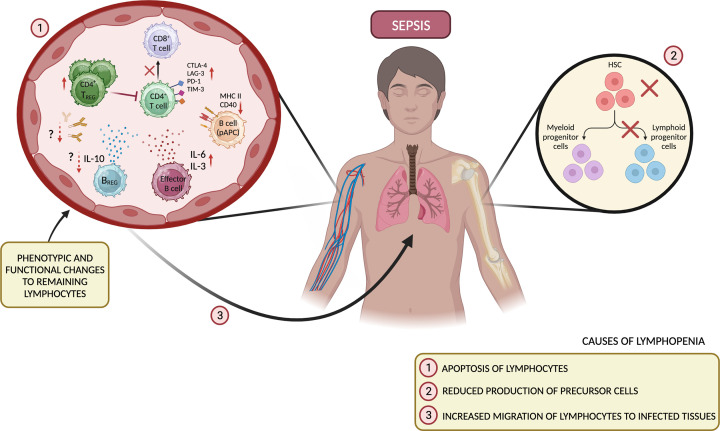
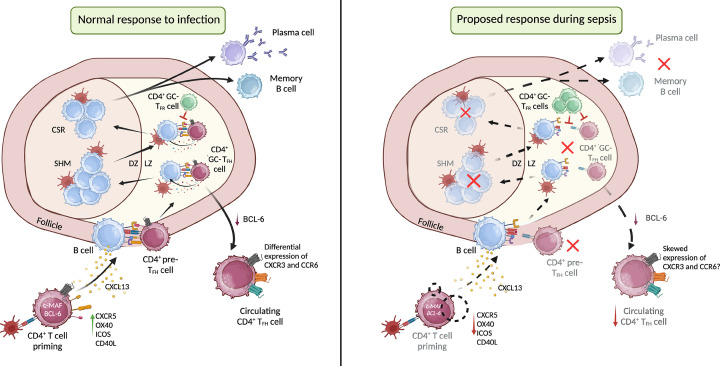
Sepsis is a heterogeneous condition defined as life-threatening organ dysfunction caused by a dysregulated host response to infection. For some, sepsis presents as a predominantly suppressive disorder, whilst others experience a pro-inflammatory condition which can culminate in a 'cytokine storm'. Frequently, patients experience signs of concurrent hyper-inflammation and immunosuppression, underpinning the difficulty in directing effective treatment. Although intensive care unit mortality rates have improved in recent years, one-third of discharged patients die within the following year. Half of post-sepsis deaths are due to exacerbation of pre-existing conditions, whilst half are due to complications arising from a deteriorated immune system. It has been suggested that the intense and dysregulated response to infection may induce irreversible metabolic reprogramming in immune cells. As a critical arm of immune protection in vertebrates, alterations to the adaptive immune system can have devastating repercussions. Indeed, a marked depletion of lymphocytes is observed in sepsis, correlating with increased rates of mortality. Such sepsis-induced lymphopenia has profound consequences on how T cells respond to infection but equally on the humoral immune response that is both elicited by B cells and supported by distinct CD4+ T follicular helper (TFH) cell subsets. The immunosuppressive state is further exacerbated by functional impairments to the remaining lymphocyte population, including the presence of cells expressing dysfunctional or exhausted phenotypes. This review will specifically focus on how sepsis destabilises the adaptive immune system, with a closer examination on how B cells and CD4+ TFH cells are affected by sepsis and the corresponding impact on humoral immunity.
脓毒症是一种异质性疾病,定义为感染引起的宿主反应失调导致的危及生命的器官功能障碍。对于一些患者,脓毒症表现为主要抑制性疾病,而其他患者则经历促炎状态,最终可能导致“细胞因子风暴”。经常,患者表现出同时存在的过度炎症和免疫抑制迹象,这突显了有效治疗的困难。尽管近年来重症监护病房的死亡率有所改善,但三分之一出院的患者在接下来的一年内死亡。一半的脓毒症后死亡是由于原有疾病恶化,而另一半是由于免疫系统恶化引起的并发症。有人认为,对感染的强烈和失调反应可能会导致免疫细胞发生不可逆转的代谢重编程。作为脊椎动物免疫保护的关键组成部分,适应性免疫系统的改变可能会产生毁灭性的影响。事实上,在脓毒症中观察到淋巴细胞明显耗竭,与死亡率增加相关。这种脓毒症诱导的淋巴细胞减少症对 T 细胞如何对感染作出反应具有深远的影响,但对 B 细胞引发和支持独特的 CD4+滤泡辅助性 T(TFH)细胞亚群的体液免疫反应同样具有深远的影响。剩余淋巴细胞群体的功能障碍进一步加剧了免疫抑制状态,包括存在表达功能失调或耗竭表型的细胞。本综述将专门讨论脓毒症如何使适应性免疫系统不稳定,并更仔细地研究 B 细胞和 CD4+ TFH 细胞如何受到脓毒症的影响以及对体液免疫的相应影响。