Okanishi Hiroki, Ohgaki Ryuichi, Xu Minhui, Endou Hitoshi, Kanai Yoshikatsu
Department of Bio-system Pharmacology, Graduate School of Medicine, Osaka University, Osaka, Japan.
Integrated Frontier Research for Medical Science Division, Institute for Open and Transdisciplinary Research Initiatives (OTRI), Osaka University, Osaka, Japan.
Cancer Metab. 2022 Nov 10;10(1):18. doi: 10.1186/s40170-022-00295-8.
Cancer-upregulated L-type amino acid transporter 1 (LAT1; SLC7A5) supplies essential amino acids to cancer cells. LAT1 substrates are not only needed for cancer rapid growth, but involved in cellular signaling. LAT1 has been proposed as a potential target for cancer treatment-its inhibitor, JPH203, is currently in clinical trials and targets biliary tract cancer (BTC). Here, we revealed to what extent LAT1 inhibitor affects intracellular amino acid content and what kind of cellular signals are directly triggered by LAT1 inhibition.
Liquid chromatography assay combined with o-phthalaldehyde- and 9-fluorenyl-methylchloroformate-based derivatization revealed changes in intracellular amino acid levels induced by LAT1 inhibition with JPH203 treatment in three BTC cell lines. Tandem mass tag-based quantitative phosphoproteomics characterized the effect of JPH203 treatment on BTC cells, and suggested key regulators in LAT1-inhibited cells. We further studied one of the key regulators, CK2 protein kinase, by using Western blot, enzymatic activity assay, and co-immunoprecipitation. We evaluated anticancer effects of combination of JPH203 with CK2 inhibitor using cell growth and would healing assay.
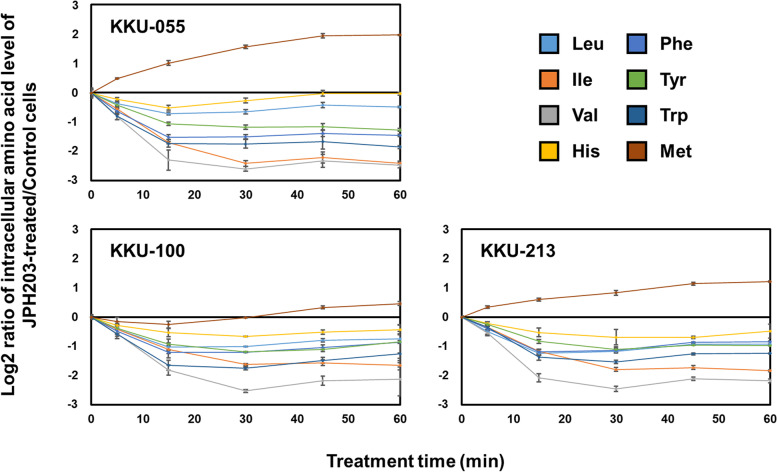
JPH203 treatment decreased intracellular levels of LAT1 substrates including essential amino acids of three BTC cell lines, immediately and drastically. We also found levels of some of these amino acids were partially recovered after longer-time treatment. Therefore, we performed phosphoproteomics with short-time JPH203 treatment prior to the cellular compensatory response, and revealed hundreds of differentially phosphorylated sites. Commonly downregulated phosphorylation sites were found on proteins involved in the cell cycle and RNA splicing. Our phosphoproteomics also suggested key regulators immediately responding to LAT1 inhibition. Focusing on one of these regulators, protein kinase CK2, we revealed LAT1 inhibition decreased phosphorylation of CK2 substrate without changing CK2 enzymatic activity. Furthermore, LAT1 inhibition abolished interaction between CK2 and its regulatory protein NOLC1, which suggests regulatory mechanism of CK2 substrate protein specificity controlled by LAT1 inhibition. Moreover, we revealed that the combination of JPH203 with CK2 inhibitor resulted in the enhanced inhibition of proliferation and migration of BTC cells.
This study provides new perspectives on LAT1-dependent cellular processes and a rationale for therapeutics targeting reprogrammed cancer metabolism.
癌症上调的L型氨基酸转运体1(LAT1;SLC7A5)为癌细胞提供必需氨基酸。LAT1底物不仅是癌症快速生长所必需的,还参与细胞信号传导。LAT1已被提议作为癌症治疗的潜在靶点——其抑制剂JPH203目前正在进行临床试验,靶向胆管癌(BTC)。在此,我们揭示了LAT1抑制剂在多大程度上影响细胞内氨基酸含量,以及LAT1抑制直接触发了何种细胞信号。
液相色谱分析结合基于邻苯二甲醛和9-芴基甲基氯甲酸酯的衍生化方法,揭示了用JPH203处理抑制LAT1后,三种BTC细胞系中细胞内氨基酸水平的变化。基于串联质谱标签的定量磷酸化蛋白质组学表征了JPH203处理对BTC细胞的影响,并提出了LAT1抑制细胞中的关键调节因子。我们通过蛋白质印迹、酶活性测定和免疫共沉淀进一步研究了其中一个关键调节因子CK2蛋白激酶。我们使用细胞生长和伤口愈合试验评估了JPH203与CK2抑制剂联合使用的抗癌效果。
JPH203处理立即且显著降低了三种BTC细胞系中包括必需氨基酸在内的LAT1底物的细胞内水平。我们还发现,经过较长时间处理后,其中一些氨基酸的水平部分恢复。因此,我们在细胞代偿反应之前用短时间的JPH203处理进行了磷酸化蛋白质组学分析,揭示了数百个差异磷酸化位点。在参与细胞周期和RNA剪接的蛋白质上发现了共同下调的磷酸化位点。我们的磷酸化蛋白质组学还提出了对LAT1抑制立即做出反应的关键调节因子。聚焦于其中一个调节因子蛋白激酶CK2,我们发现LAT1抑制降低了CK2底物的磷酸化,而不改变CK2的酶活性。此外,LAT1抑制消除了CK2与其调节蛋白NOLC1之间的相互作用,这表明了LAT1抑制控制CK2底物蛋白特异性的调节机制。此外,我们发现JPH203与CK2抑制剂联合使用可增强对BTC细胞增殖和迁移的抑制作用。
本研究为依赖LAT1的细胞过程提供了新的视角,并为靶向重编程癌症代谢的治疗方法提供了理论依据。