Papadopoulos Nicolas, Suelves Nuria, Perrin Florian, Vadukul Devkee M, Vrancx Céline, Constantinescu Stefan N, Kienlen-Campard Pascal
SIGN Unit, de Duve Institute, UCLouvain, 1200 Brussels, Belgium.
Ludwig Institute for Cancer Research Brussels, 1348 Brussels, Belgium.
Biomedicines. 2022 Oct 29;10(11):2753. doi: 10.3390/biomedicines10112753.
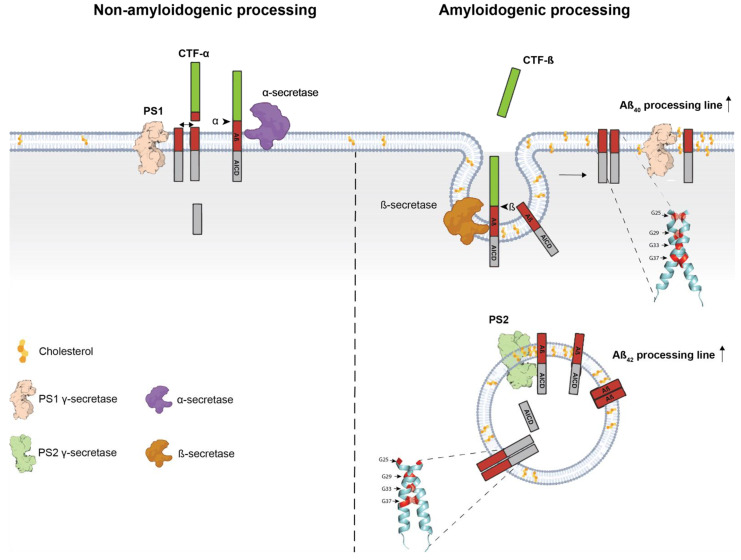
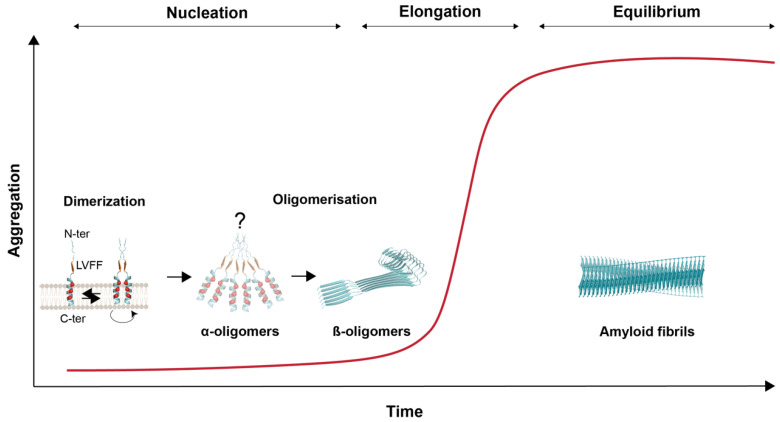
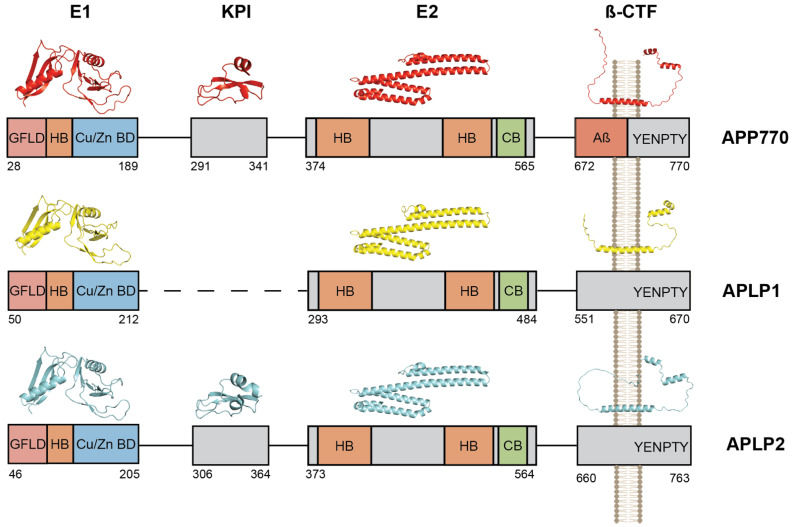
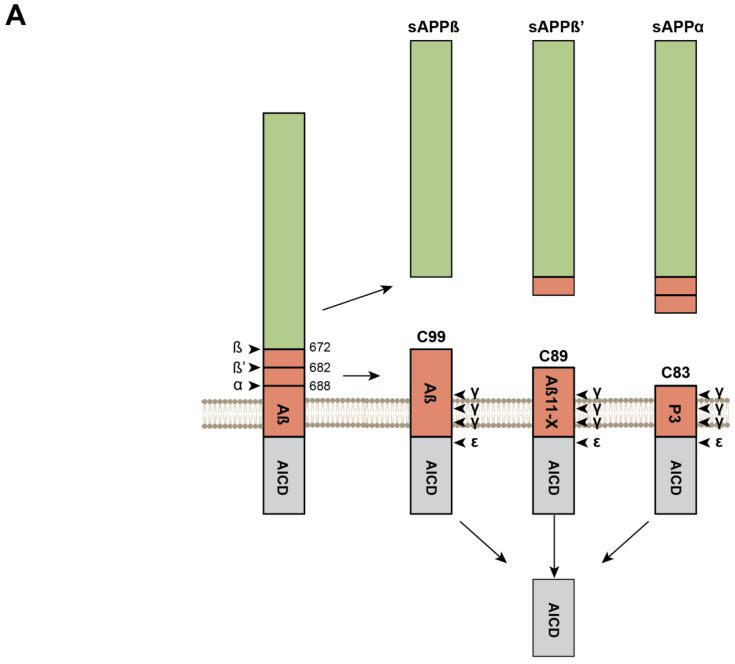
Most neurodegenerative diseases have the characteristics of protein folding disorders, i.e., they cause lesions to appear in vulnerable regions of the nervous system, corresponding to protein aggregates that progressively spread through the neuronal network as the symptoms progress. Alzheimer's disease is one of these diseases. It is characterized by two types of lesions: neurofibrillary tangles (NFTs) composed of tau proteins and senile plaques, formed essentially of amyloid peptides (Aβ). A combination of factors ranging from genetic mutations to age-related changes in the cellular context converge in this disease to accelerate Aβ deposition. Over the last two decades, numerous studies have attempted to elucidate how structural determinants of its precursor () modify Aβ production, and to understand the processes leading to the formation of different Aβ aggregates, e.g., fibrils and oligomers. The synthesis proposed in this review indicates that the same motifs can control function and Aβ production essentially by regulating membrane protein dimerization, and subsequently Aβ aggregation processes. The distinct properties of these motifs and the cellular context regulate the conformation to trigger the transition to the amyloid pathology. This concept is critical to better decipher the patterns switching protein conformation from physiological to pathological and improve our understanding of the mechanisms underpinning the formation of amyloid fibrils that devastate neuronal functions.
大多数神经退行性疾病具有蛋白质折叠紊乱的特征,即它们会导致病变出现在神经系统的脆弱区域,这与随着症状进展而在神经网络中逐渐扩散的蛋白质聚集体相对应。阿尔茨海默病就是这类疾病之一。它的特征是两种类型的病变:由tau蛋白组成的神经原纤维缠结(NFTs)和主要由淀粉样肽(Aβ)形成的老年斑。从基因突变到细胞环境中与年龄相关的变化等多种因素共同作用于这种疾病,加速了Aβ的沉积。在过去二十年中,众多研究试图阐明其前体的结构决定因素如何改变Aβ的产生,并了解导致不同Aβ聚集体(如纤维和寡聚体)形成的过程。本综述中提出的合成表明,相同的基序可以通过调节膜蛋白二聚化,进而调节Aβ聚集过程,来基本控制 功能和Aβ产生。这些基序的独特性质和细胞环境调节 构象,以触发向淀粉样病理的转变。这一概念对于更好地解读 蛋白质构象从生理状态转变为病理状态的模式以及增进我们对破坏神经元功能的淀粉样纤维形成机制的理解至关重要。 (注:原文中存在部分未明确的内容,用括号标注了,翻译时保留原样。)