Nappi Francesco, Fiore Antonio, Masiglat Joyce, Cavuoti Teresa, Romandini Michela, Nappi Pierluigi, Avtaar Singh Sanjeet Singh, Couetil Jean-Paul
Department of Cardiac Surgery, Centre Cardiologique du Nord, 93200 Saint-Denis, France.
Department of Cardiac Surgery, Hôpitaux Universitaires Henri Mondor, Assistance Publique-Hôpitaux de Paris, 94000 Creteil, France.
Biomedicines. 2022 Nov 10;10(11):2884. doi: 10.3390/biomedicines10112884.
The endothelium plays a pivotal role in homeostatic mechanisms. It specifically modulates vascular tone by releasing vasodilatory mediators, which act on the vascular smooth muscle. Large amounts of work have been dedicated towards identifying mediators of vasodilation and vasoconstriction alongside the deleterious effects of reactive oxygen species on the endothelium. We conducted a systematic review to study the role of the factors released by the endothelium and the effects on the vessels alongside its role in atherosclerosis.
A search was conducted with appropriate search terms. Specific attention was offered to the effects of emerging modulators of endothelial functions focusing the analysis on studies that investigated the role of reactive oxygen species (ROS), perivascular adipose tissue, shear stress, AMP-activated protein kinase, potassium channels, bone morphogenic protein 4, and P2Y2 receptor.
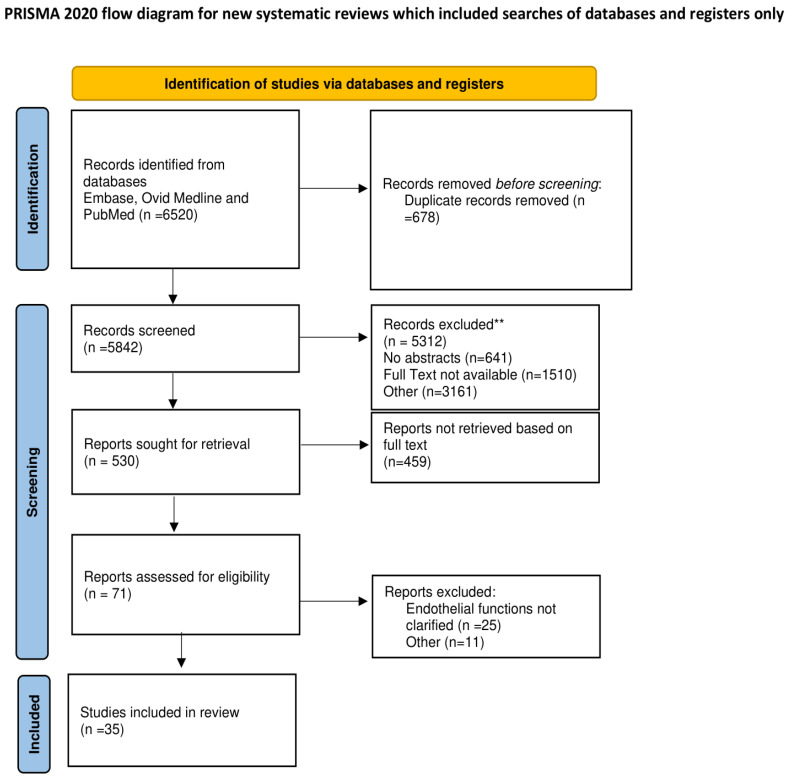
530 citations were reviewed, with 35 studies included in the final systematic review. The endpoints were evaluated in these studies which offered an extensive discussion on emerging modulators of endothelial functions. Specific factors such as reactive oxygen species had deleterious effects, especially in the obese and elderly. Another important finding included the shear stress-induced endothelial nitric oxide (NO), which may delay development of atherosclerosis. Perivascular Adipose Tissue (PVAT) also contributes to reparative measures against atherosclerosis, although this may turn pathological in obese subjects. Some of these factors may be targets for pharmaceutical agents in the near future.
The complex role and function of the endothelium is vital for regular homeostasis. Dysregulation may drive atherogenesis; thus, efforts should be placed at considering therapeutic options by targeting some of the factors noted.
内皮细胞在稳态机制中起关键作用。它通过释放作用于血管平滑肌的血管舒张介质来特异性调节血管张力。大量研究致力于确定血管舒张和收缩的介质以及活性氧对内皮细胞的有害影响。我们进行了一项系统评价,以研究内皮细胞释放的因子的作用、对血管的影响及其在动脉粥样硬化中的作用。
使用适当的检索词进行检索。特别关注内皮功能新兴调节因子的作用,将分析重点放在研究活性氧(ROS)、血管周围脂肪组织、剪切应力、AMP激活的蛋白激酶、钾通道、骨形态发生蛋白4和P2Y2受体作用的研究上。
共检索到530篇文献,最终系统评价纳入35项研究。在这些研究中对终点进行了评估,这些研究对内皮功能的新兴调节因子进行了广泛讨论。活性氧等特定因素具有有害作用,尤其是在肥胖和老年人中。另一个重要发现是剪切应力诱导的内皮一氧化氮(NO),它可能会延缓动脉粥样硬化的发展。血管周围脂肪组织(PVAT)也有助于对抗动脉粥样硬化的修复措施,尽管在肥胖个体中这可能会转变为病理性的。其中一些因素可能在不久的将来成为药物治疗的靶点。
内皮细胞复杂的作用和功能对维持正常的内环境稳定至关重要。失调可能会驱动动脉粥样硬化的发生;因此,应努力考虑通过针对上述某些因素来选择治疗方案。