Department of Periodontology and Endodontology, Institute of Biomedical Sciences, Tokushima University Graduate School, Tokushima 770-8504, Japan.
Cells. 2022 Oct 24;11(21):3345. doi: 10.3390/cells11213345.
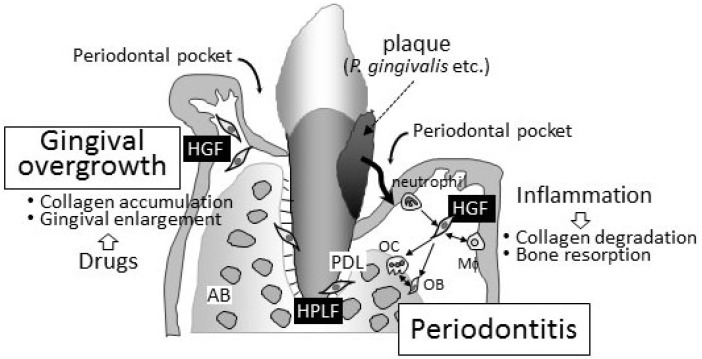
Periodontal diseases include periodontitis and gingival overgrowth. Periodontitis is a bacterial infectious disease, and its pathological cascade is regulated by many inflammatory cytokines secreted by immune or tissue cells, such as interleukin-6. In contrast, gingival overgrowth develops as a side effect of specific drugs, such as immunosuppressants, anticonvulsants, and calcium channel blockers. Human gingival fibroblasts (HGFs) are the most abundant cells in gingival connective tissue, and human periodontal ligament fibroblasts (HPLFs) are located between the teeth and alveolar bone. HGFs and HPLFs are both crucial for the remodeling and homeostasis of periodontal tissue, and their roles in the pathogenesis of periodontal diseases have been examined for 25 years. Various responses by HGFs or HPLFs contribute to the progression of periodontal diseases. This review summarizes the biological effects of HGFs and HPLFs on the pathogenesis of periodontal diseases.
牙周病包括牙周炎和牙龈增生。牙周炎是一种细菌性传染病,其病理级联反应受免疫或组织细胞分泌的多种炎症细胞因子调节,如白细胞介素-6。相比之下,牙龈增生是某些药物的副作用,如免疫抑制剂、抗惊厥药和钙通道阻滞剂。人牙龈成纤维细胞(HGFs)是牙龈结缔组织中最丰富的细胞,人牙周韧带成纤维细胞(HPLFs)位于牙齿和牙槽骨之间。HGFs 和 HPLFs 对于牙周组织的重塑和稳态都至关重要,它们在牙周病发病机制中的作用已经研究了 25 年。HGFs 或 HPLFs 的各种反应有助于牙周病的进展。本综述总结了 HGFs 和 HPLFs 对牙周病发病机制的生物学影响。