• 文献检索
  • 文档翻译
  • 深度研究
  • 学术资讯
  • Suppr Zotero 插件Zotero 插件
  • 邀请有礼
  • 套餐&价格
  • 历史记录
应用&插件
Suppr Zotero 插件Zotero 插件浏览器插件Mac 客户端Windows 客户端微信小程序
定价
高级版会员购买积分包购买API积分包
服务
文献检索文档翻译深度研究API 文档MCP 服务
关于我们
关于 Suppr公司介绍联系我们用户协议隐私条款
关注我们

Suppr 超能文献

核心技术专利:CN118964589B侵权必究
粤ICP备2023148730 号-1Suppr @ 2026

文献检索

告别复杂PubMed语法,用中文像聊天一样搜索,搜遍4000万医学文献。AI智能推荐,让科研检索更轻松。

立即免费搜索

文件翻译

保留排版,准确专业,支持PDF/Word/PPT等文件格式,支持 12+语言互译。

免费翻译文档

深度研究

AI帮你快速写综述,25分钟生成高质量综述,智能提取关键信息,辅助科研写作。

立即免费体验

应用于 COVID-19 神经系统症状的不良结局途径框架。

The Adverse Outcome Pathway Framework Applied to Neurological Symptoms of COVID-19.

机构信息

National Toxicology Program Interagency Center for the Evaluation of Alternative Toxicological Methods, National Institute of Environmental Health Sciences, National Institutes of Health, Research Triangle Park, NC 27518, USA.

Johns Hopkins University, Baltimore, MD 21205, USA.

出版信息

Cells. 2022 Oct 28;11(21):3411. doi: 10.3390/cells11213411.

DOI:10.3390/cells11213411
PMID:36359807
原文链接:https://pmc.ncbi.nlm.nih.gov/articles/PMC9658029/
Abstract

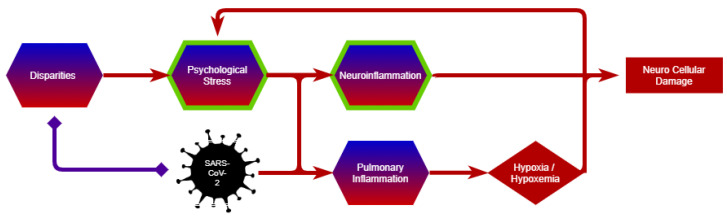
Several reports have shown that the severe acute respiratory syndrome coronavirus 2 (SARS-CoV-2) has the potential to also be neurotropic. However, the mechanisms by which SARS-CoV-2 induces neurologic injury, including neurological and/or psychological symptoms, remain unclear. In this review, the available knowledge on the neurobiological mechanisms underlying COVID-19 was organized using the AOP framework. Four AOPs leading to neurological adverse outcomes (AO), anosmia, encephalitis, stroke, and seizure, were developed. Biological key events (KEs) identified to induce these AOs included binding to ACE2, blood-brain barrier (BBB) disruption, hypoxia, neuroinflammation, and oxidative stress. The modularity of AOPs allows the construction of AOP networks to visualize core pathways and recognize neuroinflammation and BBB disruption as shared mechanisms. Furthermore, the impact on the neurological AOPs of COVID-19 by modulating and multiscale factors such as age, psychological stress, nutrition, poverty, and food insecurity was discussed. Organizing the existing knowledge along an AOP framework can represent a valuable tool to understand disease mechanisms and identify data gaps and potentially contribute to treatment, and prevention. This AOP-aligned approach also facilitates synergy between experts from different backgrounds, while the fast-evolving and disruptive nature of COVID-19 emphasizes the need for interdisciplinarity and cross-community research.

摘要

已有多项报告表明,严重急性呼吸综合征冠状病毒 2(SARS-CoV-2)也具有神经嗜性。然而,SARS-CoV-2 引发神经损伤(包括神经系统和/或心理症状)的机制仍不清楚。在本综述中,使用 AOP 框架对与 COVID-19 相关的神经生物学机制的现有知识进行了组织。制定了四个导致神经不良结局(AO)、嗅觉丧失、脑炎、中风和癫痫的 AOP。确定可诱发这些 AOs 的生物学关键事件(KEs)包括与 ACE2 的结合、血脑屏障(BBB)破坏、缺氧、神经炎症和氧化应激。AOP 的模块化允许构建 AOP 网络,以可视化核心途径,并将神经炎症和 BBB 破坏视为共享机制。此外,还讨论了调节和多尺度因素(如年龄、心理压力、营养、贫困和粮食不安全)对 COVID-19 神经 AOP 的影响。沿着 AOP 框架组织现有知识可以代表一种理解疾病机制和识别数据空白的有价值工具,并可能有助于治疗和预防。这种与 AOP 一致的方法还促进了来自不同背景的专家之间的协同作用,而 COVID-19 的快速发展和颠覆性性质强调了跨学科和跨社区研究的必要性。

https://cdn.ncbi.nlm.nih.gov/pmc/blobs/dcc2/9658029/4dc50de2cf3b/cells-11-03411-g002.jpg
https://cdn.ncbi.nlm.nih.gov/pmc/blobs/dcc2/9658029/f1930e02c8d1/cells-11-03411-g001.jpg
https://cdn.ncbi.nlm.nih.gov/pmc/blobs/dcc2/9658029/4dc50de2cf3b/cells-11-03411-g002.jpg
https://cdn.ncbi.nlm.nih.gov/pmc/blobs/dcc2/9658029/f1930e02c8d1/cells-11-03411-g001.jpg
https://cdn.ncbi.nlm.nih.gov/pmc/blobs/dcc2/9658029/4dc50de2cf3b/cells-11-03411-g002.jpg

相似文献

1
The Adverse Outcome Pathway Framework Applied to Neurological Symptoms of COVID-19.应用于 COVID-19 神经系统症状的不良结局途径框架。
Cells. 2022 Oct 28;11(21):3411. doi: 10.3390/cells11213411.
2
COVID-19 through Adverse Outcome Pathways: Building networks to better understand the disease - 3rd CIAO AOP Design Workshop.COVID-19 通过不良结局途径:构建网络以更好地了解疾病 - 第三届 CIAO AOP 设计研讨会。
ALTEX. 2022;39(2):322–335. doi: 10.14573/altex.2112161. Epub 2022 Jan 3.
3
Mechanistic Understanding of the Olfactory Neuroepithelium Involvement Leading to Short-Term Anosmia in COVID-19 Using the Adverse Outcome Pathway Framework.利用不良结局路径框架理解 COVID-19 导致短期嗅觉丧失的嗅神经上皮参与的机制。
Cells. 2022 Sep 27;11(19):3027. doi: 10.3390/cells11193027.
4
Understanding COVID-19 through adverse outcome pathways - 2nd CIAO AOP Design Workshop.通过不良结局途径理解 COVID-19-第二届 CIAO AOP 设计研讨会。
ALTEX. 2021;38(2):351-357. doi: 10.14573/altex.2102221. Epub 2021 Mar 5.
5
A systematic scoping review of the neurological effects of COVID-19.一项关于 COVID-19 对神经系统影响的系统范围综述。
Neurotoxicology. 2024 Jul;103:16-26. doi: 10.1016/j.neuro.2024.05.003. Epub 2024 May 18.
6
Neurological Sequelae of COVID-19.新型冠状病毒肺炎的神经系统后遗症。
J Integr Neurosci. 2022 Apr 6;21(3):77. doi: 10.31083/j.jin2103077.
7
Beyond chemicals: Opportunities and challenges of integrating non-chemical stressors in adverse outcome pathways.超越化学物质:整合非化学应激物于不良结局途径的机遇与挑战。
ALTEX. 2024;41(2):233-247. doi: 10.14573/altex.2307061. Epub 2023 Nov 17.
8
Systematic Organization of COVID-19 Data Supported by the Adverse Outcome Pathway Framework.基于不良结局途径框架的 COVID-19 数据的系统组织。
Front Public Health. 2021 May 19;9:638605. doi: 10.3389/fpubh.2021.638605. eCollection 2021.
9
Understanding the neurotropic characteristics of SARS-CoV-2: from neurological manifestations of COVID-19 to potential neurotropic mechanisms.了解 SARS-CoV-2 的神经嗜性特征:从 COVID-19 的神经系统表现到潜在的神经嗜性机制。
J Neurol. 2020 Aug;267(8):2179-2184. doi: 10.1007/s00415-020-09929-7. Epub 2020 May 26.
10
Developing adverse outcome pathways on silver nanoparticle-induced reproductive toxicity via oxidative stress in the nematode Caenorhabditis elegans using a Bayesian network model.利用贝叶斯网络模型研究线虫中氧化应激介导的银纳米颗粒诱导生殖毒性的不良结局途径。
Nanotoxicology. 2018 Dec;12(10):1182-1197. doi: 10.1080/17435390.2018.1529835. Epub 2019 Jan 21.

引用本文的文献

1
Building an Adverse Outcome Pathway network for COVID-19.构建2019冠状病毒病的不良结局途径网络。
Front Syst Biol. 2024 Jun 6;4:1384481. doi: 10.3389/fsysb.2024.1384481.
2
A systematic scoping review of the neurological effects of COVID-19.一项关于 COVID-19 对神经系统影响的系统范围综述。
Neurotoxicology. 2024 Jul;103:16-26. doi: 10.1016/j.neuro.2024.05.003. Epub 2024 May 18.
3
CIAO: a living experiment in interdisciplinary large-scale collaboration facilitated by the Adverse Outcome Pathway framework.CIAO:通过不良反应途径框架促进的跨学科大规模合作的活体实验。

本文引用的文献

1
Mechanistic Understanding of the Olfactory Neuroepithelium Involvement Leading to Short-Term Anosmia in COVID-19 Using the Adverse Outcome Pathway Framework.利用不良结局路径框架理解 COVID-19 导致短期嗅觉丧失的嗅神经上皮参与的机制。
Cells. 2022 Sep 27;11(19):3027. doi: 10.3390/cells11193027.
2
Factors Modulating COVID-19: A Mechanistic Understanding Based on the Adverse Outcome Pathway Framework.调节2019冠状病毒病的因素:基于不良结局途径框架的机制理解
J Clin Med. 2022 Jul 31;11(15):4464. doi: 10.3390/jcm11154464.
3
COVID-19 and olfactory dysfunction: a looming wave of dementia?
Front Public Health. 2023 Aug 10;11:1212544. doi: 10.3389/fpubh.2023.1212544. eCollection 2023.
4
Oxidative stress and COVID-19-associated neuronal dysfunction: mechanisms and therapeutic implications.氧化应激与 COVID-19 相关神经元功能障碍:机制与治疗意义。
Acta Biochim Biophys Sin (Shanghai). 2023 Jun 25;55(8):1153-1167. doi: 10.3724/abbs.2023085.
5
Influence of SARS-CoV-2 on Adult Human Neurogenesis.新冠病毒对成人神经发生的影响。
Cells. 2023 Jan 6;12(2):244. doi: 10.3390/cells12020244.
COVID-19 与嗅觉功能障碍:即将到来的痴呆浪潮?
J Neurophysiol. 2022 Aug 1;128(2):436-444. doi: 10.1152/jn.00255.2022. Epub 2022 Jul 27.
4
Neurobiological Links between Stress, Brain Injury, and Disease.神经生物学中应激、脑损伤和疾病之间的关联。
Oxid Med Cell Longev. 2022 May 25;2022:8111022. doi: 10.1155/2022/8111022. eCollection 2022.
5
Neurological Sequelae of COVID-19.新型冠状病毒肺炎的神经系统后遗症。
J Integr Neurosci. 2022 Apr 6;21(3):77. doi: 10.31083/j.jin2103077.
6
Long COVID Citizen Scientists: Developing a Needs-Based Research Agenda by Persons Affected by Long COVID.长新冠公民科学家:受长新冠影响人群制定基于需求的研究议程。
Patient. 2022 Sep;15(5):565-576. doi: 10.1007/s40271-022-00579-7. Epub 2022 Apr 28.
7
Stress-Related Disorders of Family Members of Patients Admitted to the Intensive Care Unit With COVID-19.COVID-19 患者重症监护病房家属的应激相关障碍。
JAMA Intern Med. 2022 Jun 1;182(6):624-633. doi: 10.1001/jamainternmed.2022.1118.
8
Persistent COVID-19 symptoms in a community study of 606,434 people in England.英格兰一项针对 606434 人的社区研究显示,新冠病毒感染康复者仍有长期症状。
Nat Commun. 2022 Apr 12;13(1):1957. doi: 10.1038/s41467-022-29521-z.
9
FcγR-mediated SARS-CoV-2 infection of monocytes activates inflammation.FcγR 介导的 SARS-CoV-2 感染单核细胞激活炎症反应。
Nature. 2022 Jun;606(7914):576-584. doi: 10.1038/s41586-022-04702-4. Epub 2022 Apr 6.
10
SARS-CoV-2 is associated with changes in brain structure in UK Biobank.在英国生物银行中,严重急性呼吸综合征冠状病毒2(SARS-CoV-2)与大脑结构变化有关。
Nature. 2022 Apr;604(7907):697-707. doi: 10.1038/s41586-022-04569-5. Epub 2022 Mar 7.