Jiménez-Rodríguez Tamara, De la Barrera Usue, Schoeps Konstanze, Valero-Moreno Selene, Montoya-Castilla Inmaculada
Department Personality, Assessment and Psychological Treatments, Faculty of Psychology and Speech Therapy, Universitat de Valencia, Blasco Ibáñez, 21, 46010 Valencia, Spain.
Department Developmental and Educational Psychology, Faculty of Psychology and Speech Therapy, Universitat de Valencia, Blasco Ibáñez, 21, 46010 Valencia, Spain.
Children (Basel). 2022 Nov 8;9(11):1711. doi: 10.3390/children9111711.
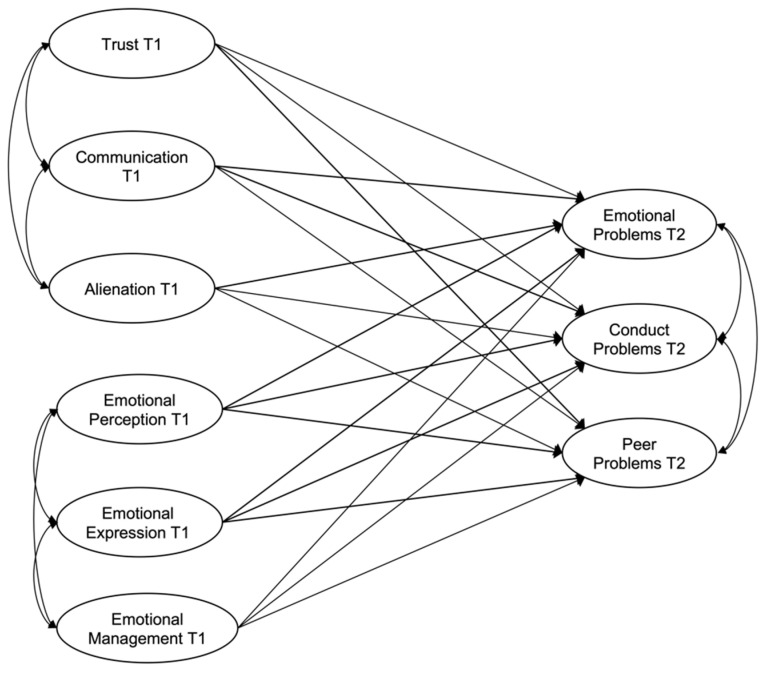
Emotional competencies as well as secure attachment relationships with peers are protective factors that facilitate psychological adjustment among adolescents. In this study, we will analyse how these socio-emotional factors influence adolescents' emotional symptoms, conduct problems and peer problems. The participants were 815 Spanish adolescents aged 12-17 years ( = 13.69; = 1.21) who completed the Strengths and Difficulties Questionnaire (SDQ), the Parent and Peer Attachment Inventory (IPPA) and the Emotional Skills and Competence Questionnaire (ESCQ). Besides descriptive analyses, such as Pearson's bivariate correlations, two different methodologies were combined to predict adolescent adjustment: structural equation modelling (SEM) and fuzzy set qualitative comparative analysis (fsQCA). The results show that secure attachment with peers and high emotional competence predict better psychological adjustment (low levels of emotional symptoms, conduct problems and peer problems), while insecure peer attachment and low emotional competence predict maladjustment. These results emphasise the role of socio-emotional variables in the promotion of psychological adjustment in adolescence through the implementation of emotional education programs.
情绪能力以及与同伴的安全依恋关系是促进青少年心理调适的保护因素。在本研究中,我们将分析这些社会情感因素如何影响青少年的情绪症状、行为问题和同伴问题。参与者为815名年龄在12至17岁之间的西班牙青少年(平均年龄=13.69岁;标准差=1.21),他们完成了优势与困难问卷(SDQ)、亲子与同伴依恋量表(IPPA)以及情绪技能与能力问卷(ESCQ)。除了描述性分析,如皮尔逊双变量相关性分析外,还结合了两种不同的方法来预测青少年的调适情况:结构方程模型(SEM)和模糊集定性比较分析(fsQCA)。结果表明,与同伴的安全依恋和高情绪能力预示着更好的心理调适(情绪症状、行为问题和同伴问题水平较低),而不安全的同伴依恋和低情绪能力则预示着调适不良。这些结果强调了社会情感变量在通过实施情绪教育项目促进青少年心理调适方面的作用。