Wanko Keutchafo Esther L, Kerr Jane, Baloyi Olivia B
School of Nursing and Public Health, College of Health Sciences, University of KwaZulu-Natal, Durban 4001, South Africa.
Healthcare (Basel). 2022 Oct 22;10(11):2119. doi: 10.3390/healthcare10112119.
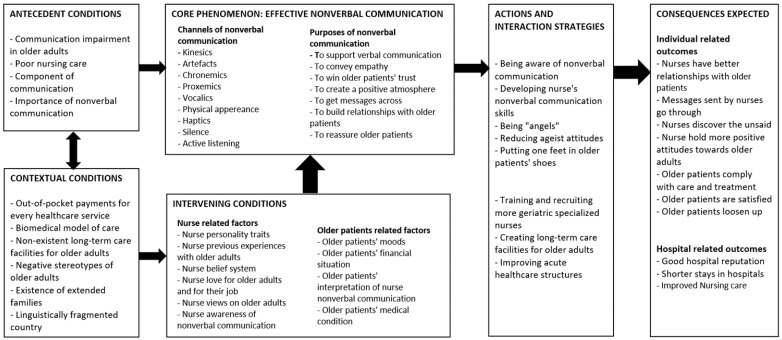
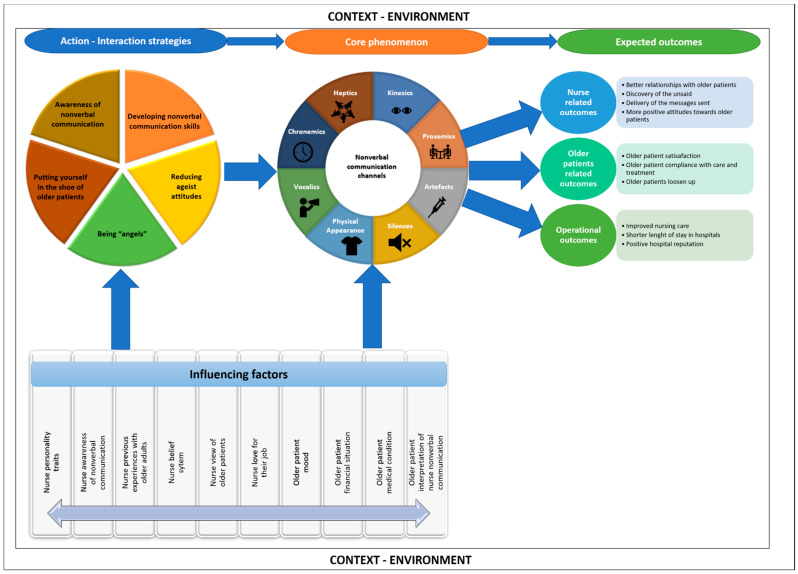
Nonverbal communication is an inevitable art to be effectively mastered by nurses. Nurse nonverbal communication has many benefits when it is effective. For instance, nonverbal communication is important to convey affective and emotional information, and demonstrate respect for and build therapeutic relationships with older patients. As the older population is growing fast worldwide, effective nonverbal communication with older patients is an essential skill for nurses and will improve patients' satisfaction and the quality of care. Therefore, this article presents a model to guide effective nonverbal communication between nurses and older patients. A Grounded Theory approach guided the study. Data were collected between July 2018 and January 2020 through overt participant observations and individual interviews. Purposive and theoretical sampling were used to select 13 clinically experienced nurses, 4 nursing students, and 8 older adults. Data analysis encompassed open coding, axial coding, and selective coding. The results showed that effective nonverbal communication emerged as the co-phenomenon hinged within context and/or environment and is influenced by certain factors. This model, which is in support of person-centered communication and care, advocates for effective nonverbal communication between nurses and older patients.
非语言沟通是护士必须有效掌握的一门艺术。有效的护士非语言沟通有诸多益处。例如,非语言沟通对于传递情感和情绪信息、表达对老年患者的尊重以及建立治疗关系都很重要。由于全球老年人口快速增长,与老年患者进行有效的非语言沟通是护士的一项基本技能,这将提高患者满意度和护理质量。因此,本文提出了一个指导护士与老年患者进行有效非语言沟通的模型。本研究采用扎根理论方法。2018年7月至2020年1月期间,通过公开参与观察和个人访谈收集数据。采用目的抽样和理论抽样选取了13名临床经验丰富的护士、4名护生和8名老年人。数据分析包括开放式编码、轴心式编码和选择性编码。结果表明,有效的非语言沟通是一种在情境和/或环境中相互关联的共同现象,并受到某些因素的影响。该模型支持以患者为中心的沟通和护理,倡导护士与老年患者之间进行有效的非语言沟通。