Neuroscience Center-HiLIFE, Helsinki Institute of Life Science, University of Helsinki, 00014 Helsinki, Finland.
IRD, APHM, MEPHI, IHU Méditerranée Infection, Aix Marseille University, 13005 Marseille, France.
Int J Mol Sci. 2022 Nov 2;23(21):13383. doi: 10.3390/ijms232113383.
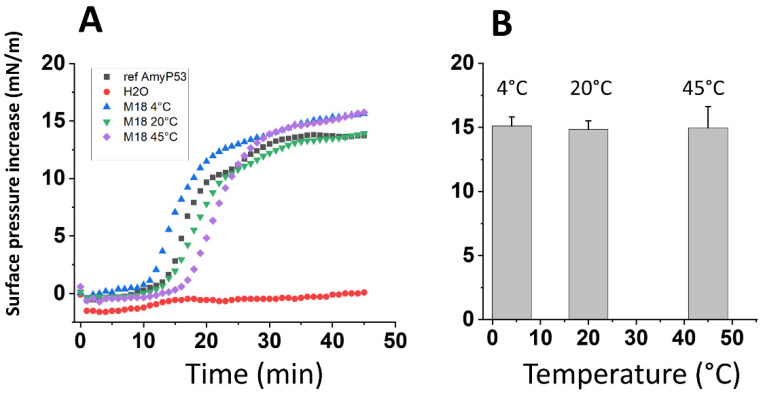
Neurodegenerative disorders are a major public health issue. Despite decades of research efforts, we are still seeking an efficient cure for these pathologies. The initial paradigm of large aggregates of amyloid proteins (amyloid plaques, Lewis bodies) as the root cause of Alzheimer's and Parkinson's diseases has been mostly dismissed. Instead, membrane-bound oligomers forming Ca-permeable amyloid pores are now considered appropriate targets for these diseases. Over the last 20 years, our group deciphered the molecular mechanisms of amyloid pore formation, which appeared to involve a common pathway for all amyloid proteins, including Aβ (Alzheimer) and α-synuclein (Parkinson). We then designed a short peptide (AmyP53), which prevents amyloid pore formation by targeting gangliosides, the plasma membrane receptors of amyloid proteins. Herein, we show that aqueous solutions of AmyP53 are remarkably stable upon storage at temperatures up to 45 °C for several months. AmyP53 appeared to be more stable in whole blood than in plasma. Pharmacokinetics studies in rats demonstrated that the peptide can rapidly and safely reach the brain after intranasal administration. The data suggest both the direct transport of AmyP53 via the olfactory bulb (and/or the trigeminal nerve) and an indirect transport via the circulation and the blood-brain barrier. In vitro experiments confirmed that AmyP53 is as active as cargo peptides in crossing the blood-brain barrier, consistent with its amino acid sequence specificities and physicochemical properties. Overall, these data open a route for the use of a nasal spray formulation of AmyP53 for the prevention and/or treatment of Alzheimer's and Parkinson's diseases in future clinical trials in humans.
神经退行性疾病是一个主要的公共卫生问题。尽管经过了几十年的研究努力,我们仍在寻找这些疾病的有效治疗方法。最初将淀粉样蛋白(淀粉样斑块、路易小体)的大聚集体作为阿尔茨海默病和帕金森病的根本原因的范式已基本被否定。相反,现在认为形成钙通透性的膜结合寡聚物是这些疾病的合适靶点。在过去的 20 年里,我们小组揭示了淀粉样孔形成的分子机制,该机制似乎涉及所有淀粉样蛋白(包括 Aβ(阿尔茨海默病)和α-突触核蛋白(帕金森病))的共同途径。然后,我们设计了一种短肽(AmyP53),通过靶向神经节苷脂(淀粉样蛋白的质膜受体)来阻止淀粉样孔形成。在此,我们表明,AmyP53 的水溶液在高达 45°C 的温度下储存数月后,稳定性显著。AmyP53 在全血中的稳定性似乎高于在血浆中。在大鼠中的药代动力学研究表明,该肽经鼻内给药后可以迅速且安全地到达大脑。数据表明,AmyP53 可以通过嗅球(和/或三叉神经)直接运输,也可以通过循环和血脑屏障间接运输。体外实验证实,AmyP53 与货物肽一样具有穿过血脑屏障的活性,这与其氨基酸序列特异性和物理化学性质一致。总的来说,这些数据为在未来的人类临床试验中使用鼻喷雾剂形式的 AmyP53 预防和/或治疗阿尔茨海默病和帕金森病开辟了一条道路。