School of Biosciences and Veterinary Medicine, University of Camerino, Via Gentile III da Varano, 62032 Camerino, Italy.
Research Unit for Bioactive Natural Products and Biotechnology UR17ES49, Faculty of Dental Medicine of Monastir, University of Monastir, Avicenne Street, Monastir 5000, Tunisia.
Molecules. 2022 Nov 5;27(21):7591. doi: 10.3390/molecules27217591.
Breast cancer is the most diagnosed cancer among women, and its incidence and mortality are rapidly growing worldwide. In this regard, plant-derived natural compounds have been shown to be effective as chemotherapeutic and preventative agents. Apricot kernels are a rich source of nutrients including proteins, lipids, fibers, and phenolic compounds and contain the aromatic cyanogenic glycoside amygdalin that has been shown to exert a cytotoxic effect on cancer cells by affecting the cell cycle, inducing apoptosis, and regulating the immune function.
Here, we describe a previously unexplored proapoptotic mechanism of action of amygdalin in breast cancer (MCF7) cells that involves the modulation of intracellular proteolysis. For comparative purposes, the same investigations were also conducted upon cell treatment with two apricot kernel aqueous extracts from L.
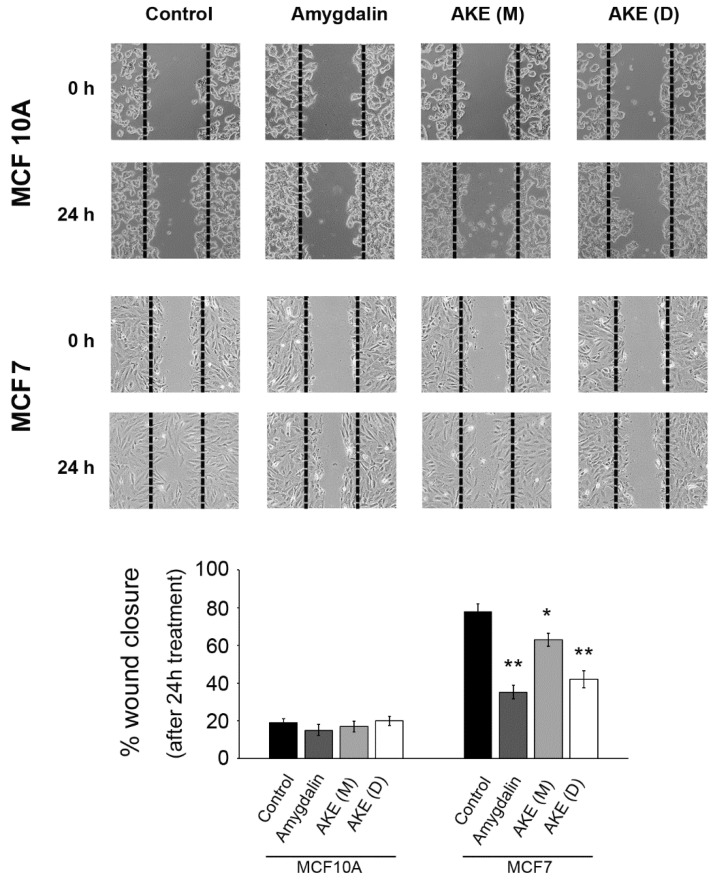
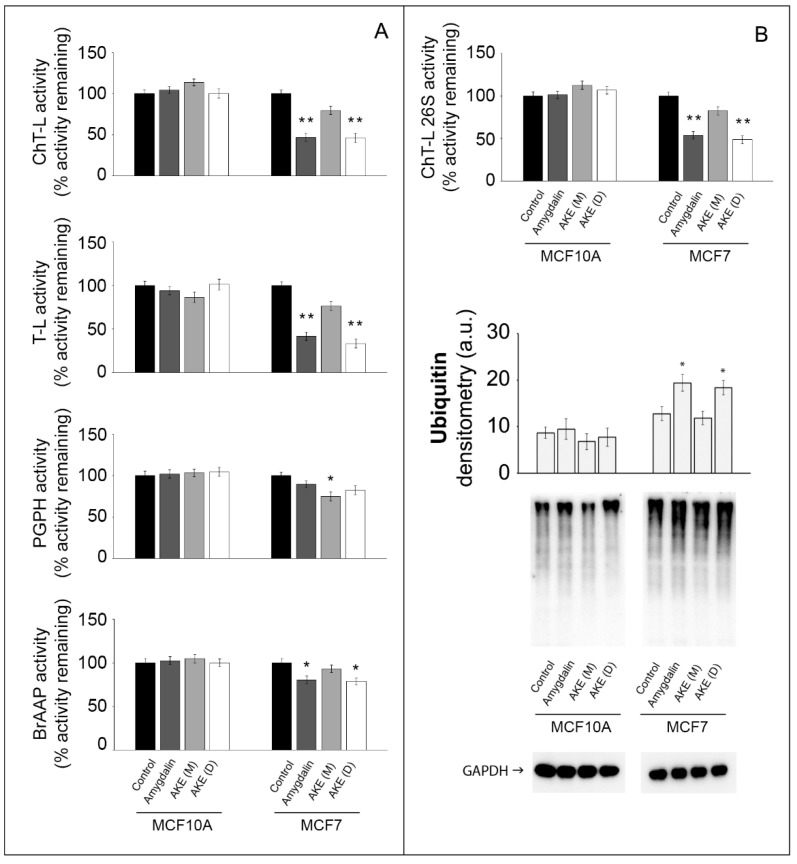
We observed that both the 20S and 26S proteasome activities were downregulated in the MCF7 cells upon 24 h treatments. Simultaneously, the autophagy cascade resulted in being impaired due to cathepsin B and L inhibition that also contributed to a reduction in cancer cell migration. The inhibition of these proteolytic systems finally promoted the activation of apoptotic events in the MCF7 cells.
Collectively, our data unveil a novel mechanism of the anticancer activity of amygdalin, prompting further investigations for potential application in cancer preventative strategies.
乳腺癌是女性最常见的癌症,其发病率和死亡率在全球范围内迅速增长。在这方面,植物来源的天然化合物已被证明是有效的化疗和预防剂。杏仁是一种富含营养的物质,包括蛋白质、脂肪、纤维和酚类化合物,并且含有芳香氰基糖苷苦杏仁苷,它通过影响细胞周期、诱导细胞凋亡和调节免疫功能对癌细胞发挥细胞毒性作用。
在这里,我们描述了苦杏仁苷在乳腺癌(MCF7)细胞中以前未被探索的促凋亡作用机制,该机制涉及细胞内蛋白水解的调节。为了进行比较,我们还对细胞用两种来自 L. 的杏仁核水提取物进行了相同的研究。
我们观察到,在 MCF7 细胞中,24 小时处理后 20S 和 26S 蛋白酶体活性均下调。同时,由于组织蛋白酶 B 和 L 的抑制,自噬级联反应受到损害,这也导致癌细胞迁移减少。这些蛋白水解系统的抑制最终促进了 MCF7 细胞中凋亡事件的激活。
总之,我们的数据揭示了苦杏仁苷抗癌活性的新机制,促使进一步研究其在癌症预防策略中的潜在应用。