School of Basic Medicine, Youjiang Medical University for Nationalities, Baise 533000, China.
Key Laboratory of Protection and Utilization of Biological Resources in Tarim Basin of Xinjiang Production & Construction Corps, College of Life Science and Technology, Tarim University, Alar 843301, China.
Molecules. 2022 Nov 7;27(21):7627. doi: 10.3390/molecules27217627.
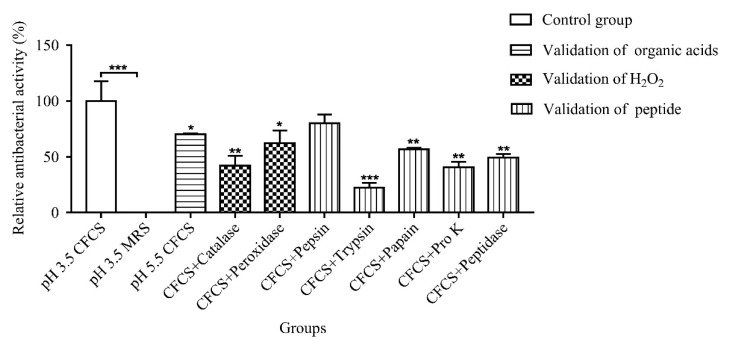
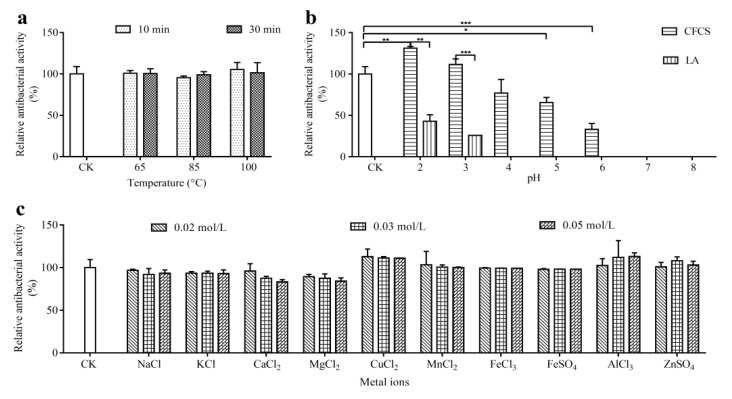
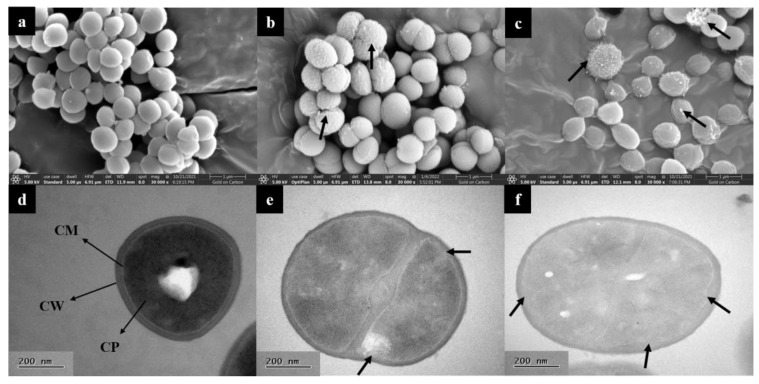
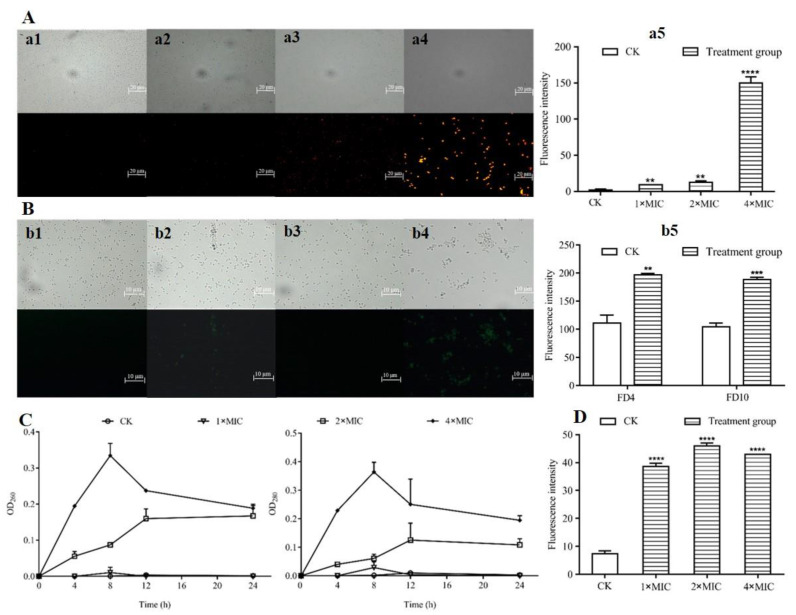
This study sought to analyze the main antibacterial active components of () L-36 cell-free culture supernatants (CFCS) in inhibiting the growth of (), to explore its physicochemical properties and anti-bacterial mechanism. Firstly, the main antibacterial active substance in L-36 CFCS was peptides, which inferred by adjusting pH and enzyme treatment methods. Secondly, the physicochemical properties of the antibacterial active substances in L-36 CFCS were studied from heat, pH, and metal ions, respectively. It demonstrated good antibacterial activity when heated at 65 °C, 85 °C and 100 °C for 10 and 30 min, indicating that it had strong thermal stability. L-36 CFCS had antibacterial activity when the pH value was 2-6, and the antibacterial active substances became stable with the decrease in pH value. After 10 kinds of metal ions were treated, the antibacterial activity did not change significantly, indicating that it was insensitive to metal ions. Finally, scanning electron microscopy, transmission electron microscopy and fluorescence probe were used to reveal the antibacterial mechanism of from the aspects of cell morphology and subcellular structure. The results demonstrated that L-36 CFCS could form 1.4-2.3 nm pores in the cell membrane of , which increased the permeability of the bacterial cell membrane, resulting in the depolarization of cell membrane potential and leakage of nucleic acid protein and other cell contents. Meanwhile, a large number of ROS are produced and accumulated in the cells, causing damage to DNA, and with the increase in L-36 CFCS concentration, the effect is enhanced, and finally leads to the death of . Our study suggests that the main antibacterial active substances of L-36 CFCS are peptides. L-36 CFCS are thermostable, active under acidic conditions, insensitive to metal ions, and exhibit antibacterial effects by damaging cell membranes, DNA and increasing ROS. Using lactic acid bacteria to inhibit provides a theoretical basis for the discovery of new antibacterial substances, and will have great significance in the development of antibiotic substitutes, reducing bacterial resistance and ensuring animal food safety.
本研究旨在分析()L-36 无细胞培养上清液(CFCS)中抑制()生长的主要抗菌活性成分,探讨其理化性质和抗菌机制。首先,通过调整 pH 值和酶处理方法推断 L-36 CFCS 中的主要抗菌活性物质为肽类。其次,分别从热、pH 值和金属离子三个方面研究 L-36 CFCS 中抗菌活性物质的理化性质。实验结果表明,当在 65°C、85°C 和 100°C 加热 10 和 30min 时,其具有良好的抗菌活性,表明其具有较强的热稳定性。L-36 CFCS 在 pH 值为 2-6 时具有抗菌活性,且随着 pH 值的降低,抗菌活性物质变得稳定。经过 10 种金属离子处理后,其抗菌活性没有明显变化,表明其对金属离子不敏感。最后,通过扫描电子显微镜、透射电子显微镜和荧光探针从细胞形态和亚细胞结构方面揭示了 L-36 对 的抗菌机制。结果表明,L-36 CFCS 可在 细胞膜上形成 1.4-2.3nm 的孔,增加了细菌细胞膜的通透性,导致细胞膜电位去极化和核酸、蛋白质等细胞内容物泄漏。同时,细胞内产生并积累大量 ROS,导致 DNA 损伤,随着 L-36 CFCS 浓度的增加,作用增强,最终导致 死亡。本研究表明,L-36 CFCS 的主要抗菌活性物质为肽类。L-36 CFCS 热稳定性好,在酸性条件下活性高,对金属离子不敏感,通过破坏细胞膜、DNA 并增加 ROS 发挥抗菌作用。利用乳酸菌抑制 为发现新的抗菌物质提供了理论依据,对抗生素替代品的开发、降低细菌耐药性和保障动物食品安全具有重要意义。