Department of Electronics and Communication Engineering, Kalasalingam Academy of Research and Education, Krishnankovil 626126, India.
Department of Computer Science and Engineering, Koneru Lakshmaiah Education Foundation, Vaddeswaram 522302, India.
Sensors (Basel). 2022 Nov 3;22(21):8449. doi: 10.3390/s22218449.
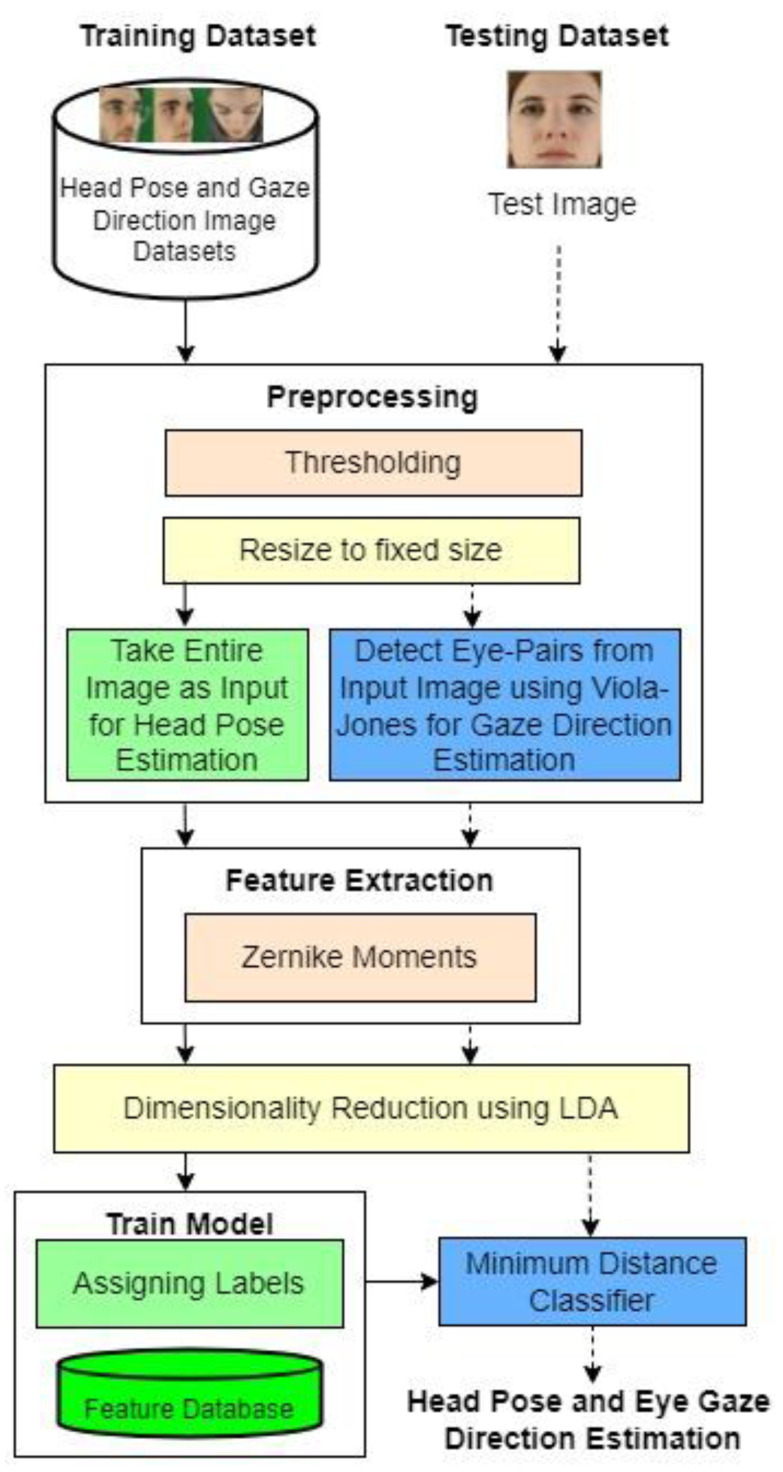
A real-time head pose and gaze estimation (HPGE) algorithm has excellent potential for technological advancements either in human-machine or human-robot interactions. For example, in high-accuracy advent applications such as Driver's Assistance System (DAS), HPGE plays a crucial role in omitting accidents and road hazards. In this paper, the authors propose a new hybrid framework for improved estimation by combining both the appearance and geometric-based conventional methods to extract local and global features. Therefore, the Zernike moments algorithm has been prominent in extracting rotation, scale, and illumination invariant features. Later, conventional discriminant algorithms were used to classify the head poses and gaze direction. Furthermore, the experiments were performed on standard datasets and real-time images to analyze the accuracy of the proposed algorithm. As a result, the proposed framework has immediately estimated the range of direction changes under different illumination conditions. We obtained an accuracy of ~85%; the average response time was 21.52 and 7.483 ms for estimating head poses and gaze, respectively, independent of illumination, background, and occlusion. The proposed method is promising for future developments of a robust system that is invariant even to blurring conditions and thus reaching much more significant performance enhancement.
实时头部姿势和凝视估计(HPGE)算法在人机或人机交互技术方面具有出色的技术进步潜力。例如,在高精度的高级驾驶辅助系统(DAS)等应用中,HPGE 在避免事故和道路危险方面发挥着至关重要的作用。在本文中,作者提出了一种新的混合框架,通过结合基于外观和基于几何的传统方法来提取局部和全局特征,从而提高估计的准确性。因此,Zernike 矩算法在提取旋转、缩放和光照不变特征方面表现出色。然后,使用传统的判别算法对头姿势和凝视方向进行分类。此外,还在标准数据集和实时图像上进行了实验,以分析所提出算法的准确性。结果表明,所提出的框架可以立即估计在不同光照条件下的方向变化范围。我们获得了约 85%的准确率;分别估计头部姿势和凝视的平均响应时间为 21.52ms 和 7.483ms,不受光照、背景和遮挡的影响。该方法有望为开发更稳健的系统提供未来的发展方向,即使在模糊条件下也具有不变性,从而实现更显著的性能提升。