Division of International Health (Public Health), Graduate School of Medical and Dental Sciences, Niigata University, Niigata 951-8510, Japan.
Infectious Diseases Research Center of Niigata University in Myanmar (IDRC), Graduate School of Medical and Dental Sciences, Niigata University, Niigata 951-8510, Japan.
Viruses. 2022 Oct 31;14(11):2414. doi: 10.3390/v14112414.
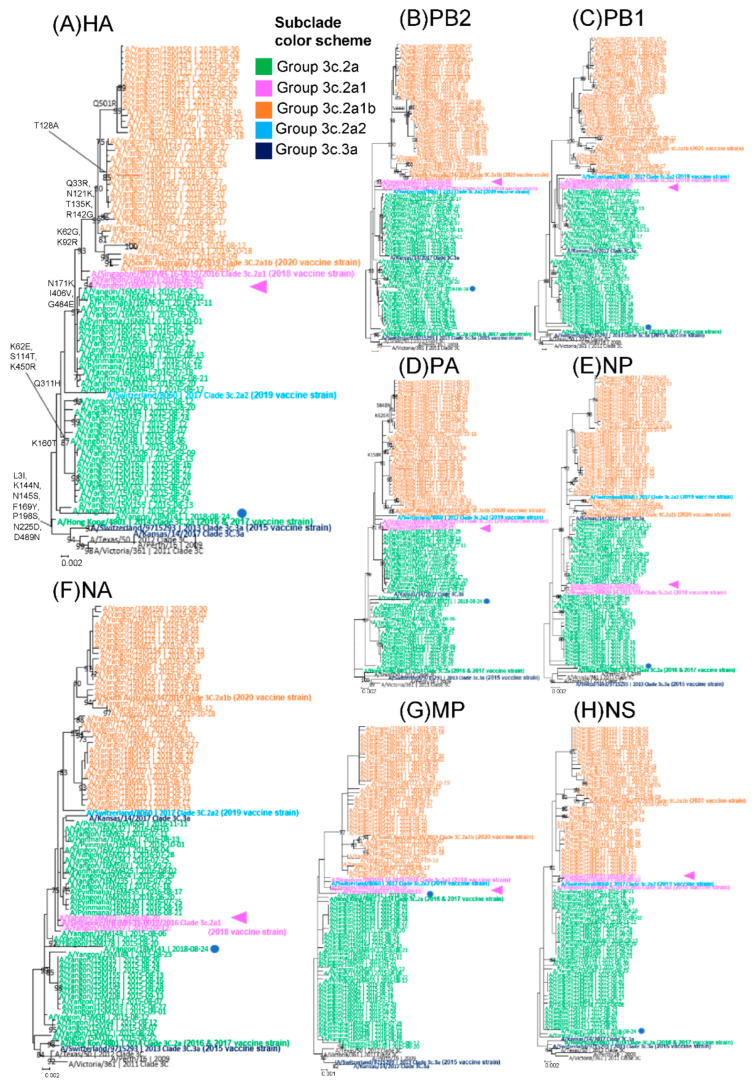
This study aimed to analyze the genetic and evolutionary characteristics of the influenza A/H3N2 viruses circulating in Myanmar from 2015 to 2019. Whole genomes from 79 virus isolates were amplified using real-time polymerase chain reaction and successfully sequenced using the Illumina iSeq100 platforms. Eight individual phylogenetic trees were retrieved for each segment along with those of the World Health Organization (WHO)-recommended Southern Hemisphere vaccine strains for the respective years. Based on the WHO clades classification, the A/H3N2 strains in Myanmar from 2015 to 2019 collectively belonged to clade 3c.2. These strains were further defined based on hemagglutinin substitutions as follows: clade 3C.2a ( = 39), 3C.2a1 ( = 2), and 3C.2a1b ( = 38). Genetic analysis revealed that the Myanmar strains differed from the Southern Hemisphere vaccine strains each year, indicating that the vaccine strains did not match the circulating strains. The highest rates of nucleotide substitution were estimated for hemagglutinin (3.37 × 10 substitutions/site/year) and neuraminidase (2.89 × 10 substitutions/site/year). The lowest rate was for non-structural protein segments (4.19 × 10 substitutions/site/year). The substantial genetic diversity that was revealed improved phylogenetic classification. This information will be particularly relevant for improving vaccine strain selection.
本研究旨在分析 2015 年至 2019 年期间在缅甸流行的甲型 H3N2 流感病毒的遗传和进化特征。使用实时聚合酶链反应扩增 79 个病毒分离株的全基因组,并使用 Illumina iSeq100 平台成功进行测序。针对每个片段,以及当年世界卫生组织(WHO)推荐的南半球疫苗株,分别检索了 8 个个体系统发育树。根据世界卫生组织的聚类分类,2015 年至 2019 年缅甸的 A/H3N2 株共同属于 3c.2 聚类。这些株系根据血凝素替换进一步定义为:3C.2a(=39)、3C.2a1(=2)和 3C.2a1b(=38)。遗传分析表明,缅甸株系每年与南半球疫苗株不同,表明疫苗株与流行株不匹配。估计血凝素(3.37×10 个核苷酸替换/位点/年)和神经氨酸酶(2.89×10 个核苷酸替换/位点/年)的核苷酸替换率最高。非结构蛋白片段的替换率最低(4.19×10 个核苷酸替换/位点/年)。所揭示的大量遗传多样性改善了系统发育分类。这些信息对于改进疫苗株选择尤为重要。