Department of Obstetrics and Gynecology, All India Institute of Medical Sciences, 151001, Bathinda, Punjab, India.
Department of Community and Family Medicine, All India Institute of Medical Sciences, 151001, Bathinda, Punjab, India.
BMC Womens Health. 2022 Nov 11;22(1):442. doi: 10.1186/s12905-022-02014-3.
Males dominate in tobacco usage, as well as in tobacco research, knowing that women face more severe health consequences. There is a specific lack of information on epidemiological statistics, risks, and the level of knowledge among women regarding tobacco. This study examines the Global Adult Tobacco Survey (GATS)-India dataset to estimate female tobacco usage and assess socio-economic variations in tobacco consumption, awareness regarding the adverse effects of tobacco, noticing pack health warnings (PHW), and intention to quit tobacco use well as factors influencing these domains.
Using a geographically clustered multistage sampling method, the nationally representative GATS II (2016-17) interviewed 40,265 female respondents aged 15 years and above from all Indian states and union territories. Standard operational definitions were used to estimate the primary independent variables (community, individual, and household categories) and dependent variables like awareness regarding the adverse effects of tobacco, noticing pack health warning (PHW), and intention to quit tobacco. Sampling weights were adjusted while performing the analysis. Bivariate and multivariable analysis were used to generate the estimates.
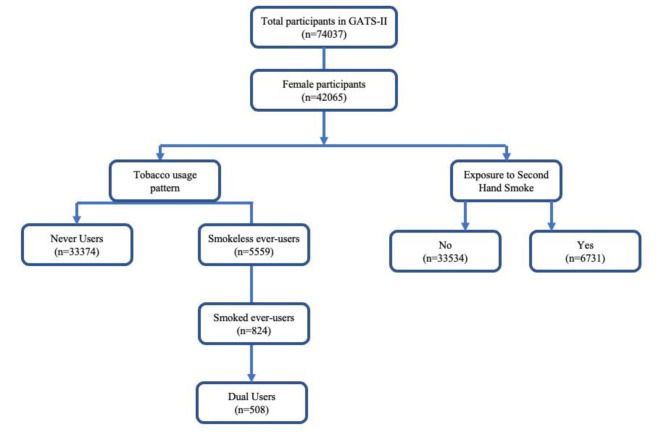
Of the total female respondents, 84.2% were never-users, 13.3% ever consumed Smokeless Tobacco (SLT) products, 1.8% ever smoked tobacco, and 0.8% were dual users once in their lives. Around 16% of the women had exposure to Second Hand Smoke (SHS) either at their homes, workplaces or in public places. Overall, maximum awareness was seen among non-smoker females (64.7%) and dual users (64.7%), followed by women exposed to SHS, SLT users, and smokers. PHW was noticed more by the bidi smokers, followed by SLT users and cigarette smokers. Factors that positively affected intention to quit smoking included younger age, secondary school education, self-employed status, the habit of buying packed cigarettes/bidi, believing that smoking causes serious illness, and attempted quitting in the last 12 months.
A high proportion of women consume tobacco which is significantly influenced by socio-demographic factors. Tobacco regulators should be especially concerned about women as the tobacco marketing experts target them. Mobilizing self-help groups and organizations working for women and children could assist broader campaigns to generate awareness and motivate quitting attempts.
男性在烟草使用方面占据主导地位,在烟草研究方面也是如此,而女性则面临着更严重的健康后果。女性在烟草方面的流行病学统计数据、风险以及知识水平方面存在明显的信息不足。本研究利用全球成人烟草调查(GATS)-印度数据集,评估女性的烟草使用情况,分析社会经济因素对烟草消费的影响,评估女性对烟草危害的认知、注意包装健康警示(PHW)以及戒烟意愿等方面的差异,并探讨影响这些方面的因素。
采用地理聚类多阶段抽样方法,对来自印度所有邦和联邦属地的 40265 名 15 岁及以上的女性受访者进行了全国代表性的 GATS II(2016-17)调查。本研究使用了标准的操作定义来估计主要的自变量(社区、个体和家庭类别)和因变量,如对烟草危害的认知、注意包装健康警示(PHW)和戒烟意愿等。在进行分析时,调整了抽样权重。采用双变量和多变量分析生成估计值。
在所有女性受访者中,84.2%从未使用过烟草,13.3%曾使用过无烟烟草制品(SLT),1.8%曾吸烟,0.8%曾同时使用过烟草和无烟烟草制品。约 16%的女性在家庭、工作场所或公共场所接触过二手烟(SHS)。总体而言,非吸烟者女性(64.7%)和双重使用者(64.7%)的认知度最高,其次是接触 SHS 的女性、SLT 用户和吸烟者。注意到 PHW 的主要是比迪烟吸烟者,其次是 SLT 用户和香烟吸烟者。对戒烟意愿产生积极影响的因素包括年龄较小、接受过中等教育、个体经营者身份、购买包装香烟/比迪的习惯、相信吸烟会导致严重疾病,以及在过去 12 个月内尝试戒烟。
相当一部分女性消费烟草,这一现象受到社会人口因素的显著影响。烟草监管机构应特别关注女性,因为烟草营销专家以她们为目标。动员妇女自助团体和组织以及为妇女和儿童服务的组织可以协助开展更广泛的宣传活动,提高认识并激励戒烟尝试。