Department of Joint Surgery, The Affiliated Hospital of Qingdao University, Qingdao, 266000, Shandong, China.
Shanghai Maritime University, Shanghai, 200120, China.
BMC Musculoskelet Disord. 2022 Nov 12;23(1):979. doi: 10.1186/s12891-022-05940-3.
Postoperative fever (POF) is a common problem after total joint arthroplasty (TJA). The goal of this research is to analyze the characteristics and risk factors of fever following TJA.
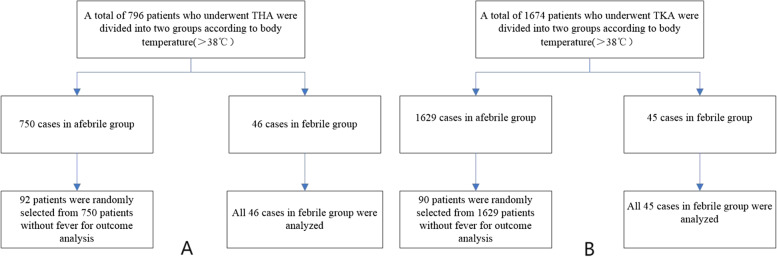
We retrospectively investigated 2482 patients who had primary total knee arthroplasty (TKA) or total hip arthroplasty (THA) surgery at our institution between January 2020 and December 2020. Those patients were divided into TKA group and THA group. The patients' axillary temperatures were measured. POF was defined as a body temperature greater than 38 °C. Then patients in the TKA and THA groups were respectively divided into afebrile group and febrile group based on their body temperatures. Temperature changing characteristics of the patients in the febrile group were analyzed and recorded. According to the number of patients in the febrile group, we randomly selected a corresponding number of patients from the afebrile group at a ratio of 1:2 to establish a control group. Gender, hypertension, diabetes, anesthesia, surgical time, and some laboratory data were analyzed between the febrile group and the afebrile group.
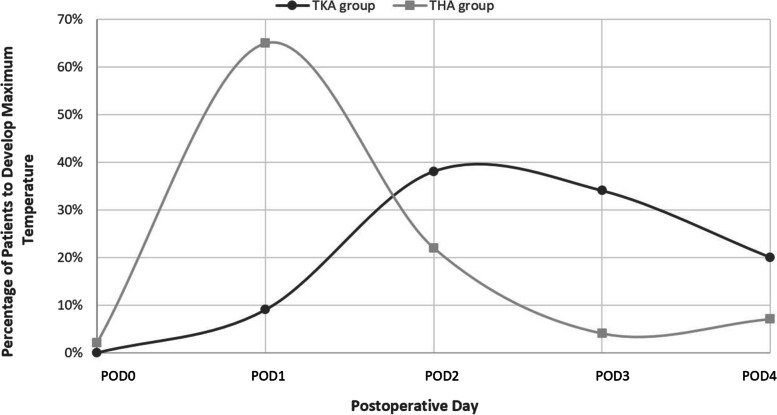
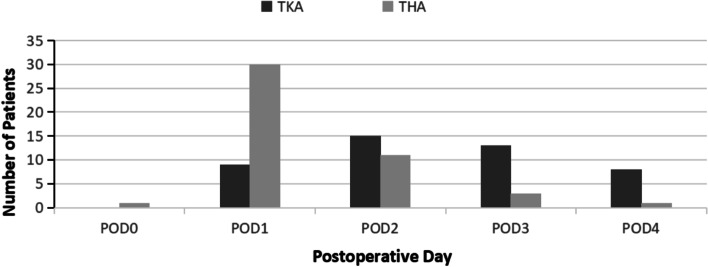
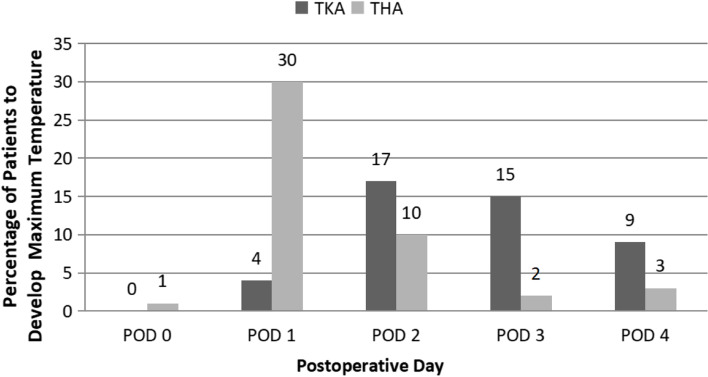
Three percent of TKA patients (N = 45) had febrile, and in the febrile group of TKA group, 38% (N = 17) had fever and maximum body temperature on postoperative day 2(POD2). Six percent of THA patients (N = 46) had fever, and in the febrile group of THA group, 65% (N = 30) of the patients had fever and maximum body temperature on POD1. In TKA group, compared with afebrile group, febrile group has higher C-reactive protein (mg/L) (CRP) after surgery. In THA group, compared with the afebrile group, the patients in the febrile group had larger fall in hemoglobin (g/L), and higher C-reactive protein (mg/L) (CRP) after surgery, so there were statistically significant differences between the two groups (P < 0.05).
The POF rate of TKA is 3%, and the first fever and maximum body temperature most commonly appear on the POD2. THA has a 6% POF rate, and the first fever and the maximum body temperature most commonly appear on the POD1. In both groups, high C-reactive protein is a risk factor for postoperative fever. In addition, the fall in hemoglobin is also related to postoperative fever in the THA group.
术后发热(POF)是全关节置换术后的常见问题。本研究旨在分析 TJA 后发热的特征和危险因素。
我们回顾性调查了 2020 年 1 月至 2020 年 12 月在我院行初次全膝关节置换术(TKA)或全髋关节置换术(THA)的 2482 例患者。将这些患者分为 TKA 组和 THA 组。测量患者的腋温。POF 定义为体温大于 38°C。然后根据体温将 TKA 和 THA 组患者分别分为无热组和发热组。分析并记录发热组患者体温变化特征。根据发热组患者人数,我们从无热组中随机选择相应数量的患者,按 1:2 的比例建立对照组。分析发热组和无热组患者的性别、高血压、糖尿病、麻醉、手术时间和部分实验室数据。
3%的 TKA 患者(N=45)发热,TKA 发热组中 38%(N=17)的患者术后第 2 天(POD2)发热,体温最高。6%的 THA 患者(N=46)发热,THA 发热组中 65%(N=30)的患者术后第 1 天(POD1)发热,体温最高。在 TKA 组中,与无热组相比,发热组术后 C 反应蛋白(mg/L)(CRP)更高。在 THA 组中,与无热组相比,发热组患者术后血红蛋白(g/L)下降更大,C 反应蛋白(mg/L)(CRP)更高,两组间差异有统计学意义(P<0.05)。
TKA 的 POF 发生率为 3%,最常见的发热和最高体温出现在 POD2。THA 的 POF 发生率为 6%,最常见的发热和最高体温出现在 POD1。两组中,CRP 升高是术后发热的危险因素。此外,THA 组术后发热与血红蛋白下降有关。