Obstetrics and Gynecology Department, Koc University, Istanbul, Turkey.
ART Fertility Clinics, Dubai, United Arab Emirates.
Hum Reprod Update. 2023 Mar 1;29(2):177-196. doi: 10.1093/humupd/dmac037.
In 2020, SARS-CoV-2 and the COVID-19 pandemic had a huge impact on the access to and provision of ART treatments. Gradually, knowledge of the virus and its transmission has become available, allowing ART activities to resume. Still, questions on the impact of the virus on human gametes and fertility remain.
This article summarizes published data, aiming to clarify the impact of SARS-CoV-2 and the COVID-19 disease on human fertility and assisted reproduction, as well as the impact of vaccination, and from this, provide answers to questions that are relevant for people contemplating pregnancy and for health care professionals.
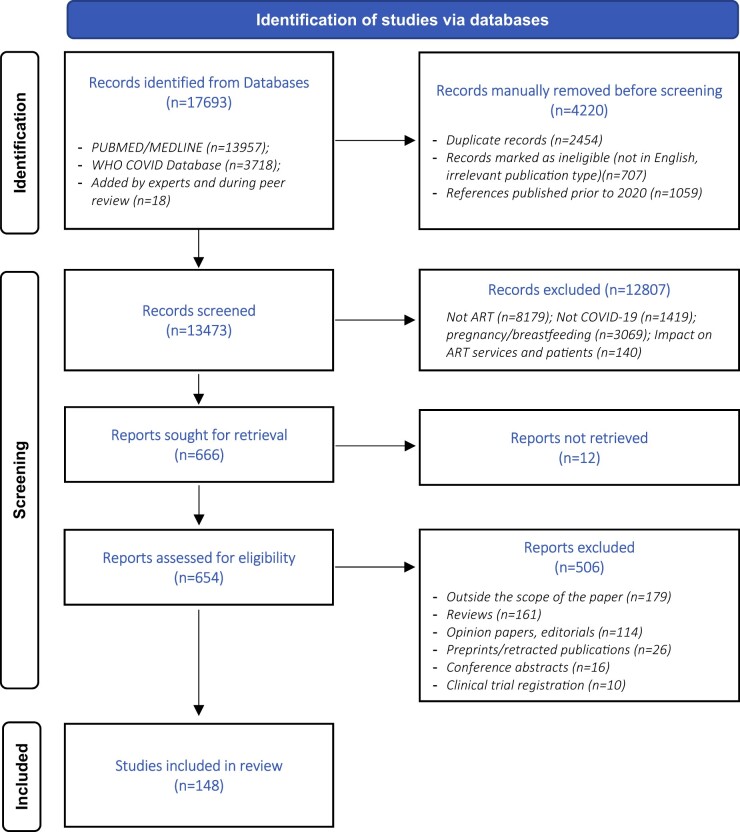
PUBMED/MEDLINE and the WHO COVID-19 database were searched from inception to 5 October 2022 with search terms focusing on 'SARS-CoV-2' and gametes, embryos, reproductive function, fertility and ART. Non-English studies and papers published prior to 2020 were excluded, as well as reviews and non-peer reviewed publications. Full papers were assessed for relevance and quality, where feasible.
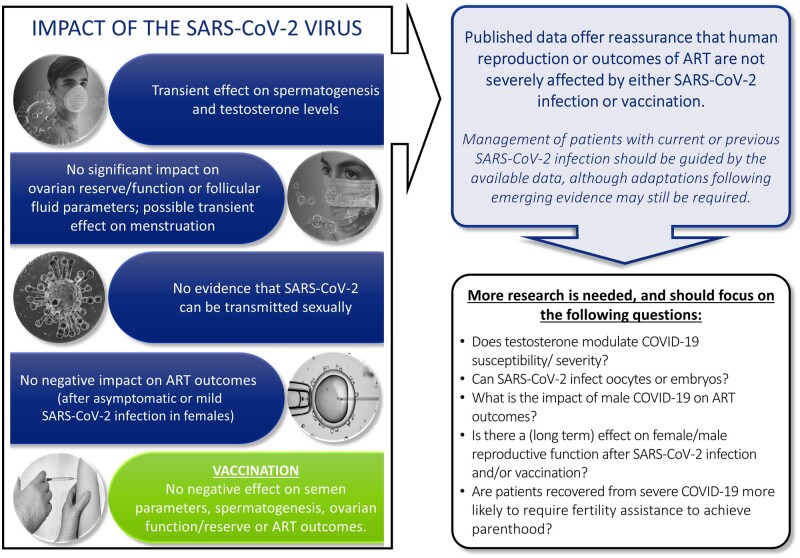
From the 148 papers included, the following observations were made. The SARS-CoV-2-binding proteins, angiotensin-converting enzyme 2 (ACE2) and type II transmembrane serine protease (TMPRSS2), are expressed in the testis, but co-expression remains to be proven. There is some evidence of SARS-CoV-2 RNA in the ejaculate of COVID-19 patients with severe disease, but not in those with mild/moderate disease. SARS-CoV-2 infection can impair spermatogenesis, but this seems to resolve after one spermatogenic cycle. Testosterone levels seem to be lower during and after COVID-19, but long-term data are lacking; disease severity may be associated with testosterone levels. COVID-19 cannot be considered a sexually transmitted disease. There is no co-expression of ACE2 and TMPRSS2 in the myometrium, uterus, ovaries or fallopian tubes. Oocytes seem to have the receptors and protease machinery to be susceptible to SARS-CoV-2 infection; however, viral RNA in oocytes has not been detected so far. Women contemplating pregnancy following COVID-19 may benefit from screening for thyroid dysfunction. There is a possible (transient) impact of COVID-19 on menstrual patterns. Embryos, and particularly late blastocysts, seem to have the machinery to be susceptible to SARS-CoV-2 infection. Most studies have not reported a significant impact of COVID-19 on ovarian reserve, ovarian function or follicular fluid parameters. Previous asymptomatic or mild SARS-CoV-2 infection in females does not seem to negatively affect laboratory and clinical outcomes of ART. There are no data on the minimum required interval, if any, between COVID-19 recovery and ART. There is no evidence of a negative effect of SARS-CoV-2 vaccination on semen parameters or spermatogenesis, ovarian function, ovarian reserve or folliculogenesis. A transient effect on the menstrual cycle has been documented. Despite concerns, cross reactivity between anti-SARS-CoV-2 spike protein antibodies and Syncytin-1, an essential protein in human implantation, is absent. There is no influence of mRNA SARS-CoV-2 vaccine on patients' performance during their immediate subsequent ART cycle. Pregnancy rates post-vaccination are similar to those in unvaccinated patients.
This review highlights existing knowledge on the impact of SARS-CoV-2 infection or COVID-19 on fertility and assisted reproduction, but also identifies gaps and offers suggestions for future research. The knowledge presented should help to provide evidence-based advice for practitioners and couples contemplating pregnancy alike, facilitating informed decision-making in an environment of significant emotional turmoil.
2020 年,SARS-CoV-2 和 COVID-19 大流行对获得和提供 ART 治疗产生了巨大影响。随着对该病毒及其传播方式的了解逐渐深入,ART 活动得以恢复。然而,关于该病毒对人类配子和生育力的影响仍存在疑问。
本文总结了已发表的数据,旨在阐明 SARS-CoV-2 和 COVID-19 疾病对人类生育力和辅助生殖的影响,以及疫苗接种的影响,并由此回答与考虑怀孕的人群和医疗保健专业人员相关的问题。
从 2020 年以前开始,通过 PUBMED/MEDLINE 和世界卫生组织 COVID-19 数据库搜索了与“SARS-CoV-2”和配子、胚胎、生殖功能、生育力和 ART 相关的术语。排除了非英语研究和发表于 2020 年以前的论文,以及综述和非同行评审出版物。对符合条件的全文进行了相关性和质量评估。
从纳入的 148 篇论文中得出以下观察结果。SARS-CoV-2 结合蛋白,血管紧张素转换酶 2(ACE2)和 II 型跨膜丝氨酸蛋白酶(TMPRSS2),在睾丸中表达,但两者的共表达仍有待证明。在患有严重疾病的 COVID-19 患者的精液中发现了 SARS-CoV-2 RNA,但在患有轻度/中度疾病的患者中则没有。SARS-CoV-2 感染可能损害精子发生,但似乎在一个精子发生周期后即可恢复。睾酮水平在 COVID-19 期间和之后似乎较低,但缺乏长期数据;疾病严重程度可能与睾酮水平有关。COVID-19 不能被认为是一种性传播疾病。在子宫肌层、子宫、卵巢或输卵管中没有 ACE2 和 TMPRSS2 的共表达。卵母细胞似乎具有受体和蛋白酶机制,容易受到 SARS-CoV-2 感染;然而,迄今为止尚未检测到卵母细胞中的病毒 RNA。在 COVID-19 后考虑怀孕的女性可能受益于甲状腺功能障碍筛查。COVID-19 可能对月经模式产生(暂时)影响。胚胎,特别是晚期囊胚,似乎具有受体和蛋白酶机制,容易受到 SARS-CoV-2 感染。大多数研究未报告 COVID-19 对卵巢储备、卵巢功能或卵泡液参数有显著影响。以前在女性中无症状或轻度 SARS-CoV-2 感染似乎不会对 ART 的实验室和临床结局产生负面影响。关于 COVID-19 康复和 ART 之间所需的最短间隔(如果有),目前尚无数据。没有证据表明 SARS-CoV-2 疫苗接种对精液参数、精子发生、卵巢功能、卵巢储备或卵泡发生有负面影响。已经记录了对月经周期的短暂影响。尽管存在担忧,但抗 SARS-CoV-2 刺突蛋白抗体与 Syncytin-1(人类着床所必需的一种蛋白)之间的交叉反应性并不存在。mRNA SARS-CoV-2 疫苗对患者在其随后的 ART 周期中的表现没有影响。接种疫苗后的妊娠率与未接种疫苗的患者相似。
本综述强调了 SARS-CoV-2 感染或 COVID-19 对生育力和辅助生殖的现有知识,但也确定了差距,并为未来的研究提供了建议。所呈现的知识应有助于为从业者和考虑怀孕的夫妇提供循证建议,在充满重大情绪动荡的环境中,促进知情决策。