State Key Laboratory of Natural and Biomimetic Drugs, School of Pharmaceutical Sciences, Peking University, Beijing 100191, China.
Proteomics Laboratory, Medical and Healthy Analytical Center, Peking University Health Science Center, Beijing 100191, China.
EBioMedicine. 2022 Dec;86:104353. doi: 10.1016/j.ebiom.2022.104353. Epub 2022 Nov 11.
The E2F family of transcription factors play a crucial role in the development of various cancers. However, E2F members lack targetable binding pockets and are typically considered "undruggable". Unlike canonical small-molecule therapeutics, molecular glues mediate new E3 ligase-protein interactions to induce selective proteasomal degradation, which represents an attractive option to overcome these limitations.
Human proteome microarray was utilized to identify a natural product-derived molecular glue for targeting E2F2 degradation. Co-IP analysis with stable isotope labeling of amino acids in cell culture (SILAC)-based quantitative proteomics was carried out to further explore the E3 ligase for E2F2 degradation.
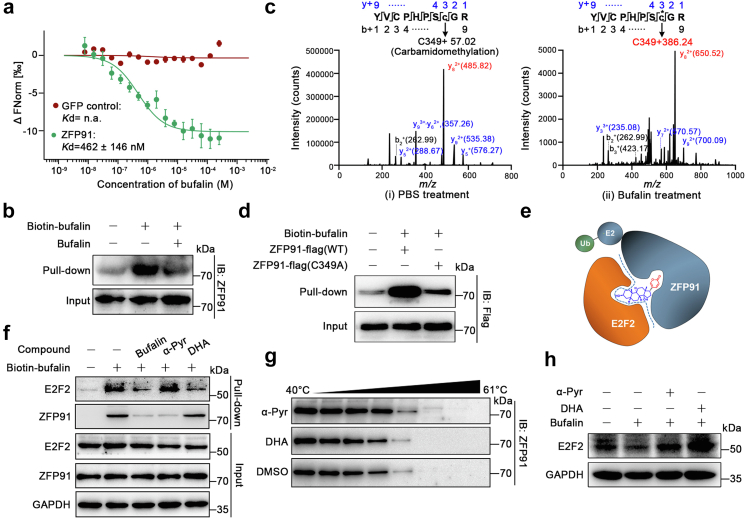
In this study, we identified a molecular glue bufalin, which significantly promoted E2F2 degradation. Unexpectedly, E2F2 underwent ubiquitination and proteasomal degradation via a previously undisclosed atypical E3 ligase, zinc finger protein 91 (ZFP91). In particular, we observed that bufalin markedly promoted E2F2-ZFP91 complex formation, thereby leading to E2F2 polyubiquitination via K48-linked ubiquitin chains for degradation. E2F2 degradation subsequently caused transcriptional suppression of multiple oncogenes including c-Myc, CCNE1, CCNE2, MCM5 and CDK1, and inhibited hepatocellular carcinoma growth in vitro and in vivo.
Collectively, our findings open up a new direction for transcription factors degradation by targeting atypical E3 ligase ZFP91. Meanwhile, the chemical knockdown strategy with molecular glue may promote innovative transcription factor degrader development in cancer therapy.
This work was financially supported by the National Key Research and Development Project of China (2022YFC3501601), National Natural Sciences Foundation of China (81973505, 82174008, 82030114), and China Postdoctoral Science Foundation (2019M650396), the Fundamental Research Funds for the Central Universities.
E2F 转录因子家族在多种癌症的发展中起着至关重要的作用。然而,E2F 成员缺乏可靶向结合口袋,通常被认为是“不可成药的”。与典型的小分子治疗药物不同,分子胶介导新的 E3 连接酶-蛋白质相互作用,诱导选择性蛋白酶体降解,这是克服这些限制的一个有吸引力的选择。
利用人类蛋白质组微阵列鉴定一种靶向 E2F2 降解的天然产物衍生分子胶。利用稳定同位素标记的细胞培养物中的氨基酸(SILAC)基于定量蛋白质组学的共免疫沉淀分析,进一步探索 E3 连接酶对 E2F2 降解的作用。
在这项研究中,我们鉴定了一种分子胶 bufalin,它能显著促进 E2F2 的降解。出乎意料的是,E2F2 通过一个以前未被发现的非典型 E3 连接酶锌指蛋白 91(ZFP91)发生泛素化和蛋白酶体降解。特别是,我们观察到 bufalin 显著促进了 E2F2-ZFP91 复合物的形成,从而导致 E2F2 通过 K48 连接的泛素链发生多泛素化降解。E2F2 的降解随后导致多个癌基因包括 c-Myc、CCNE1、CCNE2、MCM5 和 CDK1 的转录抑制,并抑制了体外和体内肝癌的生长。
总的来说,我们的研究结果为靶向非典型 E3 连接酶 ZFP91 的转录因子降解开辟了新的方向。同时,分子胶的化学敲低策略可能会促进癌症治疗中创新的转录因子降解剂的开发。
本工作得到国家重点研发计划(2022YFC3501601)、国家自然科学基金(81973505、82174008、82030114)和中国博士后科学基金(2019M650396)、中央高校基本科研业务费的资助。