Department of General Practice, Erasmus Medical Center, Rotterdam, The Netherlands
Department of General Practice, Erasmus Medical Center, Rotterdam, The Netherlands.
BMJ Open. 2022 Nov 14;12(11):e064779. doi: 10.1136/bmjopen-2022-064779.
The incidence of degenerative disorders, including osteoarthritis (OA), increases rapidly in women after menopause. However, the influence of the menopause is still insufficiently investigated due to the slowness of menopausal transition. In this study, a novel human model is used in which it is expected that menopausal-related changes will occur faster. This is the Females discontinuing Oral Contraceptives Use at Menopausal age model. The ultimate aim is to link these changes to OA and other degenerative disorders, including cardiovascular diseases, diabetes, osteoporosis and tendinopathies.
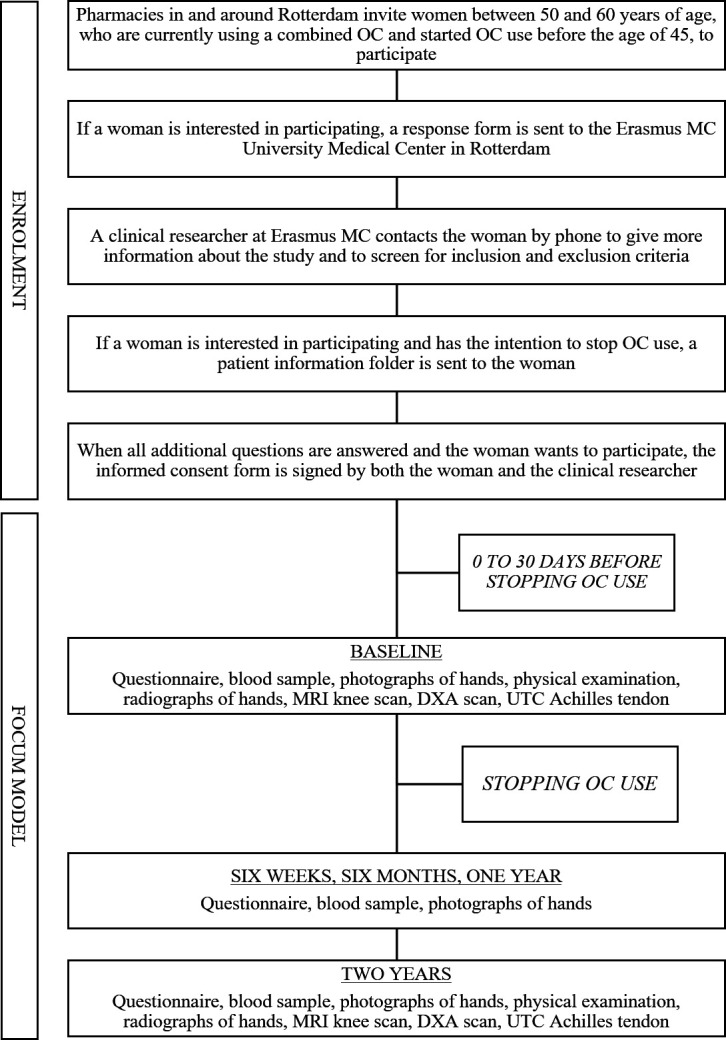
This is a pilot observational prospective cohort study with 2 years of follow-up. Fifty women aged 50-60 who use oral contraceptive (OC) and have the intention to stop are included. Measurements are performed once before stopping OC, and four times thereafter at 6 weeks, 6 months, 1 year and 2 years. At every time point, a questionnaire is filled in and a sample of blood is drawn. At the first and final time points, a physical examination, hand radiographs and a MRI scan of one knee are performed. The primary OA outcome is progression of the MRI Osteoarthritis Knee Score. Secondary OA outcomes are the development of clinical knee and hand OA, development of knee OA according to the MRI definition, and progression of radiographic features for hand OA. Principal component analysis will be used to assess which changes occur after stopping OC. Univariate and multivariate generalised estimating equation models will be used to test for associations between these components and OA.
The study has been approved by the Medical Ethics Committee of the Erasmus MC University Medical Center Rotterdam (MEC-2019-0592). All participants must give informed consent before data collection. Results will be disseminated in national and international journals.
NL70796.078.19.
退行性疾病(包括骨关节炎[OA])的发病率在女性绝经后迅速增加。然而,由于绝经过渡期缓慢,绝经对这些疾病的影响仍未得到充分研究。在这项研究中,使用了一种新的人类模型,预计其中的绝经相关变化会更快发生。这是女性在绝经年龄停止口服避孕药模型。最终目标是将这些变化与 OA 以及其他退行性疾病(包括心血管疾病、糖尿病、骨质疏松症和肌腱病)联系起来。
这是一项具有 2 年随访期的前瞻性观察性队列研究。纳入了 50 名年龄在 50-60 岁之间、正在服用口服避孕药(OC)且打算停药的女性。在停止服用 OC 之前进行一次测量,之后在 6 周、6 个月、1 年和 2 年时进行 4 次测量。每次测量时都会填写一份问卷并抽取一份血样。在第一次和最后一次测量时,会进行体格检查、手部 X 光检查和膝关节 MRI 扫描。主要 OA 结局是 MRI 骨关节炎膝关节评分的进展。次要 OA 结局是临床膝关节和手部 OA 的发展、MRI 定义下的膝关节 OA 发展以及手部 OA 的放射学特征进展。主成分分析将用于评估停止服用 OC 后发生的变化。单变量和多变量广义估计方程模型将用于测试这些成分与 OA 之间的关联。
该研究已获得鹿特丹伊拉斯谟医学中心 Erasmus MC 大学医学中心医学伦理委员会的批准(MEC-2019-0592)。在数据收集之前,所有参与者必须给予知情同意。结果将在国家和国际期刊上发表。
NL70796.078.19.