Department of Orthopaedics, The Second Affiliated Hospital of Chongqing Medical University, 76 Linjiang Road, Yuzhong District, Chongqing, 400010, China.
Department of Orthopaedic Surgery, Affiliated Xinqiao Hospital, Army Medical University, No.183, Xinqiao Street, Shapingba District, Chongqing, 400037, People's Republic of China.
BMC Musculoskelet Disord. 2022 Nov 14;23(1):982. doi: 10.1186/s12891-022-05905-6.
Retrospective study.
To explore the incidence and risk factors for symptomatic adjacent segment disease (ASD) in patients enveloped in degenerative lumbar diseases after minimally invasive transforaminal lumbar interbody fusion (MIS-TLIF).
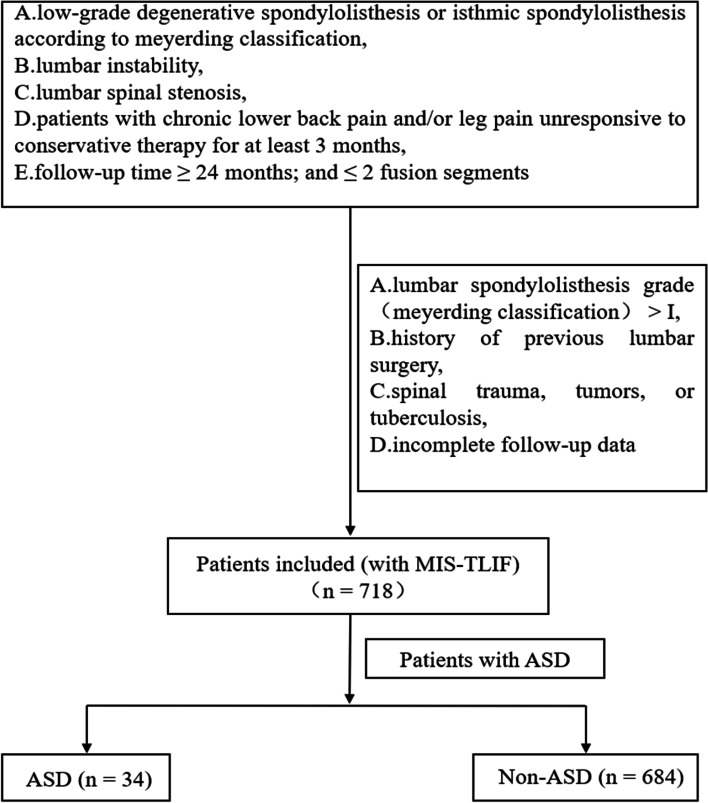
Data were retrospectively analyzed on 744 patients who underwent MIS-TLIF for degenerative lumbar diseases in our hospital from October 2012 to December 2018. The patients were divided into the ASD group and non-ASD (N-ASD) group on the basis of developing ASD at follow-up, and then the incidence of ASD was calculated. Clinical and radiological risk factors were assessed over time to determine their association with ASD by excluding less important factors.
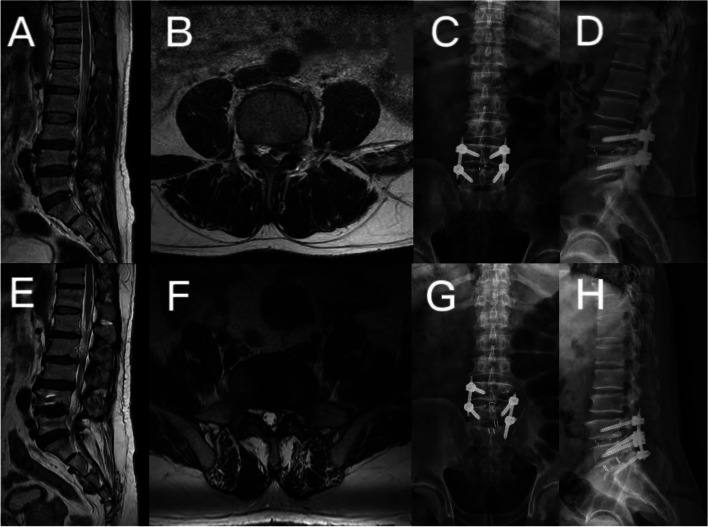
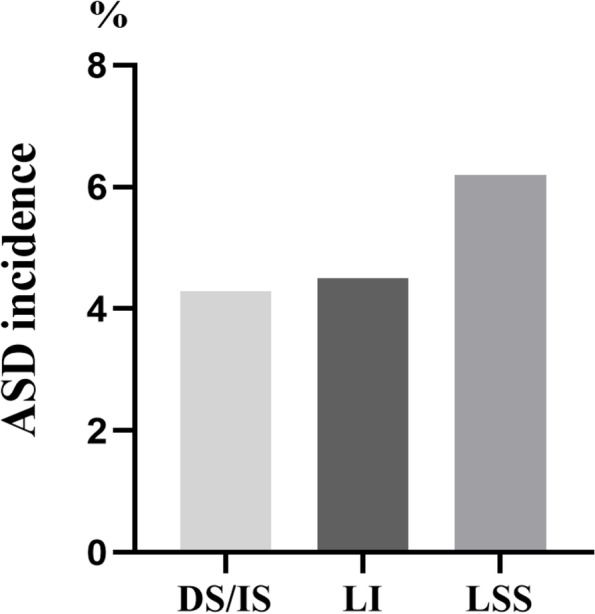
Data were missing for 26 patients, while a total of 718 patients were successfully monitored after MIS-TLIF. Of the 718 individuals participated in the study, 34 (4.7%) patients plagued by ASD required surgical intervention. The average onset time of ASD was 62.7 ± 15.1 months. Univariate analysis results shows that age, bone mineral density (BMD), body mass index (BMI), preoperative adjacent intervertebral disc height and preoperative adjacent segment disc degeneration were significantly different between the ASD and N-ASD groups (p < 0.05). The logistic regression analysis results demonstrated that BMD (p = 0.039, OR = 0.986, 95% CI 0.899-1.115), BMI (p = 0.041, OR = 1.119, 95% CI 1.103-2.397), and preoperative adjacent intervertebral disc degeneration (p = 0.023, OR = 1.215, 95% CI 1.015-1.986) may be seen as risk factors for ASD after MIS-TLIF.
The incidence of ASD was about 4.7% in patients suffer from degenerative lumbar diseases after MIS-TLIF. BMD, BMI and preoperative adjacent intervertebral disc degeneration might be the risk factors for the occurrence of ASD after MIS-TLIF. Our research also suggested that patients with lower BMD, higher BMI and disc preoperative adjacent segment disc degeneration were more likely to develop ASD after MIS-TLIF.
回顾性研究。
探讨微创经椎间孔腰椎体间融合术(MIS-TLIF)治疗退行性腰椎疾病患者中症状性邻近节段疾病(ASD)的发生率和危险因素。
对 2012 年 10 月至 2018 年 12 月我院收治的 744 例行 MIS-TLIF 治疗退行性腰椎疾病的患者进行回顾性数据分析。根据随访时是否发生 ASD 将患者分为 ASD 组和非 ASD(N-ASD)组,计算 ASD 的发生率。评估随时间推移的临床和影像学危险因素,排除次要因素后确定其与 ASD 的相关性。
26 例患者数据缺失,MIS-TLIF 后共有 718 例患者成功监测。在纳入研究的 718 名患者中,34 名(4.7%)患有 ASD 的患者需要手术干预。ASD 的平均发病时间为 62.7±15.1 个月。单因素分析结果显示,ASD 组与 N-ASD 组在年龄、骨密度(BMD)、体质量指数(BMI)、术前邻近椎间盘高度和术前邻近节段椎间盘退变方面差异有统计学意义(p<0.05)。Logistic 回归分析结果显示,BMD(p=0.039,OR=0.986,95%CI 0.899-1.115)、BMI(p=0.041,OR=1.119,95%CI 1.103-2.397)和术前邻近节段椎间盘退变(p=0.023,OR=1.215,95%CI 1.015-1.986)可能是 MIS-TLIF 后 ASD 的危险因素。
退行性腰椎疾病患者行 MIS-TLIF 后 ASD 的发生率约为 4.7%。BMD、BMI 和术前邻近节段椎间盘退变可能是 MIS-TLIF 后 ASD 发生的危险因素。本研究还提示 BMD 较低、BMI 较高和术前邻近节段椎间盘退变的患者更有可能在 MIS-TLIF 后发生 ASD。