Morales-Juarez David A, Jackson Stephen P
Wellcome and Cancer Research UK Gurdon Institute, and Department of Biochemistry, University of Cambridge, Cambridge, UK.
Cancer Research UK Cambridge Institute, University of Cambridge, Cambridge, UK.
NPJ Precis Oncol. 2022 Nov 15;6(1):85. doi: 10.1038/s41698-022-00319-y.
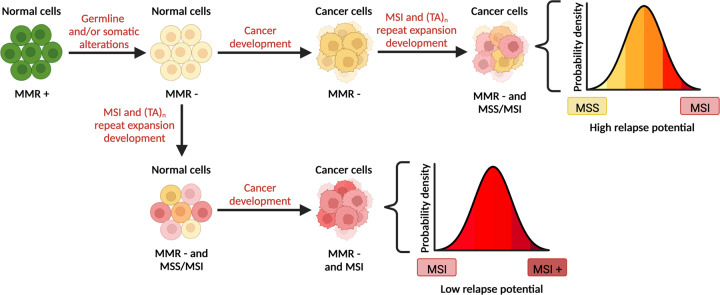
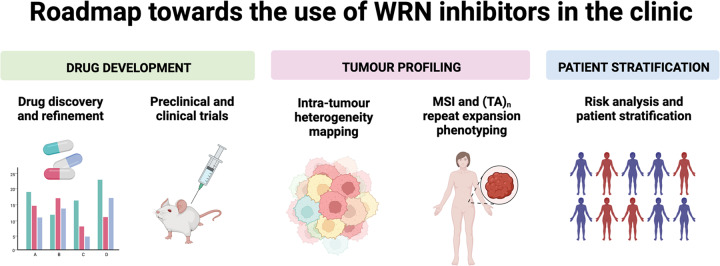
The discovery of synthetic lethal interactions with genetic deficiencies in cancers has highlighted several candidate targets for drug development, with variable clinical success. Recent work has unveiled a promising synthetic lethal interaction between inactivation/inhibition of the WRN DNA helicase and tumours with microsatellite instability, a phenotype that arises from DNA mismatch repair deficiency. While these and further studies have highlighted the therapeutic potential of WRN inhibitors, compounds with properties suitable for clinical exploitation remain to be described. Furthermore, the complexities of MSI development and its relationship to cancer evolution pose challenges for clinical prospects. Here, we discuss possible paths of MSI tumour development, the viability of WRN inhibition as a strategy in different scenarios, and the necessary conditions to create a roadmap towards successful implementation of WRN inhibitors in the clinic.
癌症中与基因缺陷的合成致死相互作用的发现突出了几个药物开发的候选靶点,但临床成功率各不相同。最近的研究揭示了WRN DNA解旋酶失活/抑制与微卫星不稳定肿瘤之间有前景的合成致死相互作用,微卫星不稳定是一种由DNA错配修复缺陷引起的表型。虽然这些研究及进一步研究突出了WRN抑制剂的治疗潜力,但仍有待描述具有适合临床应用特性的化合物。此外,微卫星不稳定的发展复杂性及其与癌症进化的关系给临床前景带来了挑战。在此,我们讨论微卫星不稳定肿瘤发展的可能路径、在不同情况下将抑制WRN作为一种策略的可行性,以及为在临床上成功应用WRN抑制剂制定路线图所需的条件。