Division of Developmental Medicine, Boston Children's Hospital, Boston, Massachusetts.
Pediatrics, Harvard Medical School, Boston, Massachusetts.
J Neurophysiol. 2022 Dec 1;128(6):1546-1554. doi: 10.1152/jn.00295.2022. Epub 2022 Nov 16.
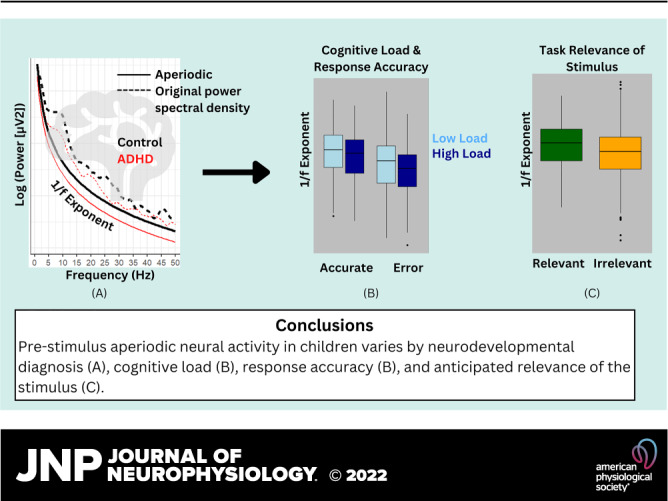
Aperiodic spectral slope is a measure of spontaneous neural oscillatory activity that is believed to support regulation of brain responses to environmental stimuli. Compared to typically developing (TD) control participants, children with attention deficit hyperactivity disorder (ADHD) have been shown to have flatter aperiodic spectral slope at rest as well as attenuated event-related potential (ERP) amplitudes in response to environmental stimuli. A small body of research suggests that aperiodic slope may also explain differences in behavioral responses. In this study, we examine associations between prestimulus aperiodic slope, stimulus characteristics, environmental demands, and neural as well as behavioral responses to these stimuli. Furthermore, we evaluate whether ADHD diagnostic status moderates these associations. Seventy-nine children with ADHD and 27 TD school-age children completed two visual ERP experiments with predictable alternating presentations of task-relevant and task-irrelevant stimuli. Aperiodic slope was extracted from prestimulus time windows. Prestimulus aperiodic slope was steeper for the TD relative to ADHD group, driven by task-relevant rather than task-irrelevant stimuli. For both groups, the aperiodic slope was steeper during a task with lower cognitive demand and before trials in which they responded correctly. Aperiodic slope did not mediate the association between ADHD diagnosis and attenuated P300 amplitude. The aperiodic spectral slope is dynamic and changes in anticipation of varying stimulus categories to support performance. The aperiodic slope and P300 amplitude reflect distinct cognitive processes. Background neural oscillations, captured via aperiodic slope, support cognitive behavioral control and should be included in etiological models of ADHD. This study constitutes the first investigation of associations between aperiodic spectral slope and three aspects of neurocognition: event-related potential (ERP) amplitudes, cognitive load, and task performance. We find that background oscillatory activity is dynamic, shifting in anticipation of varying levels of task relevance and in response to increasing cognitive load. Moreover, we report that aperiodic activity and ERPs constitute distinct neurophysiological processes. Children with attention deficit hyperactivity disorder (ADHD) show reduced aperiodic dynamics in addition to attenuated ERP amplitudes.
非周期性谱斜率是衡量自发神经振荡活动的一种指标,据信它有助于调节大脑对环境刺激的反应。与典型发育(TD)对照参与者相比,患有注意力缺陷多动障碍(ADHD)的儿童在休息时的非周期性谱斜率更平坦,并且对环境刺激的事件相关电位(ERP)幅度减弱。少量研究表明,非周期性斜率也可能解释行为反应的差异。在这项研究中,我们研究了刺激前非周期性斜率、刺激特征、环境需求以及对这些刺激的神经和行为反应之间的关联。此外,我们还评估了 ADHD 诊断状态是否调节了这些关联。79 名 ADHD 儿童和 27 名 TD 学龄儿童完成了两个具有可预测的交替呈现任务相关和任务无关刺激的视觉 ERP 实验。从刺激前时间窗口中提取非周期性斜率。TD 组相对于 ADHD 组,非周期性斜率更陡峭,这是由任务相关而非任务无关的刺激驱动的。对于两个组,在认知需求较低的任务期间和他们正确反应的试验之前,非周期性斜率更陡峭。非周期性斜率不能介导 ADHD 诊断与 P300 振幅减弱之间的关联。非周期性谱斜率是动态的,会根据变化的刺激类别进行调整,以支持表现。非周期性斜率和 P300 振幅反映了不同的认知过程。通过非周期性斜率捕获的背景神经振荡支持认知行为控制,应包括在 ADHD 的病因模型中。这项研究首次调查了非周期性谱斜率与神经认知的三个方面之间的关联:事件相关电位(ERP)振幅、认知负荷和任务表现。我们发现,背景振荡活动是动态的,会根据任务相关性的变化和认知负荷的增加进行调整。此外,我们报告说,非周期性活动和 ERP 构成了不同的神经生理过程。除了 ERP 振幅减弱外,患有注意力缺陷多动障碍(ADHD)的儿童的非周期性活动也减少。